
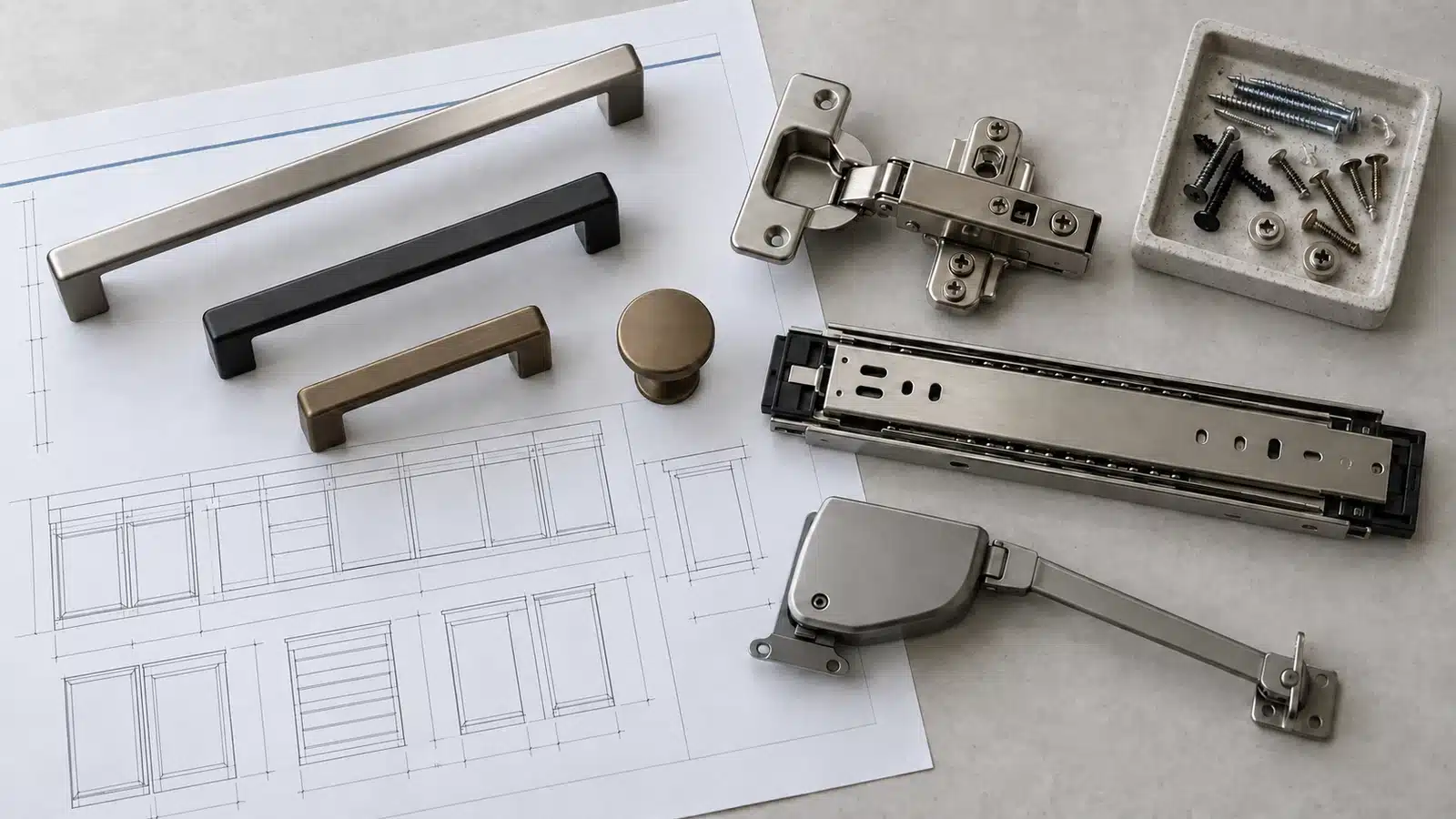
A practical guide to specifying cabinet pulls, knobs, hinges, drawer slides, lift systems, finishes, performance evidence, approvals, and delivery controls.
Quick answer: effective cabinet hardware specifications identify the cabinet and application, exact hardware type, dimensions and drilling interface, material and finish, required operation and performance, quantity, approved evidence, and installation conditions. The schedule should use one item code for each distinct configuration and link it to the latest cabinet drawings, samples, product data, and approval status.
Do not select hardware by appearance alone. A pull can look correct but conflict with an appliance; a hinge can fit the door yet strike an adjacent panel; and a drawer slide can have a suitable nominal rating but require different clearances or fixing. This guide turns design intent into information that designers, cabinet makers, bidders, inspectors, and installers can verify.
Written by Winston
Project Director at Skyland Building · 10+ Years of Building Materials Experience
Updated September 2026 · 17-minute read
Key Takeaways
- Define the cabinet construction, user, exposure, operating pattern, and maintenance needs before choosing a model.
- Specify the interface as well as the hardware: door or drawer thickness, overlay or inset condition, boring pattern, clearances, fasteners, and adjustment.
- Use product-specific data for load, cycle, opening angle, extension, corrosion resistance, and warranty; do not apply one generic rating to every configuration.
- Separate finish appearance from technical performance, then approve physical samples on the actual or representative substrate under consistent lighting.
- Require bids and substitutions to identify deviations. “Similar” appearance does not establish equivalent dimensions, operation, performance, or serviceability.
- Release purchasing only after the hardware schedule, product data, sample, and coordinated shop drawing agree.
What Cabinet Hardware Specifications Should Include
The following fields form a practical minimum. Not every field applies to every item, but a blank should mean “not applicable” or “to be confirmed”—not an unstated supplier assumption.
| Specification field | What to record | Why it matters |
| Identity and location | Item code; room, zone, cabinet mark, opening or elevation reference; latest drawing revision. | Connects the product, quantity, approval, package, and installation location. |
| Hardware type and function | Pull, knob, hinge, runner, lift system, catch, shelf support, pantry or corner fitting; intended action. | Prevents a visual reference from replacing the required function. |
| Cabinet interface | Frameless or face-frame construction; inset or overlay; door or drawer material, thickness, size, weight, and edge condition. | Controls compatibility, fixing, movement, and adjustment. |
| Dimensions | Centers, overall size, projection, grip clearance, opening angle, slide length, extension, hole or cup data, and tolerances as applicable. | Protects drilling, clearances, usable storage, and adjacent interfaces. |
| Mounting and fasteners | Boring pattern, fixing method, screw or insert requirement, mounting plate, supplied parts, template, and installer responsibility. | Avoids rework, missing components, and unsuitable screw engagement. |
| Material and finish | Base material, finish process or code, color, sheen, texture, visible faces, acceptable variation, and exposure. | Makes appearance and durability review more objective. |
| Operation and performance | Closing action, adjustment, release method, rated load or duty, cycle or strength evidence, operating force, environment, and warranty. | Creates a measurable basis for approval and substitution review. |
| Commercial and logistics | Manufacturer and model, quantity, spares, lead time, packing group, labeling, documents, exclusions, and approval status. | Supports comparable bids, delivery control, replacements, and closeout. |
Hardware selection also depends on panel construction and finish. Use the cabinet material selection guide to define the cabinet box, front, edge, substrate, and exposed finish before the hardware interface is frozen.
Select the Hardware Type by Application
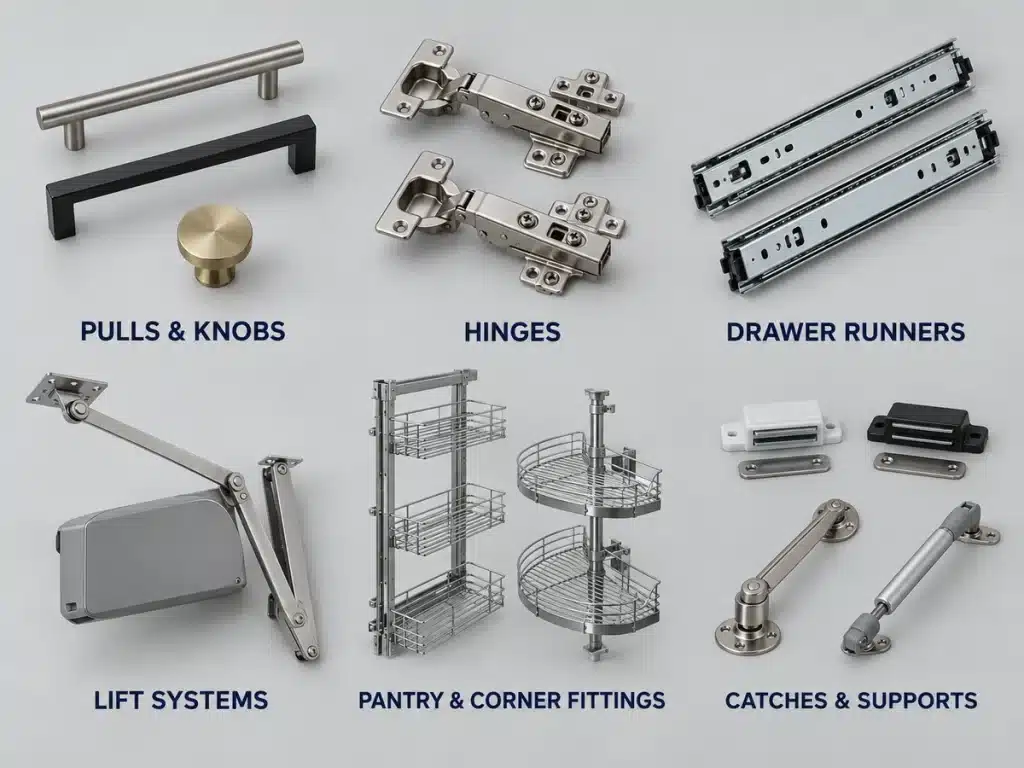
Start with the action the user performs and the cabinet condition, then select a product family. A coordinated project can use several mechanisms while maintaining a consistent visible finish.
| Hardware family | Use and selection criteria | Minimum data to verify | Common coordination risk |
| Knobs, pulls, handles, and edge pulls | Choose for hand contact, front size, user group, visual rhythm, cleaning, and required grip. | Centers, overall length, projection, grip clearance, section, orientation, fasteners, finish. | Collisions, difficult grasp, inconsistent drilling, visible screws, or edge-profile conflicts. |
| Concealed and exposed hinges | Match the cabinet construction, inset or overlay, door thickness, weight, opening action, and required adjustment. | Hinge type, overlay or reveal, cup and boring data, mounting plate, angle, adjustment, closing action, hinge quantity. | Door striking a wall, appliance, adjacent front, internal accessory, or thick-door edge. |
| Drawer slides and runner systems | Select for drawer size, expected contents, mounting arrangement, useful extension, closing action, and service access. | System and length, rated load for the configuration, extension, side or bottom clearance, fixing, adjustment, locking devices. | Reduced internal width or depth, unsupported loads, inaccessible releases, or mismatched drawer construction. |
| Lift-up, flap, and stay systems | Use for overhead fronts after checking door size, mass, center of gravity, headroom, and user reach. | Mechanism range, power-factor or model basis, angle or stop, mounting pattern, cover set, adjustment, safety features. | Incorrect mechanism range, ceiling collision, excessive operating force, or difficult adjustment. |
| Pantry, corner, waste, and internal pull-outs | Treat the mechanism and cabinet as one assembly; verify stored load, door coupling, usable opening, and cleaning access. | Minimum internal cabinet size, opening, mounting hand, basket or tray count, load data, fixings, adjustment, removal method. | Services, shelves, adjacent doors, handles, plinths, or hinges reducing the required operating envelope. |
| Catches, shelf supports, brackets, and connectors | Choose by retention, supported load, panel material, visibility, removal needs, and environment. | Type, quantity, fixing, drilling, material, finish, load basis where relevant, replacement access. | Small parts omitted from the schedule, packed separately, or installed into unsuitable substrate. |
Specify Dimensions and Cabinet Interfaces
Dimensions should describe both the product and the surrounding assembly. Use one unit system, state whether dimensions are nominal or finished, and identify tolerances only where they affect appearance, fit, drilling, or operation.
Pulls and knobs
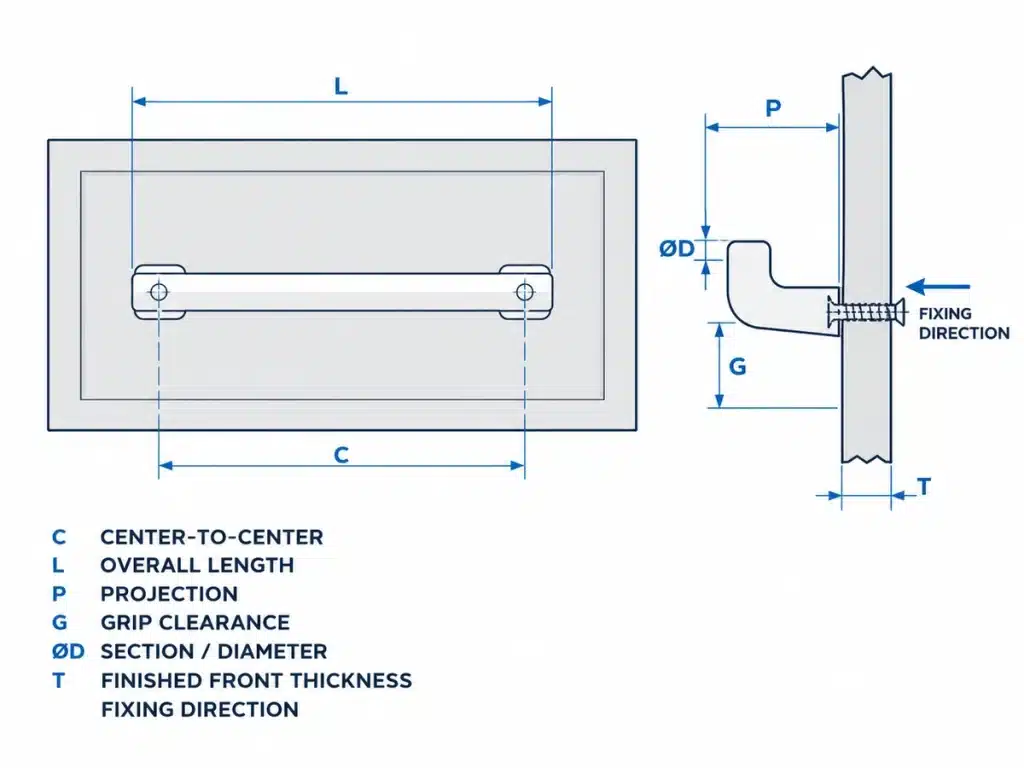
For a two-point pull, record center-to-center spacing, overall length, projection from the finished front, grip clearance, cross-section or diameter, orientation, and fixing method. For a knob, record diameter or overall size, projection, base or rose size, and fixing. Confirm the finished front thickness and required screw engagement; one screw length may not suit veneered, framed, thickened, or applied fronts.
Show placement from stable finished edges or centerlines on the elevation rather than relying on a phrase such as “standard position.” Test representative door and drawer sizes, including corner conditions and tall fronts, before drilling is released.
Hinges
Define whether the door is inset, half overlay, full overlay, or another documented condition. Record door thickness and weight, hinge quantity, cup diameter and depth where applicable, cup setback or boring pattern, mounting plate or base, opening angle, closing action, adjustment directions, and any restrictor or special plate.
Review the complete movement envelope in plan and elevation. The nominal opening angle is not enough if the front, pull, hinge arm, or appliance panel contacts a wall return, filler, shelf, neighboring door, countertop, or internal fitting.
Drawer slides, lift systems, and specialty mechanisms
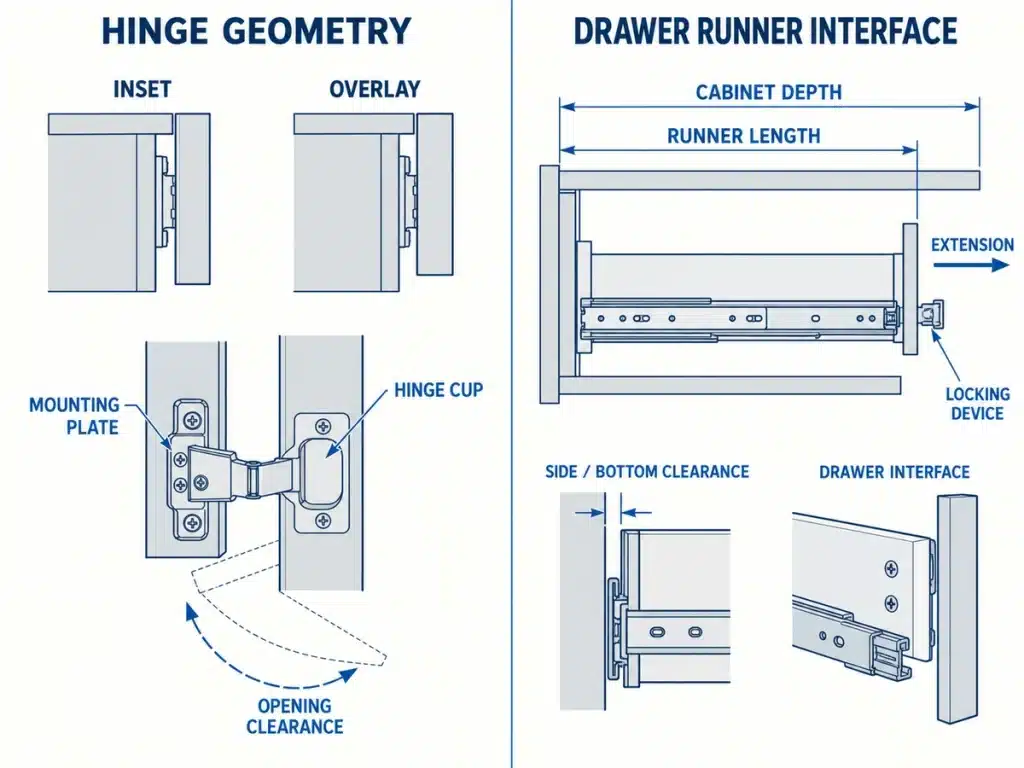
For drawer slides or runner systems, record the exact system, nominal length, required internal cabinet depth, drawer construction, mounting arrangement, required side or bottom clearance, extension, rated load for the proposed configuration, adjustment, release or locking device, and closing feature. Verify how load is defined and tested instead of comparing one number without its conditions.
For lift systems, pantry fittings, corner units, and waste pull-outs, include the cabinet width and depth range, door or load data, handedness, operating envelope, internal obstructions, plinth or service-zone effects, and access for adjustment or replacement. Coordinate these mechanisms with the latest custom cabinetry scope and drawings so the fittings are not selected after the cabinet drilling and internal layout have already been fixed.
Define Materials, Finishes, and Exposure
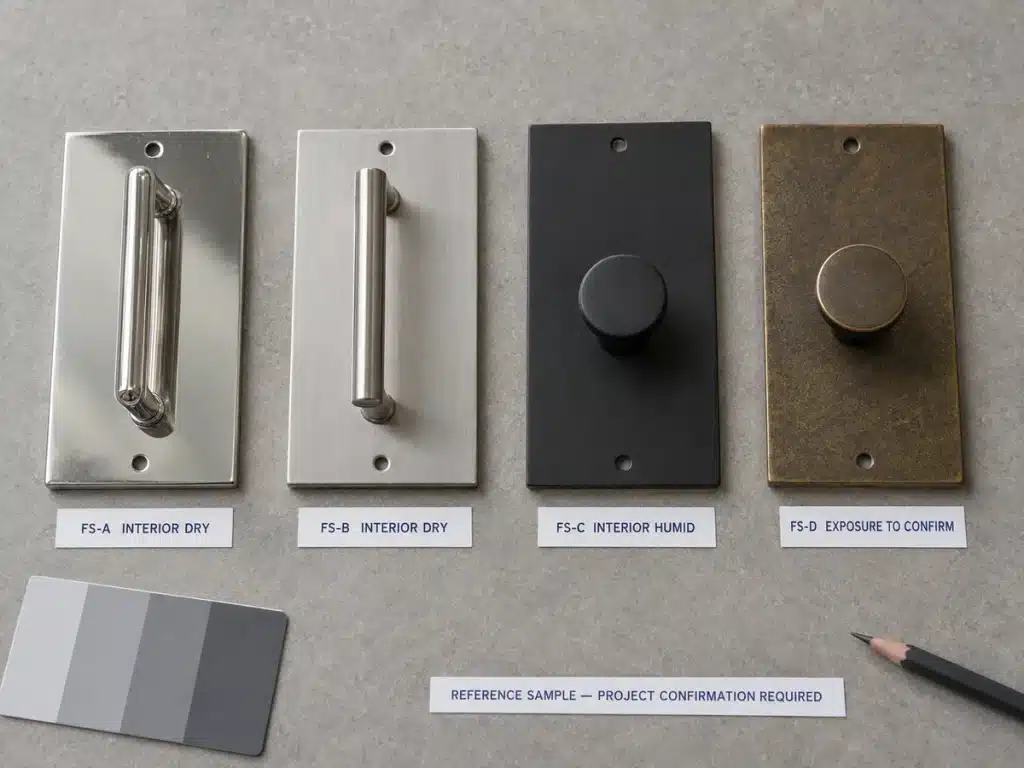
A color name does not fully define a finish. Record the base material where it affects performance; the coating, plating, brushing, polishing, anodizing, or patination process where known; the manufacturer finish code; color, sheen, texture, brushing direction, and visible-face requirements; and the approved range of variation.
Exposure should be explicit. A dry bedroom wardrobe, bathroom vanity, laundry, hospitality pantry, commercial kitchen, and coastal project do not create the same moisture, salt, abrasion, or cleaning conditions. Ask the proposer to confirm suitability of the exact substrate-and-finish combination and identify cleaning or warranty limitations.
Different substrates can look different even when suppliers use the same finish name. Review pulls, hinge cover caps, exposed plates, screws, appliance handles, plumbing fixtures, and adjacent metal trim together where visual matching matters. Decide which items must match closely and which concealed functional parts may differ.
Use a controlled material sample approval process to record the item code, substrate, finish, supplier, approval date, reviewer, permitted variation, and relationship to the final production batch.
Set Performance, Evidence, and Compliance Requirements
Performance requirements should reflect the actual use and be stated separately from aesthetic preferences. Identify what must be demonstrated—such as operating action, strength, durability, load, adjustment, retention, corrosion behavior, or chemical compatibility—and what evidence is acceptable for the exact model and configuration.
In North American work, ANSI/BHMA A156.9-2026 for Cabinet Hardware provides current cabinet-hardware terminology and operational, cycle, and strength criteria across multiple product categories. Cite the applicable edition, product category, test, and required grade or result only after confirming they match the project. A reference to the standard title alone is not a complete performance specification.
Manufacturer ratings are configuration-specific. A runner load can depend on length, mounting, drawer construction, and test conditions; a hinge quantity can depend on door height, width, weight, thickness, and center of gravity. Require the technical sheet or selection calculation for the exact quoted item, not a brochure for a neighboring product family.
Accessibility and user operation
Where accessible storage or operable parts are required by the project or jurisdiction, coordinate approach, reach, clear floor space, grasping method, and operating force with the applicable design criteria. The U.S. Access Board guidance on operable parts is a useful U.S. reference, but project scoping determines which elements are covered. Do not label every cabinet pull “ADA compliant” without verifying the complete installed condition and governing requirements.
Submittal evidence and warranty
For performance-sensitive items, request the named model and configuration, current technical data, test or classification evidence where specified, installation instructions, adjustment procedure, cleaning guidance, spare-part information, warranty terms, and exclusions. Confirm that the evidence covers the product being supplied, not merely the brand.
Build a Procurement-Ready Hardware Schedule
A useful schedule lets a reviewer answer: where is the item used, what exactly is being offered, how many are needed, what must it interface with, and what controls release? Use one row for each materially different configuration and keep revision history.
| Schedule column | Example content | Approval control |
| Item and location | HW-07; Level 2; Room 2.14; cabinet C-214-03; drawer 2. | Matches the current cabinet schedule and drawing revision. |
| Description | Full-extension concealed runner with integrated closing action. | Describes function without relying only on a trade name. |
| Interface | 500 mm system; defined drawer construction; required cabinet depth and clearances. | Cabinet maker confirms drilling, space, fixing, and compatibility. |
| Performance | Project-required load or duty and evidence; adjustment; operating and environmental needs. | Exact technical sheet and requested evidence reviewed. |
| Material and finish | Concealed functional finish; visible covers in approved project finish. | Controlled sample or documented visual reference approved. |
| Product and substitution | Preferred manufacturer/model or approved equivalent; proposed reference and deviations. | No substitution accepted by appearance or price alone. |
| Quantity and spares | Installed quantity, complete sets, fasteners, accessories, commissioning units, and separately identified spares. | Count reconciled to fronts and mechanisms, not rough room totals. |
| Status and logistics | Submittal, sample, shop drawing, release, inspection, package ID, delivery, and closeout status. | Dates, reviewer, revision, and exceptions remain traceable. |
For quotation control, issue the schedule with drawings, quantities, evidence requirements, allowed alternatives, commercial inclusions, and a bidder-deviation form. The whole-house building materials RFQ guide explains how to structure a comparable inquiry, while the construction procurement schedule guide helps connect submittals, approvals, production, inspection, shipment, and required-on-site dates.
Control Samples, Shop Drawings, and Release
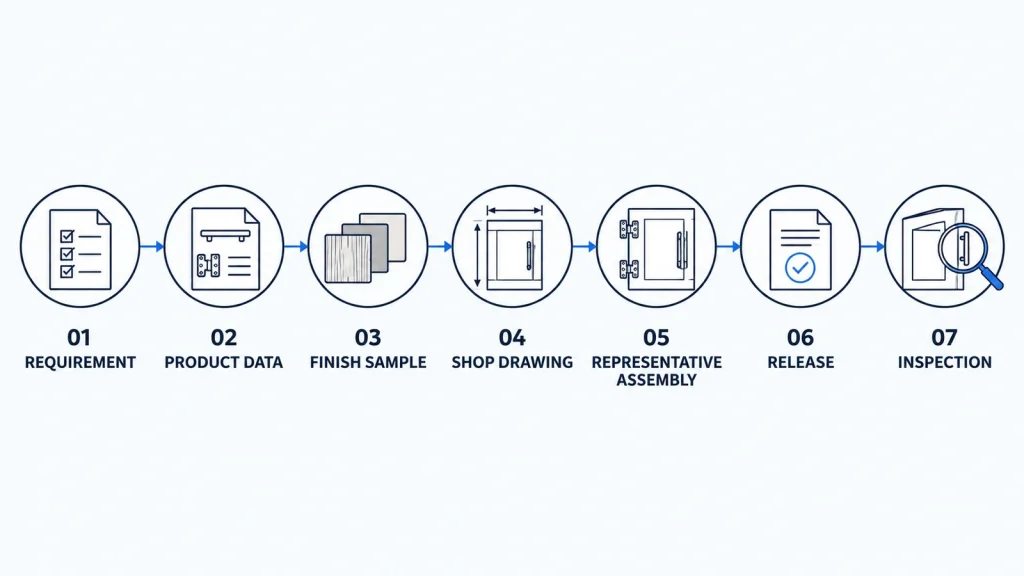
Hardware approval is a sequence, not one signature on a catalog page. Keep every approval tied to the item code and revision so the product data, finish sample, cabinet drawing, purchase order, and delivered package cannot drift apart.
- Freeze the requirement. Confirm cabinet marks, front construction, user and environment, design intent, measurable performance, quantities, and responsible reviewers.
- Review the technical proposal. Check the exact manufacturer, model, configuration, dimensions, clearances, function, evidence, warranty, inclusions, and declared deviations.
- Approve the finish sample. Label the physical or controlled digital reference with item codes, substrate and process, approval date, acceptable variation, and any conditions.
- Coordinate the shop drawing. Show placement, boring, overlay or inset geometry, opening arcs, drawer and mechanism clearances, fasteners, adjacent panels, appliances, and service zones.
- Test a representative assembly. Where risk justifies it, use a cabinet corner, typical door and drawer, or room mock-up to confirm appearance, grasp, operation, collision, adjustment, and installation sequence.
- Release the controlled package. State the approved item, quantity, spare allowance, drawing and sample revisions, documents, inspection points, packaging, and destination labeling.
- Record change and closeout. Treat substitutions or design changes as revised submittals; preserve final schedules, drawings, product data, warranties, maintenance information, and spare locations.
Use the shop drawing approval process to manage interfaces and revision status before drilling or fabrication is authorized.
Evaluate Bids and Substitutions on Equal Criteria
Normalize each bid against the same hardware schedule. Separate unit price, installed or supplied quantity, complete sets, fasteners, mounting plates, cover caps, accessories, spares, samples, documents, freight, duties, warranty, technical support, lead time, and exclusions. A low line price can become expensive when a required component, finish, or drilling change is omitted.
Review every proposed substitution for function, dimensions, mounting pattern, clearances, product-specific performance, finish, serviceability, availability, warranty, and effect on approved drawings. Require a side-by-side compliance statement that marks each field “complies,” “deviates,” or “not submitted,” with supporting references. Obtain written approval before procurement or cabinet production.
Inspect Delivery and Installation
Inspection should use the same item codes and references as the schedule. Check the manufacturer and model, finish, dimensions, quantity, accessories, fasteners, documentation, packaging, and visible condition. Test representative operation where the inspection plan requires it, but do not claim a full production performance test from a simple functional check.
Before dispatch, adapt the pre-shipment inspection checklist to the approved hardware lines. Link each accepted package to a packing list and use the building materials packing and labeling guide to keep small parts, room references, cabinet marks, parent assemblies, and package IDs traceable through receiving.
At installation, verify the correct drilling template, screw engagement, orientation, protective measures, adjustment, opening and extension clearance, and damage-free operation. Record defects and corrective action against the cabinet and hardware item. Closeout should include the as-installed schedule, final product data, warranties, care instructions, approved substitutions, inspection records, and spare-hardware location.
Cabinet Hardware Pre-Release Checklist
| Review point | Release question | Required record |
| Scope and identity | Is every door, drawer, lift front, internal mechanism, catch, support, and accessory assigned to a unique item and cabinet reference? | Current cabinet and hardware schedules with revision dates. |
| Dimensions and interface | Do product dimensions, front thickness, overlay or inset, drilling, fasteners, clearances, and movement agree with the drawing? | Coordinated shop drawing plus exact product data. |
| Function and performance | Does the selected configuration meet the intended load, use, closing action, adjustment, environment, and specified evidence? | Technical sheet, selection basis, and required test or classification evidence. |
| Appearance and exposure | Are base material, finish process or code, color, sheen, texture, visible faces, variation, and environment understood? | Approved labeled sample and exposure confirmation. |
| Bid and substitution | Are inclusions, exclusions, accessories, spares, warranty, lead time, and deviations explicit? | Normalized bid and signed substitution review. |
| Quantity and logistics | Do installed quantities, complete sets, spare items, package groups, and destination labels reconcile? | Purchase schedule, packing register, and package labels. |
| Approval authority | Are all technical, visual, commercial, and drawing approvals complete at the same revision? | Release sheet showing reviewer, date, status, and conditions. |
Common Specification Mistakes
- Using only a product photo or collection name without dimensions, configuration, finish code, or cabinet reference.
- Choosing pulls before checking projection, grasp, front thickness, drilling, wall returns, adjacent fronts, and appliance handles.
- Selecting hinges by opening angle alone without overlay, cup and plate geometry, door data, quantity, and collision review.
- Comparing drawer-slide load numbers without the exact length, mounting, drawer construction, extension, and test conditions.
- Describing a finish only as “brass,” “black,” or “stainless” and assuming different substrates, suppliers, or batches will match.
- Writing “commercial grade,” “heavy duty,” “corrosion resistant,” or “ADA compliant” without a defined requirement and evidence basis.
- Allowing substitutions based on similar appearance while ignoring drilling, adjustment, warranty, service parts, and installation changes.
- Releasing purchase or cabinet drilling before product data, sample, schedule, and shop drawing show the same approved revision.
- Packing small hardware in a general accessories carton without cabinet marks, counts, parent-assembly links, or spare identification.
Frequently Asked Questions
What should cabinet hardware specifications include?
Include the item and cabinet reference, hardware type and function, product or performance description, dimensions, cabinet interface, drilling and fasteners, material and finish, operating and environmental requirements, quantity and spares, submittal evidence, approval status, installation needs, and packaging or closeout information.
How do I specify cabinet pulls accurately?
Record center-to-center spacing, overall length, projection, grip clearance, section or diameter, orientation, finish, visible faces, front thickness, fixing method, screw requirement, placement dimensions, and every cabinet reference that uses the pull.
What information is needed for concealed hinges?
State the cabinet construction, inset or overlay condition, reveal or overlay geometry, door material, thickness, size and weight, hinge quantity, cup and plate data, opening angle, closing action, adjustment, finish where visible, and any restrictor or collision constraint.
How should drawer slides be selected?
Match the exact runner configuration to the drawer construction, nominal length, cabinet depth and clearances, expected contents, required extension, mounting arrangement, adjustment, release method, closing action, environment, and manufacturer-rated load under the applicable conditions.
How can cabinet hardware finish mismatches be reduced?
Identify the substrate and finish process or code, approve labeled physical samples, compare adjacent metal items under consistent project lighting, define visible faces and acceptable variation, and verify production or batch relationships where appearance is sensitive.
Are cabinet hardware standards always required?
No single standard applies automatically to every project or jurisdiction. Identify the codes, accessibility provisions, client criteria, and performance standards that apply, then state the relevant product category, edition, requirement, and evidence for the exact item.
How many spare hardware pieces should be ordered?
There is no universal percentage. Base the allowance on project size, installed quantity, criticality, expected damage or commissioning needs, finish and batch sensitivity, replacement lead time, service strategy, and client requirements. Show spares as separate schedule lines and label their storage location.
Can an alternative brand be accepted?
Yes, when substitutions are permitted and the proposed model is reviewed against every relevant field: function, dimensions, drilling, clearances, configuration-specific performance, material, finish, documents, warranty, serviceability, availability, price, and schedule effect. Written approval should precede ordering or drilling.
Conclusion
Well-structured cabinet hardware specifications make a small but operationally important scope measurable. Define the application, cabinet interface, dimensions, finish, performance evidence, quantity, approval path, and installation conditions; then keep those fields connected to the same item code and drawing revision from bid through closeout.
For a villa, apartment, hotel, or commercial project, share the cabinet drawings, hardware schedule, finish references, project location, quantities, approval requirements, and target dates when you request a coordinated cabinetry quotation. Final product selection should remain subject to exact project conditions, technical data, samples, drawings, applicable requirements, and written approvals.
Next Steps for Your Project
Topic hub: Product Selection Guides
Relevant product pages: Custom Cabinetry · Kitchen Cabinets · Bespoke Wardrobes
Related guides: Cabinet Material Types · Shop Drawing Approval Process
Related service: Drawing & Sample Coordination