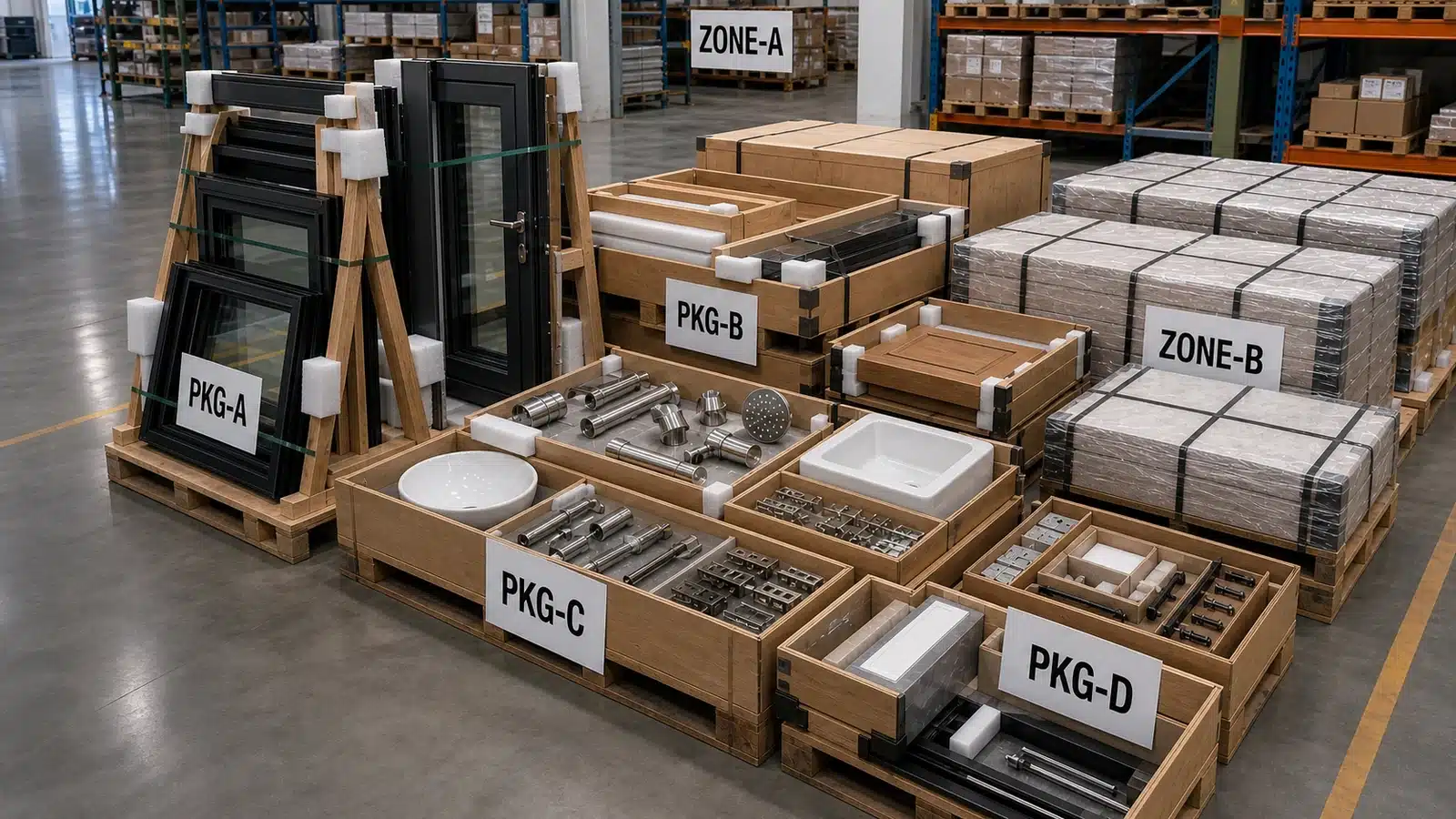
A practical system for protecting multi-category building materials, assigning traceable package IDs, coordinating handling marks, and delivering each package to the correct project area.
Building materials packing and labeling should connect four things: the product that was approved, the package that was shipped, the handling conditions that protect it, and the project location where it will be used. A room name on a carton is not enough. The team needs a stable package identifier, a controlled packing register, material-specific protection, and labels that remain readable through factory handling, consolidation, transport, receiving, storage, and installation.
This guide is written for villas, apartments, hotels, and commercial projects that combine products such as windows and doors, cabinetry, tile, stone, sanitary ware, lighting, hardware, furniture, and accessories. It explains a project-control method; it does not replace manufacturer instructions, engineered lifting or load-securing plans, dangerous-goods rules, customs advice, or destination-specific labeling law.
Written by Winston
Project Director at Skyland Building · 10+ Years of Building Materials Experience
Updated August 2026 · 17-minute read
Key Takeaways
- Give every handling unit a unique, stable package ID; use floor, room, zone, trade, and installation phase as additional controlled fields.
- Design the package for the material, total route, handling equipment, storage exposure, and unloading sequence—not for carton size alone.
- Separate project labels from original product identity, regulatory marks, dangerous-goods marks, and official wood-packaging marks.
- Use one packing register that links purchase orders, released product references, package contents, dimensions, gross weight, photographs, inspection status, and delivery location.
- Keep small but essential accessories traceable to the main assembly, even when they travel in a separate carton.
- Verify the physical package, label, register, packing list, and loading record before dispatch and again at receiving.
What Building Materials Packing and Labeling Must Control
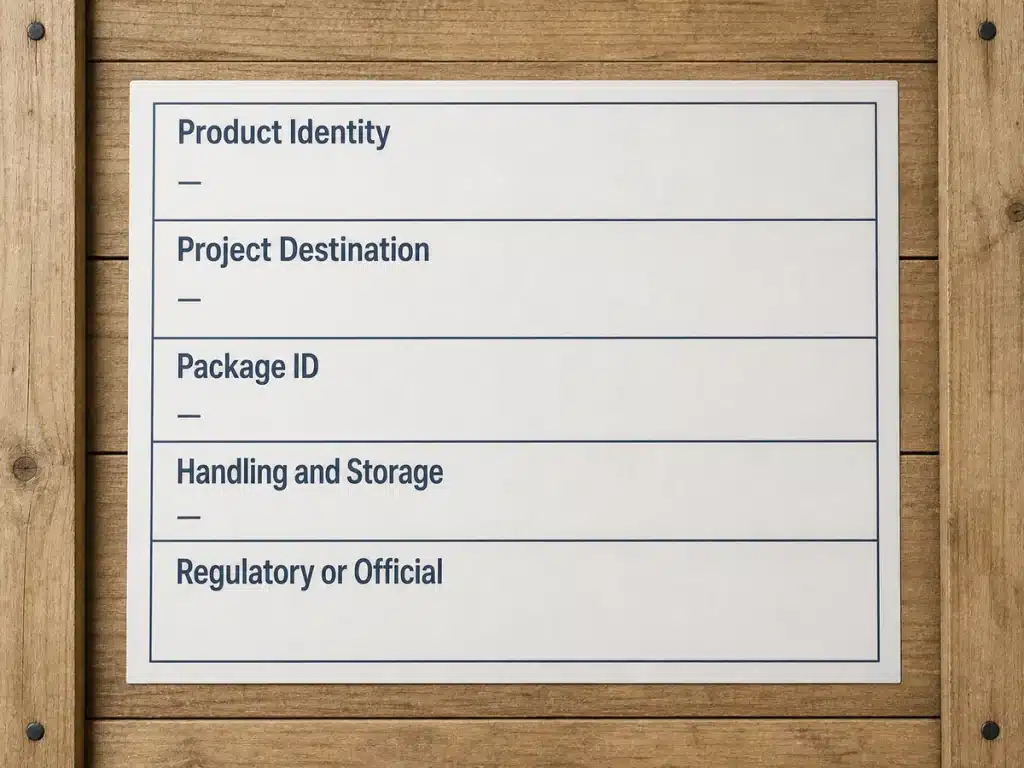
A reliable system uses several information layers. They may appear on the same outer package, but they serve different purposes and should not be treated as interchangeable.
| Information layer | Purpose | Typical content | Control boundary |
| Product identity | Preserves what the item is and where it came from. | Manufacturer, product or model, finish, batch or serial reference, quantity. | Do not cover or replace original identification without preserving traceability. |
| Project destination | Directs the package to its planned use. | Project, building, floor, room, zone, opening, assembly, phase. | These fields may change; revise them without changing the stable package ID. |
| Logistics identity | Tracks one pallet, crate, rack, bundle, or carton. | Package ID, package sequence, gross weight, dimensions, register or barcode reference. | The identifier must be unique within the shipment or chosen tracking system. |
| Handling and storage | Communicates necessary physical actions. | Orientation, lifting points, keep dry, no clamp, no stack, center-of-gravity note. | Use only applicable instructions; a symbol does not make an unsafe package safe. |
| Regulatory or official | Meets a rule that applies to the actual goods or packaging. | Dangerous-goods marks, official wood-packaging mark, destination-required product data. | Apply only after competent verification; never invent or imitate an official mark. |
Use a stable package ID, not a room name alone
Room and installation-area labels help the site team, but those assignments can change after coordination. A stable package ID—such as a controlled project code plus a serial package number—should remain with the handling unit from packing through closeout. If a package moves from one room to another, revise the destination field and register while retaining the original package ID and change history.
Preserve the original product and batch identity
The project label should supplement, not erase, the manufacturer’s identification. Preserve model, finish, size, handedness, batch, lot, serial number, and other approved references when they matter to matching, warranty, replacement, or compliance. If goods are repacked, record the relationship between the original package and the new handling unit.
The Packing and Labeling Workflow
The following eight-step workflow creates a traceable link from approved project information to the physical delivery. The responsible team should adapt it to the contract, product risks, route, and destination.
Step 1: Confirm the released packing scope
Start with the approved purchase scope, latest released drawings or schedules, product and finish references, quantities, project locations, and required-on-site dates. Mark items still awaiting technical or commercial release. Packing should not convert an unapproved item into apparently accepted cargo.
Step 2: Build the packing register
Create one controlled register showing supplier, purchase order, item, package ID, package type, package sequence, contents, quantity, dimensions, gross weight, project destination, handling needs, inspection status, photographs, and current disposition. Keep revision history instead of overwriting exceptions.
Step 3: Classify the material and route risks
Assess weight, geometry, fragility, finish, moisture sensitivity, corrosion exposure, contamination risk, stackability, shelf-life or temperature limits, lifting needs, and hazardous-goods status. Map the full route, including factory moves, consolidation, terminal handling, transport, unloading, storage, and movement inside the site.
Step 4: Design the package and handling unit
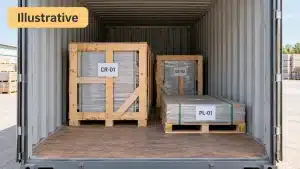
Select a carton, pallet, skid, rack, bundle, or crate with suitable internal separation, support, blocking, bracing, cushioning, edge protection, moisture control, and restraint. Confirm that the base, lifting points, center of gravity, and overall dimensions suit the available equipment and access route.
Step 5: Assign package IDs and label fields
Issue the package ID before closing the unit. Add the product identity, project destination, package sequence, quantity, dimensions, gross weight, handling and storage instructions, and revision status that apply. Keep human-readable text even when a barcode or QR code is used.
Step 6: Pack, verify, and photograph
Check the contents against the register while the package is open. Confirm accessories, separators, protective surfaces, restraints, and required documents. Photograph representative internal protection, the closed package, every label face, and any lifting or orientation feature without exposing confidential commercial data.
Step 7: Reconcile and load
Compare physical package count, IDs, gross weights, dimensions, labels, packing list, inspection disposition, and outbound load plan. Plan load distribution, restraint, compatibility, and unloading order separately; good product packaging does not by itself secure cargo inside a container or vehicle.
Step 8: Receive, stage, and close exceptions
At each handover, record package ID, visible condition, count, time, and custody. At destination, reconcile the register, isolate damaged or unidentified units, stage accepted materials by sequence and location, and record partial use, relocation, replacement, or return without losing the original identity.
Minimum Packing Register and Label Fields
The register contains the complete controlled record; the physical label contains the information needed to identify and handle the package. Do not overload the label with data that is meaningful only in the project file.
| Field | Register | Physical label | Notes |
| Unique package ID | Required | Required | Keep unchanged through receipt, relocation, partial use, and closeout. |
| Supplier / purchase order | Required | Usually useful | Use a short reference if commercial details should not be visible. |
| Product / assembly | Required | Required | Use plain description plus controlled item, model, opening, or assembly reference. |
| Project destination | Required | Required where known | Building, floor, room, zone, elevation, opening, or installation phase. |
| Package sequence | Required for a set | Required for a set | Use formats such as 2 of 5 and identify the parent kit or assembly. |
| Quantity / unit | Required | Required | Distinguish pieces, sets, cartons, square metres, or another agreed unit. |
| Dimensions / gross weight | Required | Show when useful or required | Use verified finished-package data and consistent units. |
| Handling / storage | Required when applicable | Required when applicable | Orientation, lifting, no clamp, no stack, keep dry, temperature or shelf-life limits. |
| Batch / lot / serial | When relevant | When relevant | Important for visual matching, equipment, warranty, testing, or replacement. |
| Revision / status | Required | Useful for changed labels | Prevent obsolete destination or release information from remaining active. |
A practical human-readable label layout
- Top line: project code and unique package ID in the largest type.
- Destination block: building, floor, room or zone, opening or assembly, and installation phase.
- Contents block: product description, item reference, quantity and unit, finish or batch where relevant.
- Handling block: gross weight, dimensions, approved lifting or orientation information, and necessary storage instructions.
- Control block: package sequence, supplier or purchase-order reference, label revision, and barcode or QR reference if used.
Place labels where they remain visible after wrapping and unitization. Two adjacent faces are useful when units may rotate or be stacked, but never place a project label over an official mark, product nameplate, lifting point, ventilation opening, or inspection access.
Packaging Controls by Material Category
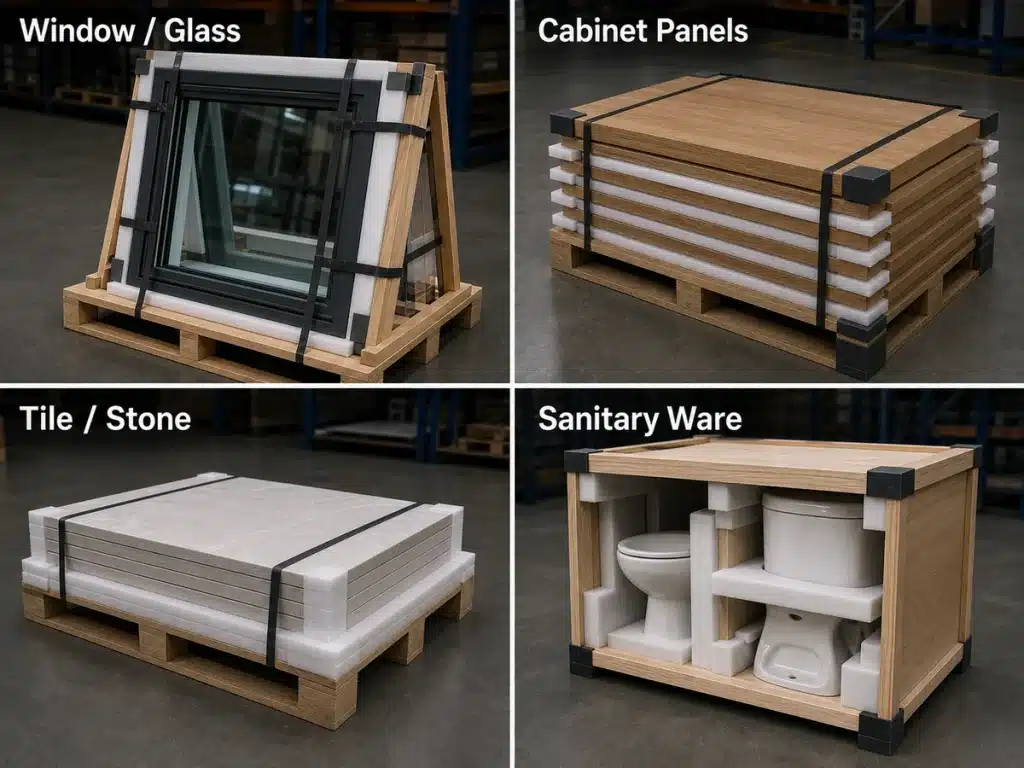
| Material category | Main risks | Typical packing controls | Label emphasis |
| Windows, doors, glass | Edge impact, frame distortion, glass contact, incorrect handing or opening. | Stable rack or crate, supported frame points, glass and finish separation, protected corners, restrained accessories. | Opening number, handing, frame/leaf or panel, finish, package orientation, lifting restrictions. |
| Cabinetry and millwork | Panel abrasion, edge damage, moisture, missing hardware, mixed room sets. | Face separators, corner and edge protection, dry raised storage, accessory sub-kits linked to the assembly. | Room/assembly, cabinet reference, finish, panel or hardware contents, multi-box sequence. |
| Tile and stone | High mass, corner chipping, breakage, mixed shades or batches, unstable stacking. | Sound pallet or skid, restrained cartons/slabs, protected corners, verified weight, suitable handling orientation. | Product/finish, batch or shade where controlled, area, quantity, gross weight, no-stack or lifting needs. |
| Sanitary ware and fixtures | Ceramic impact, surface scratches, small fitting loss, product confusion. | Rigid outer carton or crate as needed, molded or separated supports, isolated fittings, protected visible surfaces. | Room/fixture, model, color or finish, included fittings, fragile and orientation instructions. |
| Lighting and electrical items | Impact, moisture, electrostatic or component damage, mixed drivers and accessories. | Manufacturer-specified inner protection, dry outer package, separated components, linked driver and accessory references. | Fixture code, room/zone, voltage or model only as approved, driver/accessory relationship, storage limits. |
| Hardware and small accessories | Loss, mixing, counting errors, main assembly arriving incomplete. | Sealed counted sub-kits, compartmented bags or cartons, parent-package link, tamper-evident closure where appropriate. | Parent assembly, exact contents and quantity, room/opening, package ID and sequence. |
| Adhesives, sealants, coatings | Leakage, expiry, temperature exposure, incompatibility, regulated transport. | Original approved packaging, secondary containment where required, manufacturer storage conditions, competent dangerous-goods review. | Product, batch, expiry where applicable, storage limits, safety and transport marks only as legally required. |
Do not make one package do incompatible jobs
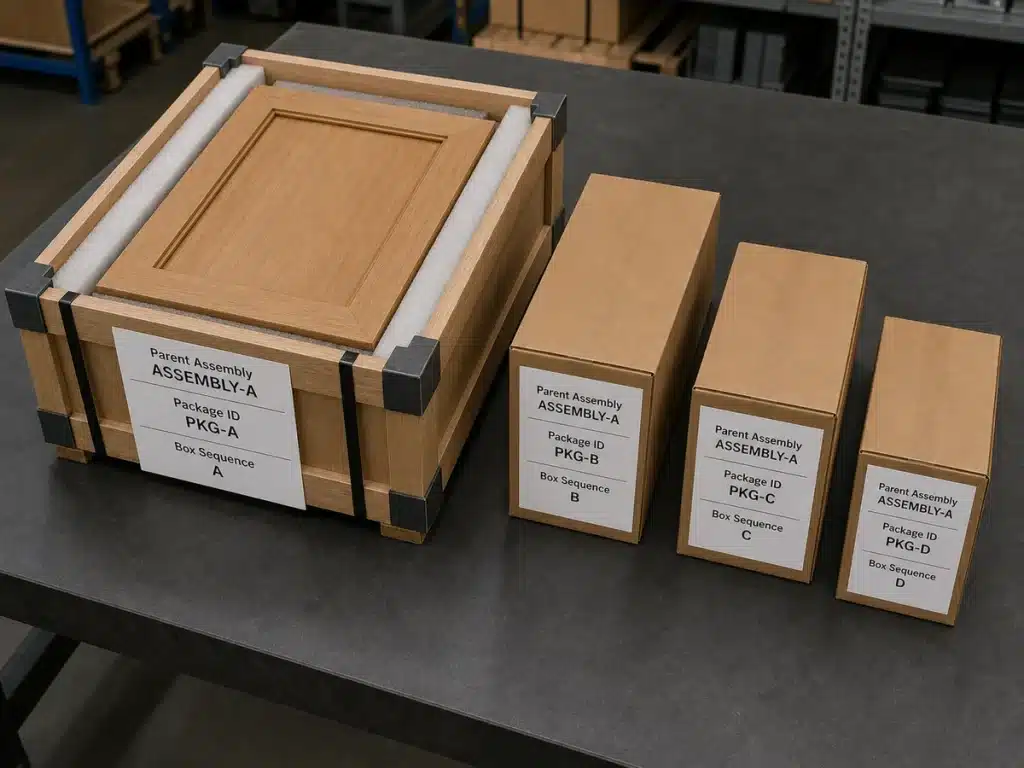
A project kit is useful only when its components can share the same package safely. Keep all parts traceable to one assembly, but use separate linked packages when heavy stone could crush hardware, metal could scratch a finished panel, moisture-sensitive goods need different storage, or a dangerous product requires separate compliant packaging. “Keep the kit together” means keep the relationship visible—not force every component into one box.
Handling Symbols, Barcodes, and Official Marks
Use handling symbols only when they convey a real instruction
ISO 780:2015 specifies graphical symbols used on distribution packages to communicate handling and storage instructions and states that symbols should be used only when necessary. Choose symbols that match the actual package and handling plan, place them where they can be seen, and retain human-readable information when the instruction could otherwise be misunderstood. ISO 780 does not cover dangerous-goods-specific instructions.
Barcodes or QR codes supplement readable labels
A barcode or QR code can connect a package to the live register, photographs, or receiving status, but scanning must not be the only way to identify it. Network access, damaged labels, incompatible apps, and changed links can interrupt digital lookup. The project code, package ID, destination, contents, and essential handling instructions should remain readable without a device.
Organizations using GS1 logistics labels can identify a logistics unit with a Serial Shipping Container Code (SSCC). An SSCC is a structured supply-chain identifier, not a number to invent casually. Use it only within a correctly implemented GS1 identification and data process; a project-specific package ID may be more appropriate when a GS1 system is not in use.
ISPM 15 applies to covered raw-wood packaging in international trade
For international movements, wood pallets, crates, skids, and dunnage made from covered raw wood may be subject to ISPM 15 and destination implementation requirements. The official mark indicates that the wood packaging material was treated and marked under the standard by an authorized system. It must not be copied onto untreated material or added as a decorative shipping mark. Processed wood products such as plywood are excluded from the standard’s scope, although a package may contain both exempt and covered components.
Dangerous-goods and product labels require separate verification
Some adhesives, sealants, coatings, aerosols, batteries, chemicals, and equipment may be regulated for transport or sale. Classification, packaging, marks, labels, declarations, language, and documentation depend on the actual product, quantity, transport mode, route, and jurisdiction. Preserve the manufacturer’s safety information and obtain competent dangerous-goods and destination advice; do not substitute generic “flammable,” “chemical,” or “safe” stickers.
Packing, Unitization, and Load Securing Are Different Controls
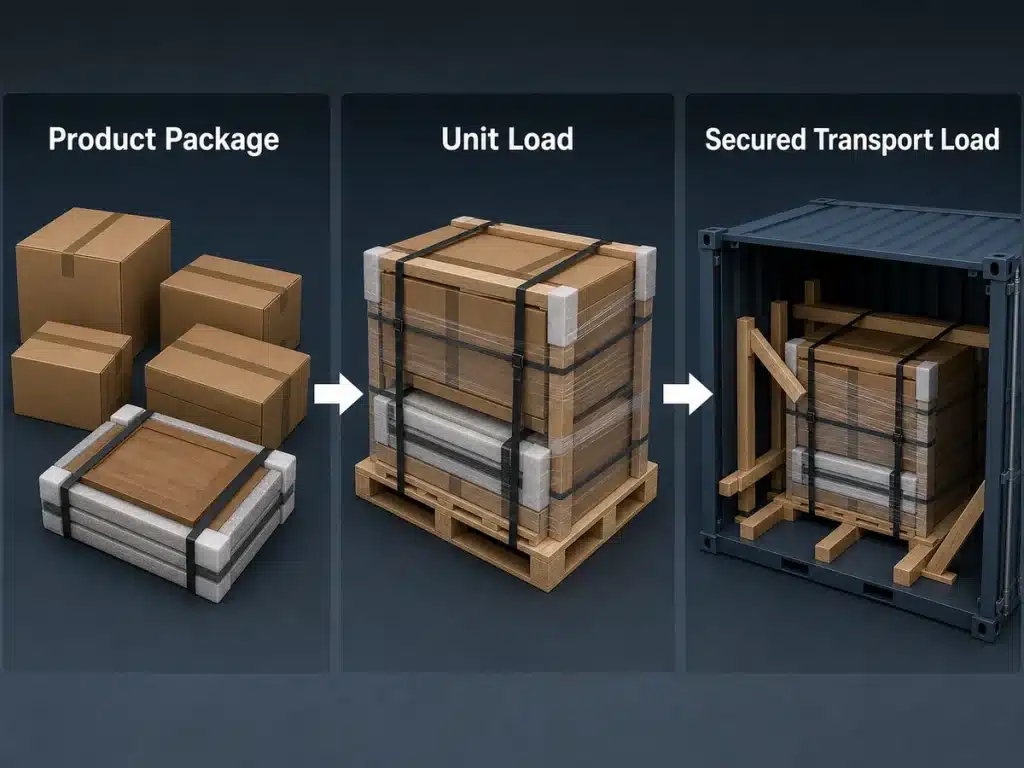
Product packaging protects an item. Unitization combines packages into a pallet, skid, rack, bundle, or crate. Load securing controls how those units behave inside a cargo transport unit, truck, or other vehicle. Each layer must work with the next. A strong crate can still move dangerously inside a container, while tight external restraint can damage an inadequately supported product.
The IMO/ILO/UNECE CTU Code provides non-mandatory global guidance for packing and securing cargo transport units across the intermodal chain. Its scope includes planning, CTU condition, mass distribution, restraint, completion, receipt, and unpacking. Apply the relevant legal, carrier, route, and engineering requirements through competent personnel rather than treating a blog checklist as a load-securing calculation.
Plan unloading before closing the load
- Confirm the destination’s access, floor or ground capacity, forklift, crane, hoist, spreader, vacuum lifter, labor, weather protection, and storage space.
- Load in a sequence that protects fragile goods and allows required packages to be removed without repeated rehandling.
- Keep package IDs and handling marks visible where practical and provide the receiving team with the register and unloading plan before arrival.
- Record cargo transport unit condition, package condition, position, restraint, and custody handover with appropriate photographs and documents.
Inspection and Handover Checklist
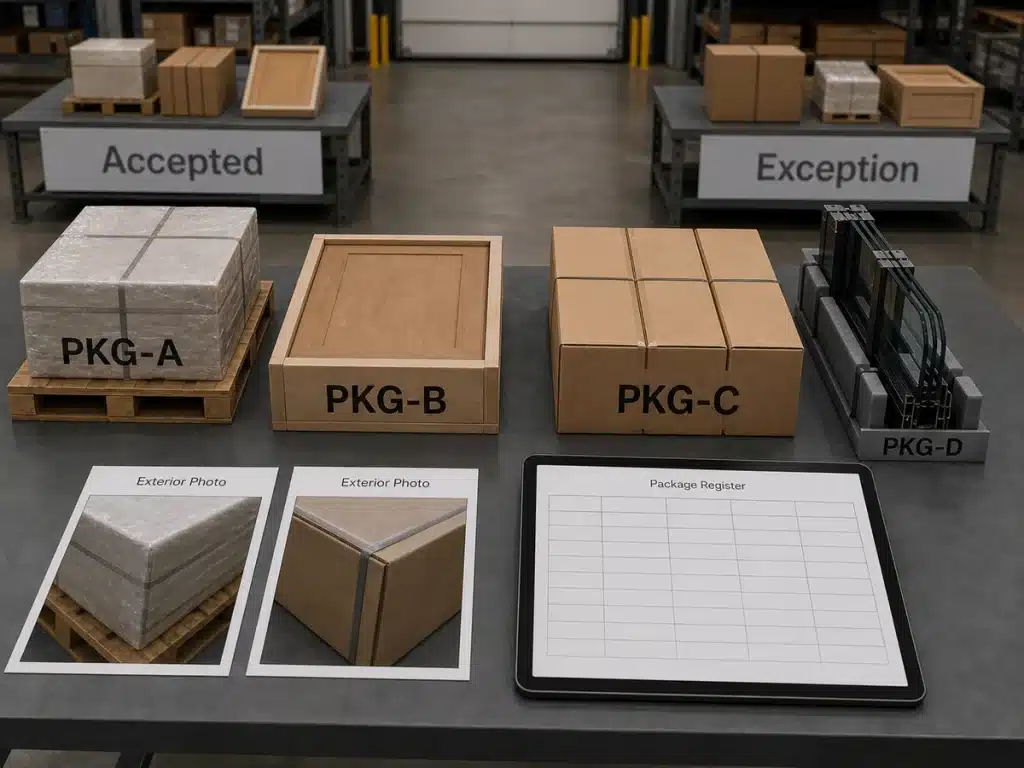
Before the package is closed
- Released item, model, finish, quantity, batch, handedness, and accessories match the controlled scope.
- Internal support, separation, cushioning, blocking, moisture protection, and surface protection suit the product and route.
- Small parts are counted, sealed, identified, and linked to the parent assembly.
- Required product identity, documents, and access points remain visible or traceable.
Before warehouse or transport release
- Package ID, sequence, contents, project destination, dimensions, gross weight, handling instructions, and revision match the register.
- Outer package, base, lifting points, closures, bands, restraints, labels, and official marks are intact and applicable.
- Physical package count matches the packing list and only accepted or authorized exceptions are released.
- Loading plan, compatibility, mass distribution, restraint, unloading sequence, and receiving equipment have been reviewed by responsible personnel.
At receiving and site storage
- Record package ID, visible condition, count, custody, photographs, and discrepancies before moving or opening the unit.
- Isolate wet, crushed, shifted, broken, unidentified, or incorrectly delivered packages pending disposition.
- Stage accepted packages in safe zones according to installation sequence and manufacturer storage conditions.
- Update the register when a package is opened, partially used, relocated, relabeled, returned, or replaced.
Common Packing and Labeling Failures
| Failure | Why it causes problems | Better control |
| Supplier item code only | The site cannot identify the room, assembly, or project purpose. | Add plain product description, stable package ID, and controlled destination fields. |
| Room name used as the ID | A design change breaks traceability and creates duplicate or ambiguous labels. | Keep a permanent package ID and revise the room or zone separately. |
| Accessories in a general carton | The main product arrives but cannot be installed. | Create counted sub-kits linked to the parent package and assembly. |
| Unverified weight or dimensions | Handling equipment, space, and load planning may be wrong. | Measure and record the finished handling unit before final release. |
| Generic “fragile” sticker | It does not define support, lifting, stacking, or restraint. | Design physical protection first, then add the necessary handling instruction. |
| Project label covers original data | Product, batch, serial, warranty, or compliance identity is lost. | Preserve original identification and place the project label separately. |
| Fake official mark or inspection stamp | It can misrepresent treatment, compliance, or acceptance. | Use only verified marks applied through the responsible authorized process. |
| Register not updated after repacking | The physical shipment no longer matches documents or photographs. | Issue a controlled revision linking old and new package identities. |
Information Needed for a Packing and Labeling Plan
- Project, building, floor, room, zone, opening, assembly, phase, and required-on-site references.
- Released product schedule, purchase orders, latest drawings, approved finishes, quantities, batches, and accessory relationships.
- Supplier locations, transport route, consolidation points, handling transfers, storage duration, and destination conditions.
- Finished package dimensions, gross weight, center of gravity or lifting information where needed, stackability, fragility, moisture and temperature limits.
- Available warehouse and site equipment, access restrictions, unloading sequence, and storage zones.
- Required product, transport, wood-packaging, dangerous-goods, customs, contractual, or destination labels and documents confirmed by competent parties.
- Requested inspection, photographs, barcode or data process, packing-list format, exception workflow, and receiving record.
Frequently Asked Questions
What should be included on a building material package label?
Include a unique package ID, product or assembly description, project destination, quantity and unit, package sequence, and the handling or storage information that applies. Add dimensions, gross weight, batch, supplier, purchase-order, and revision references where they support handling or traceability.
Should building materials be labeled by room or by trade?
Use both when useful, but do not make either one the permanent identity. Keep a stable package ID, then add building, floor, room, zone, opening, trade, and installation phase as controlled destination fields.
How should multi-box assemblies be labeled?
Repeat the parent assembly and destination on every box, give each box its own package ID, and add a sequence such as 2 of 5. The register should show which box contains the main item, hardware, trims, fittings, or other accessories.
Can QR codes replace printed package information?
No. A QR code can link to the register or documents, but essential human-readable identification and handling instructions should remain visible if scanning, network access, or the link fails.
Does every export crate need an ISPM 15 mark?
No. ISPM 15 applies to covered wood packaging material made from raw wood in international trade, subject to destination implementation. Processed wood such as plywood is excluded. An official mark may be applied only through the authorized compliant system.
Is a fragile label enough for glass, stone, or sanitary ware?
No. The package still needs suitable support, separation, edge and corner protection, cushioning or restraint, and an approved handling method. The label communicates the handling instruction; it does not provide physical protection.
What should happen when a room assignment changes?
Retain the stable package ID, issue a revised destination label, update the register and staging plan, and preserve the revision history. Remove or invalidate the obsolete destination so the package does not show conflicting instructions.
Conclusion
Building materials packing and labeling works when protection, identification, handling, project location, and documentation are designed as one traceable system. The strongest process does not rely on a room sticker or a generic fragile symbol. It gives every handling unit a stable identity, protects each product for the whole route, preserves original and official information, and records every handover and change.
To prepare a project-specific plan, provide the released product schedule, supplier and purchase-order references, package data, project destinations, required-on-site sequence, route, storage conditions, handling equipment, inspection scope, and applicable documentation requirements. Those inputs allow the packing register, label template, package design, and receiving plan to be coordinated before materials are dispatched.
Authoritative references used for technical review
UNECE — IMO/ILO/UNECE CTU Code, 2025 revision — Current revision for packing and securing cargo transport units across the intermodal chain.
ISO — ISO 780:2015 — Official abstract for graphical symbols used on distribution packages to convey handling and storage instructions.
International Plant Protection Convention — ISPM 15 — Official standard for covered wood packaging material in international trade, including scope and marking.
GS1 — Serial Shipping Container Code (SSCC) — Official description of the SSCC as a unique identifier for a logistics unit within the GS1 system.
Next Steps for Your Project
Topic hub: Shipping & Delivery Guides
Relevant product pages: Luxury Sanitary Ware Systems · Structural Glass Facades · Custom Cabinetry
Related guides: Consolidated Shipping for Building Materials · Pre-Shipment Inspection Checklist
Related service: Inspection & Packing