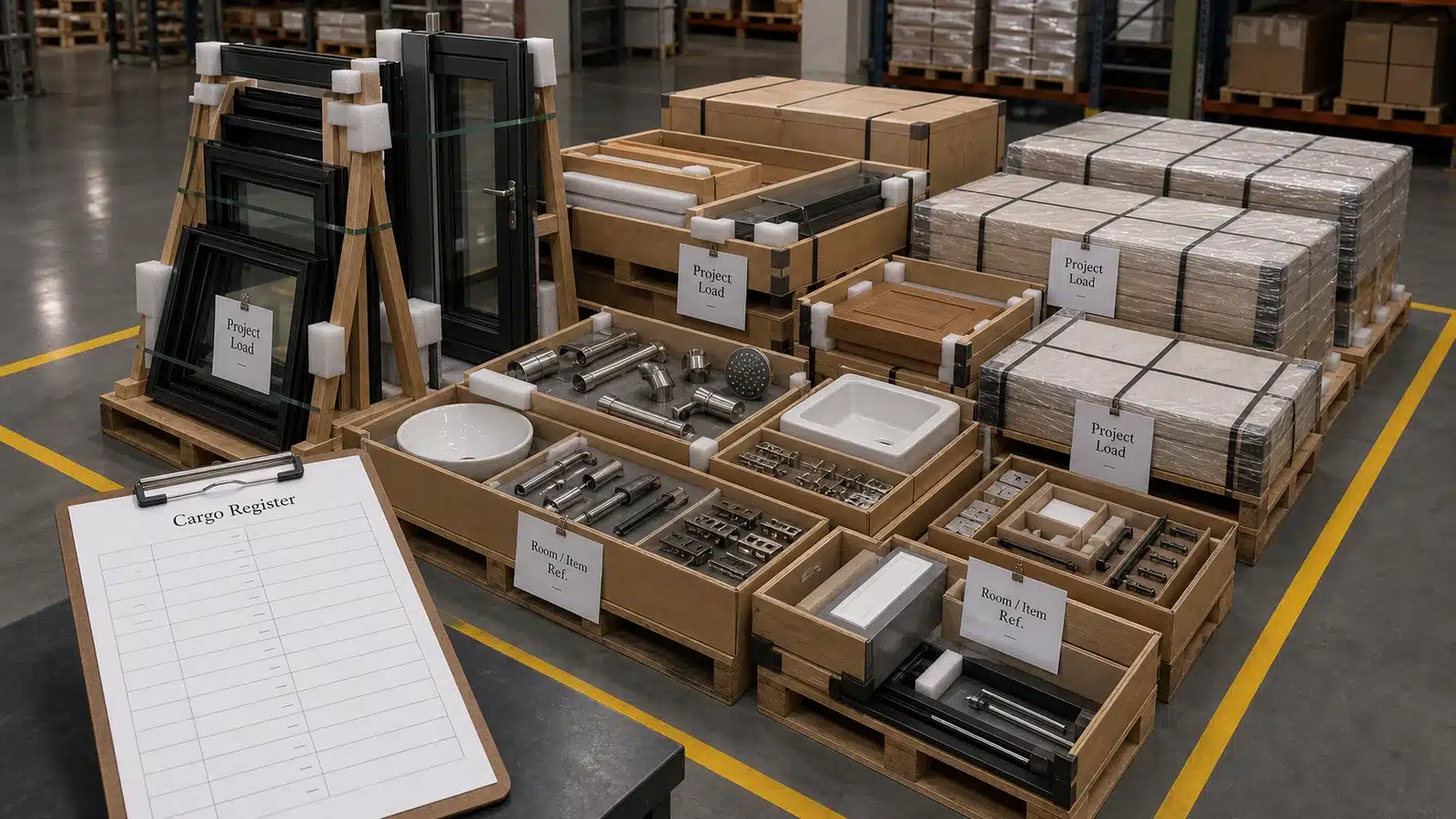
A practical guide to combining materials from multiple suppliers, controlling the consolidation warehouse, planning export packing, and comparing the complete delivered-cost scenarios.
Consolidated shipping building materials is a search phrase commonly used for combining compatible products or supplier orders into one coordinated movement. In practice, the shipment may be consolidated into a dedicated container or truck, moved as LCL or LTL freight through a carrier network, or staged at an origin warehouse before export. These are different operating models and should not be treated as interchangeable.For a villa, apartment, hotel, or commercial project, consolidation can reduce fragmented deliveries and give the team one point to reconcile quantities, packaging, labels, and documents. It can also introduce storage, extra handling, shared-delay, customs, and damage risks. The correct decision depends on the real cargo, installation sequence, route, commercial terms, and receiving capacity—not on a generic promise that consolidation is always cheaper.
Written by Winston
Project Director at Skyland Building · 10+ Years of Building Materials Experience
Updated August 2026 · 13-minute read
Key Takeaways
- Define whether “consolidation” means supplier collection into one dedicated load or carrier-managed groupage with unrelated cargo.
- Consolidate only materials that are compatible in timing, handling, weight, dimensions, environmental needs, and unloading sequence.
- Use one controlled cargo register linking every purchase order to packages, quantities, dimensions, weights, inspection status, and destination references.
- Include receiving, storage, inspection, repacking, loading, documentation, port, customs, delivery, and delay exposure in the cost comparison.
- Agree Incoterms® rules, named places, insurance, exporter/importer responsibilities, and consolidation service scope separately.
- Release the load only after the required product approvals, pre-shipment checks, packing controls, and document reconciliations are complete.
How Consolidated Shipping for Building Materials Works
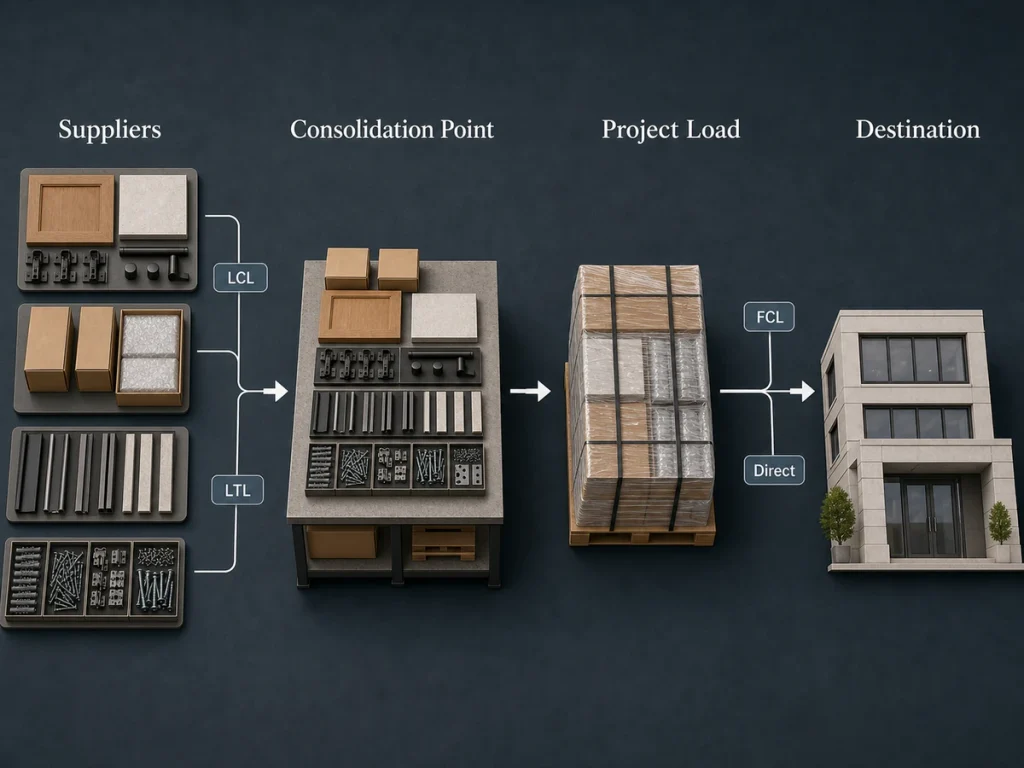
Consolidated shipping is an operating arrangement in which two or more cargo lots are coordinated into a larger transport movement. For multi-category building-material procurement, the lots may come from different factories but be received at one consolidation point, checked, staged, and loaded for the same project or destination. The commercial and transport documents must still identify the underlying goods and parties correctly.
Supplier consolidation into one project load
In a project-controlled model, windows, doors, cabinetry, tiles, sanitary ware, lighting, hardware, furniture, or other products arrive from approved suppliers under a shared cargo schedule. The coordinator receives each lot, records discrepancies, preserves traceability, and prepares one planned outbound load. That load may fill a container or vehicle, or it may enter another transport service after origin consolidation.
LCL, LTL, groupage, FCL, and FTL are service terms
Less-than-container-load (LCL) and less-than-truckload (LTL) services normally carry a shipper’s smaller consignment alongside other customers’ freight. Full-container-load (FCL) and full-truckload (FTL) describe use of a container or vehicle, but they do not prove that all goods came from one factory. Groupage is another term used for combining consignments. Actual handling, storage, transshipment, documentation, and liability vary by provider and route, so the quotation must describe the physical service rather than rely on the label alone.
| Operating model | Typical arrangement | Main control question |
| Origin supplier consolidation | Several approved supplier lots are received and prepared as one project load. | Who receives, checks, stores, repacks, documents, and releases each lot? |
| LCL / groupage | One consignment shares container space and a carrier or forwarder network with other cargo. | How many handling points, cutoffs, deconsolidation steps, and destination charges apply? |
| LTL | A smaller road consignment shares vehicle and terminal capacity with other freight. | What terminal transfers, delivery appointments, classifications, and accessorials apply? |
| FCL / FTL project load | The arranged container or vehicle carries the coordinated project cargo. | Is the cargo volume ready, compatible, safely packed, and deliverable as one load? |
| Direct supplier shipment | One supplier sends its cargo without joining the project consolidation point. | Does reduced handling outweigh the extra shipment, appointment, and document work? |
When Consolidated Shipping Works—and When It Does Not
Good conditions for consolidation
- Several supplier lots share the same project, destination region, port, warehouse, or delivery phase.
- The goods have compatible readiness windows and can wait for the planned consolidation cutoff without delaying installation.
- Complete package dimensions, gross weights, handling limits, product risks, and document requirements are available before vehicle or container selection.
- The consolidation point can receive, identify, inspect, protect, store, and load the materials without losing traceability.
- The receiving site or destination warehouse can accept the combined volume, unloading method, and delivery sequence.
Conditions that favor separate or specialized transport
- One item is urgently required and waiting for other suppliers would threaten the construction sequence.
- Cargo is oversized, unusually heavy, hazardous, temperature-controlled, contamination-sensitive, or incompatible with the proposed mixed load.
- A fragile or high-value product cannot tolerate the additional receiving, staging, or transfer steps.
- One supplier already has a complete economical load and direct delivery removes unnecessary handling.
- Customs, licensing, origin, documentary, or contractual requirements cannot be managed reliably within the combined movement.
- The site lacks space or equipment for one large delivery and staged direct deliveries better match installation.
Do not consolidate by product name alone
Compatibility is determined by the finished packages and route, not by whether products all belong to “building materials.” A crate of stone, a glass rack, boxed hardware, a cabinet pallet, and lighting cartons may share a destination but require different support, stacking, moisture, security, and unloading controls. Build the load around the most restrictive item and document any cargo that must be isolated or shipped separately.
The Consolidated Shipping Process: Eight Steps
The following framework is intended for multi-supplier project cargo. Contracts, destination rules, carrier procedures, and project risk may require additional steps.
Step 1: Build the project cargo scope
Link every purchase order and approved variation to a product schedule showing supplier, item code, quantity, installation area, required-on-site date, technical-release status, and expected packing unit. Identify items still waiting for shop drawing, sample, testing, or commercial approval; they should not be presented as released cargo.
Step 2: Collect verified cargo data
Obtain finished package counts, dimensions, gross and net weights where required, center-of-gravity or lifting information for special cargo, stack limits, moisture or orientation needs, dangerous-goods status, photographs, and pickup location. Early estimates may support planning, but final equipment and loading decisions need confirmed package data.
Step 3: Define responsibilities and commercial terms
State who arranges factory pickup, warehouse receiving, inspection, storage, repacking, export clearance, main carriage, insurance, import clearance, delivery, unloading, and claims. Record the agreed Incoterms® 2020 rule and exact named place for each sale, but use a separate service scope to describe consolidation work; an Incoterms® rule does not by itself define warehouse handling or multi-supplier coordination.
Step 4: Set cutoffs and exception rules
Publish supplier booking deadlines, latest cargo-receipt dates, document cutoffs, planned inspection and loading dates, and the required delivery window. Decide in advance whether a late item will move separately, wait for the next load, or trigger an authorized schedule change. Do not let a low-priority delay silently hold critical materials.
Step 5: Receive and reconcile each supplier lot
At the consolidation point, verify supplier, purchase order, package count, visible condition, labels, dimensions, weight records, and required documents. Record shortages, overages, damage, unidentified packages, and cargo received before approval. Preserve original supplier and batch information instead of replacing it with only a project-wide label.
Step 6: Complete required inspection and packing actions
Perform only the inspections authorized in the plan, close required nonconformities, and confirm whether goods may proceed. Repack, add protection, or reorganize unit loads where agreed. A warehouse receipt is not the same as product acceptance, and a pre-shipment inspection recommendation is not automatically commercial authorization to ship.
Step 7: Approve the load and document set
Prepare the load plan around weight distribution, cargo compatibility, restraint, unloading sequence, and transport-unit limits. Reconcile the final packing list, commercial documents, package references, weights, marks, and customs data with the physical cargo. Resolve who is shipper, consignee, exporter, and importer of record with qualified trade professionals for the route.
Step 8: Load, dispatch, track, and hand over
Record transport-unit condition, package condition, loading sequence, restraint, photographs, seal or vehicle reference where applicable, dispatch documents, and custody handover. Track meaningful milestones and provide the receiving team with the unloading plan, storage requirements, package register, and exception contacts before arrival.
Cargo Register and Supplier Coordination
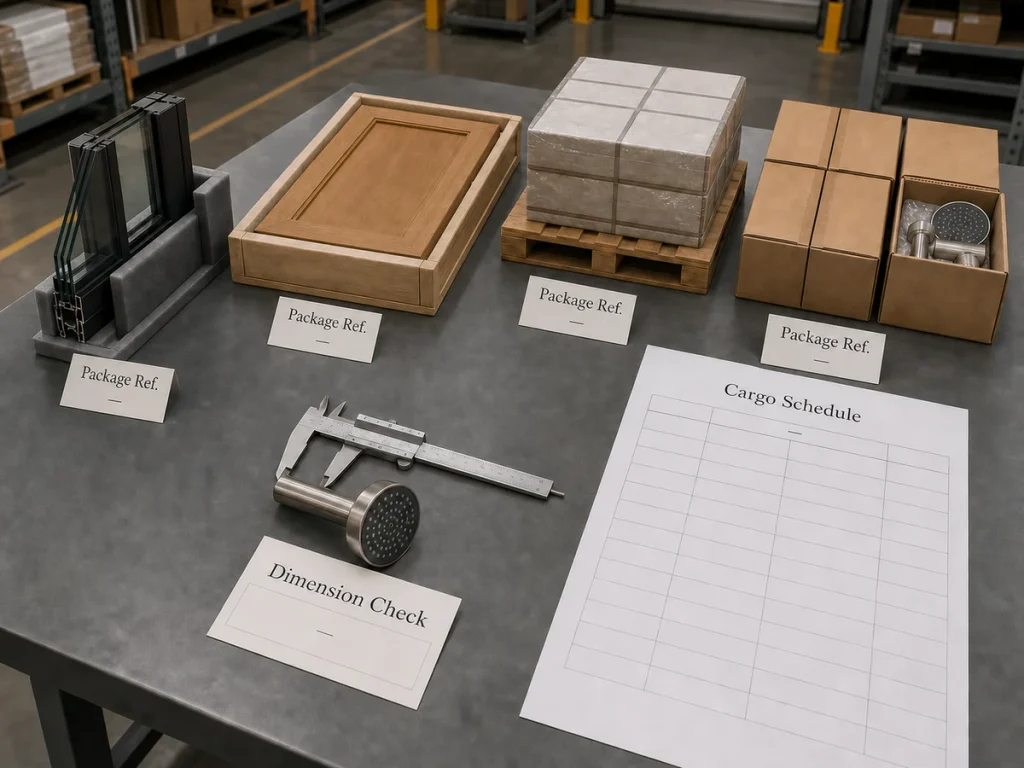
Minimum cargo-register fields
Use one controlled register rather than separate email chains. It should show the current cargo state without overwriting previous revisions.
- Supplier, purchase order, item and project-location reference, approval or release status, and required-on-site date.
- Package type, package count, dimensions, gross weight, stackability, orientation, lifting, moisture, fragility, and hazardous-goods information.
- Planned pickup, actual pickup, warehouse receipt, inspection, corrective action, document-ready, and loading status.
- Package identifiers, batch or lot, photographs, packing-list reference, exception owner, and current disposition.
- Outbound load, transport-unit or booking reference, dispatch date, destination, delivery phase, and receiving confirmation.
Blank consolidation cargo schedule
| Supplier / PO | Packages | Dimensions / weight | Ready / release | Handling / open issue |
Populate the schedule only with verified shipment data. Keep supplier packing lists and evidence attached to the relevant revision.
Control late, changed, or unapproved cargo
A revised package size, added accessory, changed finish, supplier substitution, new batch, or delayed release can affect space, documents, inspection, and site sequence. Route the change through the responsible technical, commercial, and logistics controls. Mark superseded data clearly and recalculate the load instead of adding cargo informally at the warehouse door.
Compatibility, Packaging, and Load Planning

Build a compatibility matrix
| Cargo characteristic | Questions before combining | Possible control |
| Heavy or concentrated load | Can the package, floor, pallet, container, vehicle, and unloading equipment support the weight? | Engineered skid, load spread, defined position, verified lifting plan, or separate transport. |
| Fragile or finished surface | Can adjacent cargo, straps, vibration, transfers, or unloading contact the vulnerable area? | Crate, separator, corner and face protection, no-stack zone, controlled handling. |
| Moisture-sensitive | What humidity, condensation, rain, ventilation, storage, and transit exposure is expected? | Suitable barrier or cover, dry raised storage, ventilation or desiccant where specified, condition checks. |
| Long or oversized | Does it fit through factory, warehouse, CTU, route, and site access points? | Verified dimensions, special equipment, permits where required, direct or specialized movement. |
| Hazardous or regulated | Is classification, packaging, marking, declaration, segregation, and carrier acceptance complete? | Competent dangerous-goods review and fully compliant dedicated or segregated handling. |
| Room- or sequence-specific | Can the first-needed goods be accessed without moving vulnerable or heavy cargo? | Package by area or phase, load in reverse unloading order, preserve visible identifiers. |
Design packaging for the whole route
Packaging must protect goods through factory handling, pickup, warehouse receiving, staging, loading, main carriage, unloading, storage, and movement to the installation area. Check internal restraint as well as the outer crate or carton. Finished faces, glass edges, stone corners, cabinet panels, fittings, lighting components, and hardware have different failure modes and should not be protected with one generic method.
The current IMO/ILO/UNECE CTU Code provides guidance across the intermodal chain for packing, loading, securing, receiving, and unpacking cargo transport units. Apply relevant route, carrier, and legal requirements through competent personnel; the article should not be used as a substitute for a load-securing calculation or dangerous-goods instruction.
Use labels that survive consolidation
- Keep the original supplier and product identity, then add a unique project shipment and package reference.
- Show purchase order, item or room/zone, package sequence, quantity, and any batch or lot reference needed for traceability.
- Place required handling, orientation, lifting, dry-storage, fragile, or no-stack information where it remains visible.
- Match every physical label to the controlled packing list and photograph representative completed packages.
- Avoid placing unverified compliance symbols, inspection stamps, delivery dates, or claims on labels.
Plan loading and unloading together
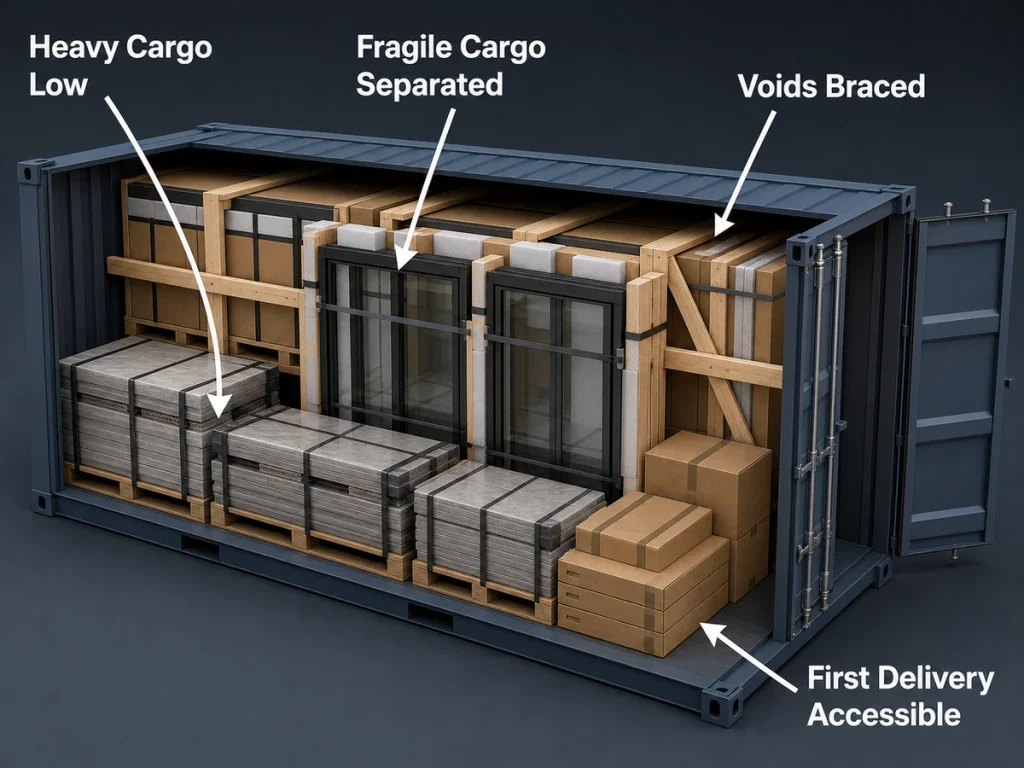
The load plan should consider cargo mass, center of gravity, floor and axle limits, restraint, voids, incompatible materials, inspection access, route forces, and unloading equipment. Loading order should support the planned destination sequence. A well-used container is not successful if the first installation package is inaccessible or if fragile goods must be moved repeatedly to unload heavier cargo.
How to Compare Consolidated and Separate Shipping Costs
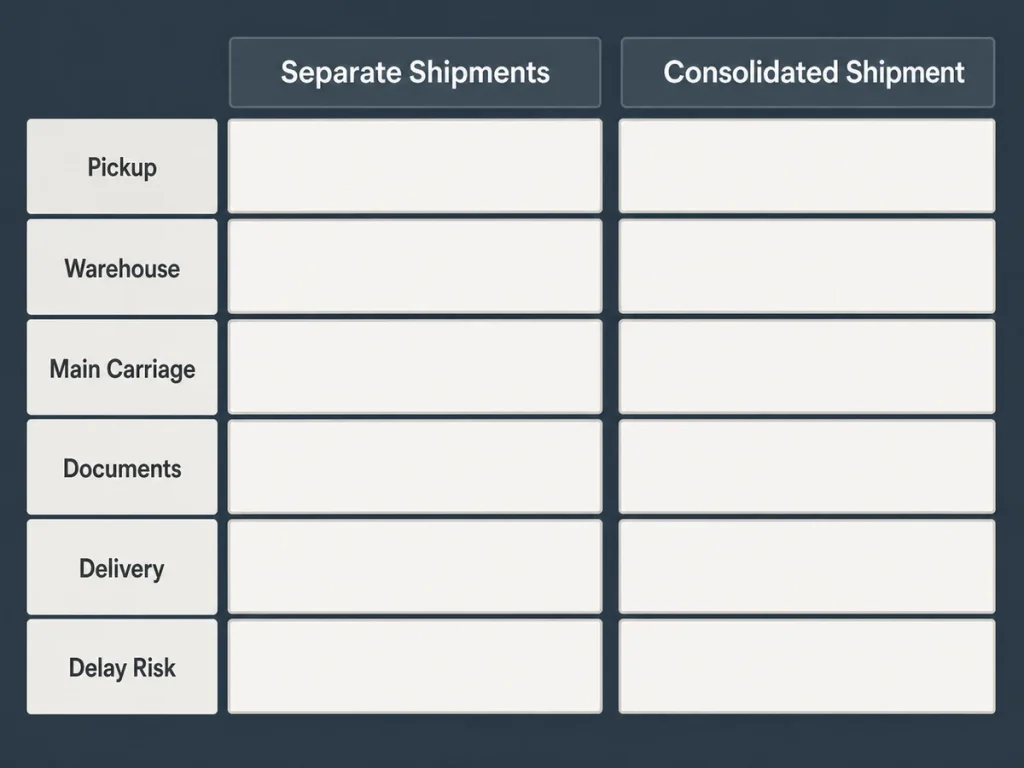
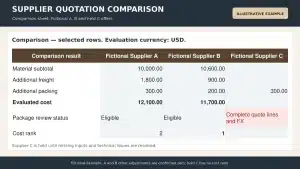
Compare complete scenarios, not one freight rate
Build separate-shipment and consolidation scenarios from the same verified cargo data, origin points, route, destination, service level, and delivery window. The comparison should show every material cost difference and every schedule dependency. Do not publish a savings percentage unless it comes from documented, like-for-like quotations and actual project records.
| Cost or risk item | Separate shipments | Consolidated shipment | Evidence needed |
| Factory pickup | Pickup per supplier or order | Multiple pickups into consolidation point | Locations, cargo readiness, equipment and collection quotations. |
| Warehouse handling | May be limited or absent | Receiving, count, inspection, storage, repacking, staging and loading may apply | Warehouse tariff, expected dwell, labor and service scope. |
| Main carriage | Several bookings or movements | One project load or groupage booking | Final dimensions, weights, route, equipment and carrier quotation. |
| Port / terminal / customs | Repeated or separate files may apply | Combined movement may still require multiple underlying records | Broker and forwarder advice for the actual route and parties. |
| Insurance and risk | Smaller loss concentration but more movements | More cargo in one movement and shared delay exposure | Cargo value, coverage, exclusions, deductibles and claims route. |
| Final delivery | Several appointments and unloads | Larger planned delivery or destination deconsolidation | Site access, equipment, crew, time window and delivery quotation. |
| Delay and disruption | One supplier delay may affect one load | Late cargo may hold or split the planned consolidation | Installation schedule, cutoff rule and contingency cost. |
Include landed and project-handling costs
Depending on the route and commercial arrangement, the analysis may include origin handling, packaging, storage, inspection, documentation, export and import charges, duties and taxes, insurance, port or terminal handling, demurrage or detention exposure, destination deconsolidation, inland delivery, unloading, site storage, damage, replacement, and schedule disruption. Customs valuation and tax treatment are jurisdiction-specific; obtain route-specific advice instead of copying a generic landed-cost formula.
Test schedule value as well as cost
Consolidation may reduce delivery appointments and create a more orderly handover, but it can also make several product categories dependent on one late factory, one warehouse issue, or one delayed transport unit. Compare the value of fewer interfaces with the cost of waiting, split releases, temporary storage, rehandling, or missed installation work. The best plan may use a consolidated main load plus separate critical-path or oversized shipments.
Risk Controls for Multi-Supplier Consolidation
Shared-delay and cutoff risk
Use readiness forecasts, firm cargo cutoffs, escalation contacts, and written split-shipment rules. Track the cause and impact of every late lot. A consolidation warehouse should not become indefinite storage for unapproved or incomplete goods, and a project should not hold released critical cargo merely to maximize container utilization.
Damage, loss, and chain of custody
Record visible condition and package count at each custody transfer. Use consistent package references on receipts, photographs, inspection reports, loading records, transport documents, and proof of delivery. When damage occurs, preserve the package, label, affected area, surrounding load context, and notification record. Claims time limits and evidence requirements vary by carrier, insurer, contract, and law.
Customs, origin, and document risk
Combining physical cargo does not erase the underlying seller, product, value, classification, origin, license, or compliance information. Commercial invoices, packing lists, declarations, bills of lading or waybills, and supporting records must be prepared for the actual parties and route. The freight forwarder or broker should confirm documentary structure; a consolidation coordinator should not invent one combined description that hides material differences.
Insurance and Incoterms® boundaries
Incoterms® 2020 allocates specified costs, risks, carriage, insurance, and clearance obligations between seller and buyer under the chosen rule and named place. It does not replace the sales contract, carrier terms, insurance policy, warehouse agreement, or consolidation scope. Confirm when risk transfers for each purchase and whether cargo remains adequately insured while moving to, stored at, and leaving the consolidation point.
Receiving-site constraints
Confirm gate and road access, appointment rules, vehicle or container positioning, crane or forklift capacity, labor, unloading time, weather protection, staging space, floor or ground capacity, and package sequence. If the site cannot receive the complete load safely, plan destination warehousing or staged delivery before dispatch rather than improvising after arrival.
Consolidation Planning Checklist
Before supplier collection
- Cargo scope, approved product references, quantities, project locations, required-on-site dates, and release status confirmed.
- Finished package counts, dimensions, weights, handling limits, hazards, stackability, photographs, and pickup addresses verified.
- Consolidation model, warehouse, carrier or forwarder, route, equipment, cutoffs, storage allowance, and exception rules agreed.
- Incoterms® rule and named place, service responsibilities, insurance, exporter/importer roles, customs advice, and document structure confirmed.
At the consolidation point
- Each supplier lot received against the cargo register; package count, identity, condition, labels, dimensions, and records reconciled.
- Unapproved, damaged, short, excess, unidentified, or nonconforming goods isolated and assigned a documented disposition.
- Required inspections and corrective actions closed before outbound release; repacking and labeling completed under the agreed scope.
- Final package list, weights, dimensions, compatibility, load position, restraint, unloading sequence, and transport-unit limits reviewed.
Before dispatch and delivery
- Physical cargo matches the final packing list and commercial or transport documents; package references remain traceable to suppliers and purchase orders.
- Transport-unit condition, loading, securing, photographs, seal or vehicle reference, handover, and dispatch status recorded where applicable.
- Receiving team has the delivery appointment, unloading plan, equipment, storage conditions, package register, and exception contacts.
- Tracking milestones, proof of delivery, receiving inspection, shortage or damage notification, and claims responsibilities are defined.
Information Needed to Quote a Consolidated Shipment
- Supplier names and pickup locations; purchase-order and item references; cargo-ready dates and allowed consolidation window.
- Package count, type, dimensions, gross weight, stackability, lifting method, fragility, moisture needs, and hazardous-goods status.
- Origin consolidation point, port or route preference where relevant, destination, delivery site, required-on-site date, and unloading constraints.
- Required receiving, inspection, storage, repacking, labeling, loading supervision, customs, insurance, tracking, and final-delivery services.
- Incoterms® rule and named place for each purchase, proposed exporter/importer and consignee structure, and available commercial documents.
- Declared cargo value and insurance requirements supplied through the appropriate secure commercial process—not inserted into a public article or image.
Frequently Asked Questions
What is consolidated shipping for building materials?
It is the coordinated combination of two or more compatible cargo lots into a larger movement. For a construction project, goods from several suppliers may be collected at one origin warehouse, checked, staged, and loaded for the same project or destination.
Is consolidated shipping the same as LCL?
No. LCL is a carrier or forwarder service in which a smaller consignment shares container space, often with unrelated cargo. A project can consolidate goods from several suppliers into its own FCL container, an LCL consignment, a truckload, or another onward service.
Is consolidation always cheaper than separate shipments?
No. It may reduce some main-carriage, appointment, or administrative duplication, but it can add pickup, receiving, storage, inspection, repacking, handling, delay, and destination charges. Compare complete like-for-like delivery scenarios.
Which building materials can be consolidated?
Products can share a movement when their finished packages are compatible in dimensions, weight, support, stacking, environmental conditions, hazard status, delivery timing, and unloading sequence. Product names alone do not establish compatibility.
Can fragile stone, glass, or cabinetry be consolidated?
Potentially, if the load plan provides suitable racks or crates, support, separation, restraint, handling, inspection access, and unloading control. Direct or specialized transport may be preferable when additional handling creates unacceptable risk.
What happens if one supplier misses the cutoff?
Follow the written exception rule: move the late cargo separately, hold it for the next release, or authorize a schedule change. The decision should reflect installation priority, storage, freight, and delay impact rather than container utilization alone.
Who is responsible for damage during consolidation?
Responsibility depends on the sales contract, Incoterms® rule and named place, warehouse and carriage contracts, insurance, custody record, applicable law, and the cause of damage. Define the roles before pickup and preserve evidence at each handover.
Conclusion
Consolidated shipping for building materials works when compatible supplier lots, release dates, packaging, documents, loading, and site delivery are managed as one controlled system. The benefit is not simply a fuller container or fewer trucks; it is a traceable project load that arrives in the condition, sequence, and document state required for the next construction phase.
Before requesting a coordinated shipping plan, provide the BOQ or product schedule, approved purchase scope, supplier locations, cargo-ready dates, finished package data, inspection and packing requirements, destination, unloading constraints, commercial terms, and required-on-site dates. That information supports a defensible comparison between consolidation, direct delivery, and split critical-path shipments.
Authoritative references used for technical review
UNECE — IMO/ILO/UNECE Code of Practice for Packing of Cargo Transport Units, 2025 revision — Current revision covering safe packing and securing of cargo transport units across the intermodal chain.
International Maritime Organization — Cargo Transport Units Code — Explains the CTU Code’s application to loading, securing, receiving, and unpacking across sea and land transport modes.
International Chamber of Commerce — Incoterms® 2020 — Official source for the current Incoterms® rules and their allocation of carriage, insurance, security, cost, and clearance obligations.
Next Steps for Your Project
Topic hub: Shipping & Delivery Guides
Relevant product pages: Custom Cabinetry · Luxury Sanitary Ware Systems · Architectural Ceramics
Related guides: Building Materials Packing and Labeling · Transporting Construction Materials
Related service: Consolidation & Shipping