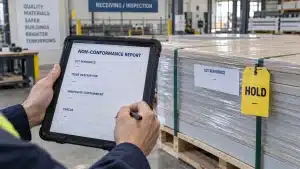
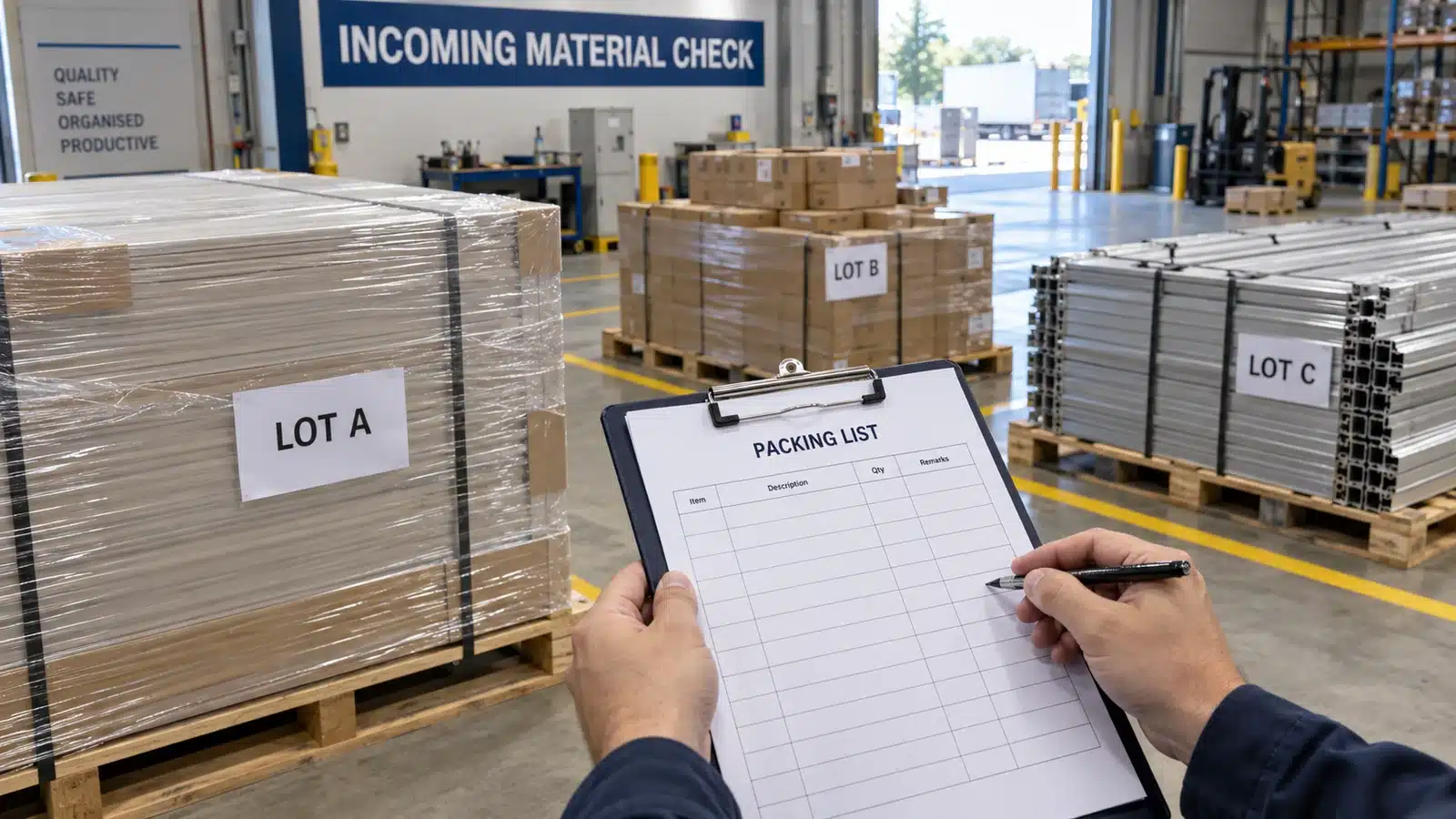
A factory incoming material inspection checklist is used when raw materials, components, or purchased assemblies arrive at a manufacturing plant and before they are released to production. It verifies identity, quantity, documents, traceability, condition, dimensions, test evidence, and final disposition. The checklist should be customized to the purchase order, approved technical documents, material sample, and inspection plan for the actual lot.
This is an incoming quality control or IQC check. It is different from a pre-shipment inspection, which checks finished goods before they leave the supplier. For a wider view of inspection stages, use the building material quality control hub.
Written by Winston
Project Director at Skyland Building · 10+ Years of Building Materials Experience
Updated September 2026 ·15-minute read
Key Takeaways
- Define the lot, controlled references, measurable criteria, sample plan, and release authority before materials arrive.
- Match the physical receipt to the purchase order, packing list, labels, certificates, batch records, and current technical documents.
- Inspect identity, quantity, transport condition, workmanship, dimensions, and required test evidence as separate controls.
- Choose full inspection or sampling according to risk and an approved plan. Do not select an AQL or sample size after seeing the results.
- Quarantine unverified or nonconforming lots so production cannot use them by mistake.
- Retain measurements, photographs, equipment IDs, document revisions, decisions, and corrective-action evidence under the same lot record.
Incoming Inspection at a Glance
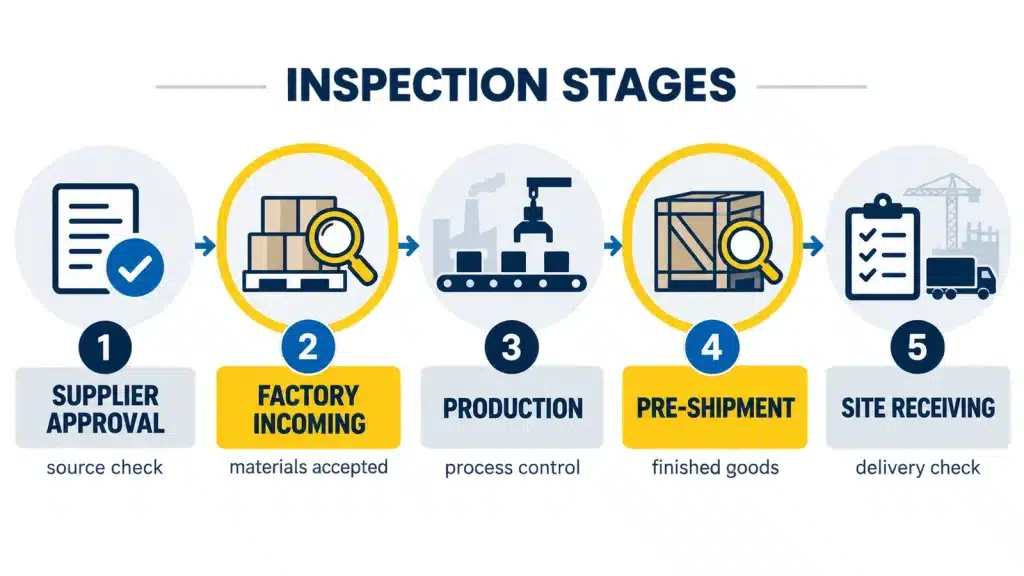
The inspection stage determines what the checklist should cover. Keep these activities separate so a pass at one stage is not treated as approval of another.
| Stage | Primary purpose | Typical decision |
| Supplier approval | Evaluate whether a supplier has the systems, capability, records, and controls needed for the intended scope. | Approve, conditionally approve, or reject the supplier for a defined category. |
| Factory incoming inspection | Verify purchased materials or components at receipt before they enter production. | Release the lot, hold it, reject it, or accept a controlled deviation. |
| Pre-shipment inspection | Verify finished goods, quantity, accessories, packing, and documents before dispatch. | Recommend release, conditional release, hold, or rejection under the agreed order rules. |
| Site receiving inspection | Check delivered products and their condition before storage or installation. | Accept into site control, quarantine, report damage, or request technical review. |
Copyable Factory Incoming Material Inspection Checklist
Use the points below as a master checklist. Delete items that do not apply and replace generic wording with the exact requirement, tolerance, method, sample size, evidence, and decision authority for the material.
Inspection Setup and Controlled References
- Record the supplier, factory, purchase order, delivery note, receipt date, inspector, and inspection report number.
- Define the lot by product, batch, heat, production date, supplier shipment, or another controlled identity.
- List the current drawing, specification, purchase order, technical submittal, approved sample, and inspection-plan revisions.
- State the characteristics to be checked, the method, the instrument, the sample size, and the pass or fail rule.
- Confirm the inspection area has suitable lighting, cleanliness, temperature, humidity, and safe access where these conditions matter.
- Verify that required gauges, scales, fixtures, comparators, and test equipment are available and suitable for the tolerance.
- Name the people authorized to release, hold, reject, rework, return, or accept a deviation.
Receiving Identity and Quantity
- Match the supplier, manufacturer, product description, item code, grade, model, finish, and configuration to the purchase order.
- Compare the delivery note and packing list with the actual packages and material presented.
- Count or weigh the receipt using the correct unit such as pieces, sets, length, area, mass, cartons, pallets, or bundles.
- Record shortages, overages, partial deliveries, mixed items, duplicate labels, and inaccessible packages separately.
- Check that coordinated sets, accessories, fasteners, templates, spares, and installation parts are present where required.
- Separate different batches, shades, calibers, heats, production dates, or supplier sources before sampling.
- Assign or confirm the internal receipt, lot, or quarantine identifier before the material moves into general storage.
Supplier Documents and Traceability
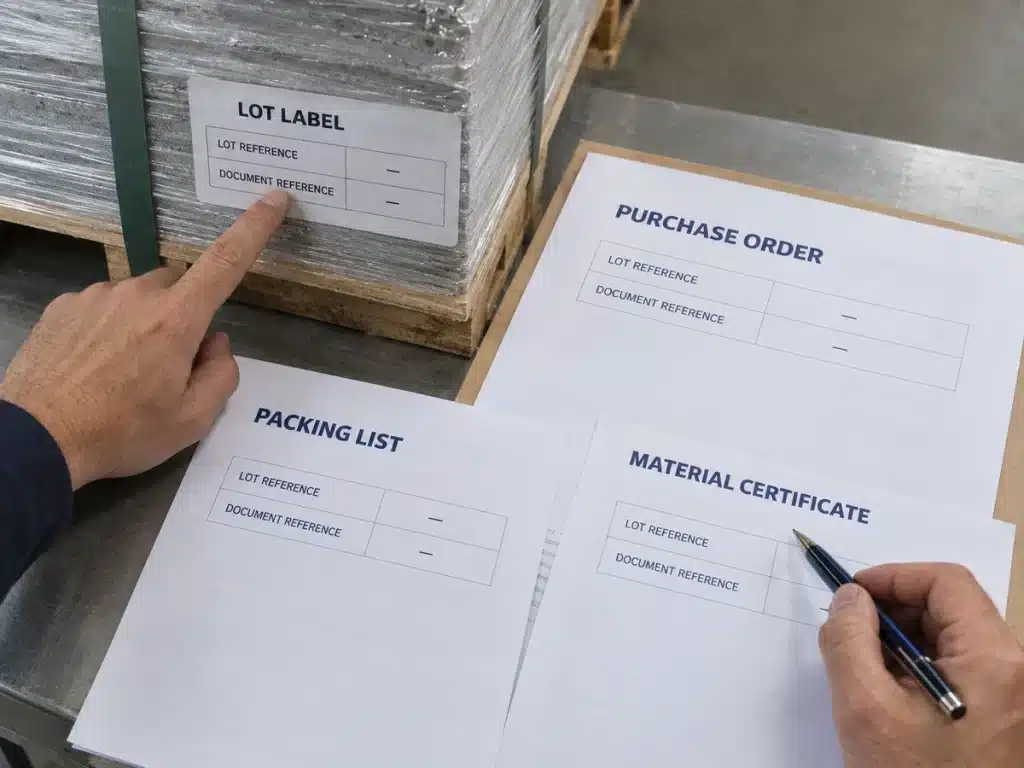
- Confirm that certificates of conformity, test reports, safety data, declarations, and other required documents are present.
- Match each document to the exact product, model, grade, lot, batch, heat, date, and specification or standard stated in the order.
- Check that drawings, submittals, samples, and change notices are the current approved revisions.
- Record missing, illegible, inconsistent, expired, or unmatched documents as open findings.
- Capture lot numbers, batch codes, heat numbers, serial numbers, manufacturing dates, and shelf-life dates from both material and labels.
- Preserve the link between supplier documents, the physical lot, the inspection record, storage location, and later production use.
Packaging Transport and Storage Condition
- Photograph crushed cartons, broken seals, water entry, exposed surfaces, unstable pallets, contamination, or handling damage before unpacking.
- Inspect internal protection, separators, corner guards, wrapping, desiccants, restraints, and contact points on representative packages.
- Confirm labels remain legible and match the package contents, lot, quantity, handling direction, and storage requirement.
- Check temperature indicators, moisture indicators, shock indicators, or seal records when the order requires them.
- Identify materials that need controlled temperature, humidity, ventilation, shelf-life rotation, isolation, or protection from deformation.
- Use the building materials packing and labeling guide when package identity and protection must remain coordinated through later handling and delivery.
Visual Dimensional and Functional Checks
- Verify material identity before judging appearance or measurements.
- Inspect surfaces, edges, corners, joints, coatings, interfaces, concealed areas, and protected faces made accessible during unpacking.
- Describe cracks, chips, dents, scratches, corrosion, stains, warping, contamination, missing parts, and poor workmanship in measurable terms.
- Compare color, sheen, grain, texture, pattern, profile, or workmanship with the controlled sample or approved range under consistent conditions.
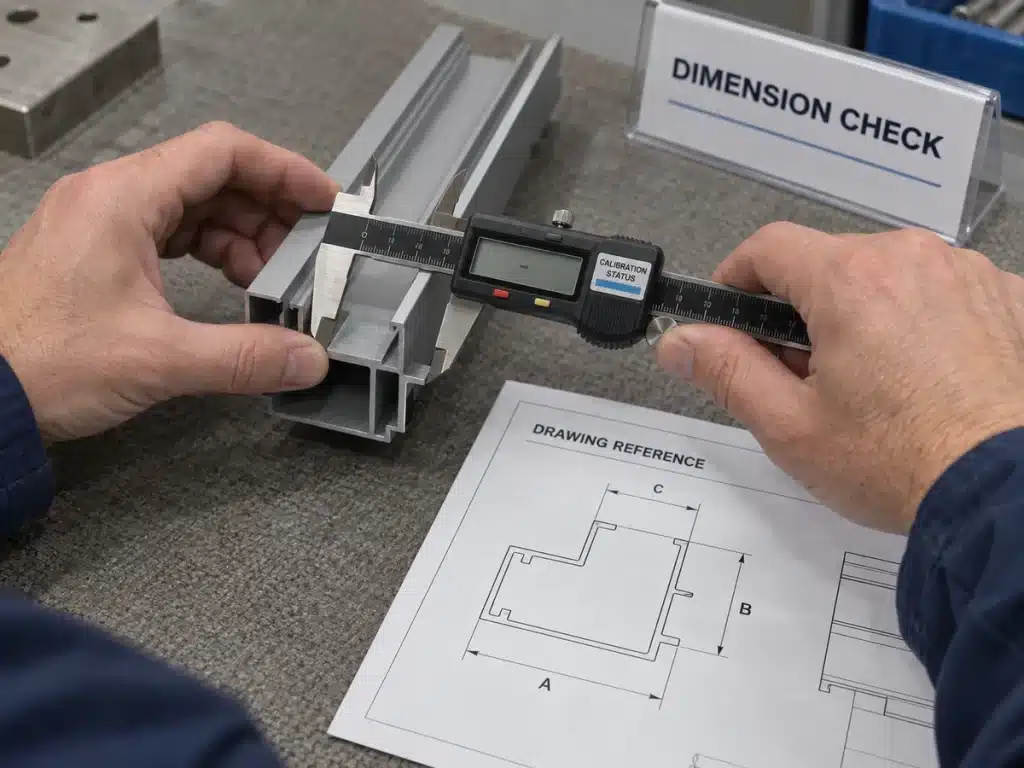
- Measure critical dimensions at defined locations from the correct datum and record actual values, units, tolerances, and instrument IDs.
- Perform safe functional or fit checks only when the approved method requires them and the check will not damage the item.
- Treat an uncertain method, unsuitable instrument, unclear datum, or uncontrolled condition as not verified rather than rounding the result into compliance.
Sampling and Test Control
- Define the lot, selection method, sample size, acceptance rule, and any switching or escalation rule before selecting samples.
- Select samples without supplier bias and keep each sample traceable to its carton, pallet, batch, heat, or serial reference.
- Use full inspection for characteristics that the approved risk assessment or requirement identifies for complete verification.
- Keep visual, dimensional, functional, and laboratory results separate because one test type does not prove the others.
- Identify destructive tests in advance, including the sample quantity, authorization, replacement responsibility, and post-test disposition.
- When sampled results are inconsistent, preserve the original evidence and expand, segregate, or escalate only under an approved rule.
Nonconformance Disposition and Release
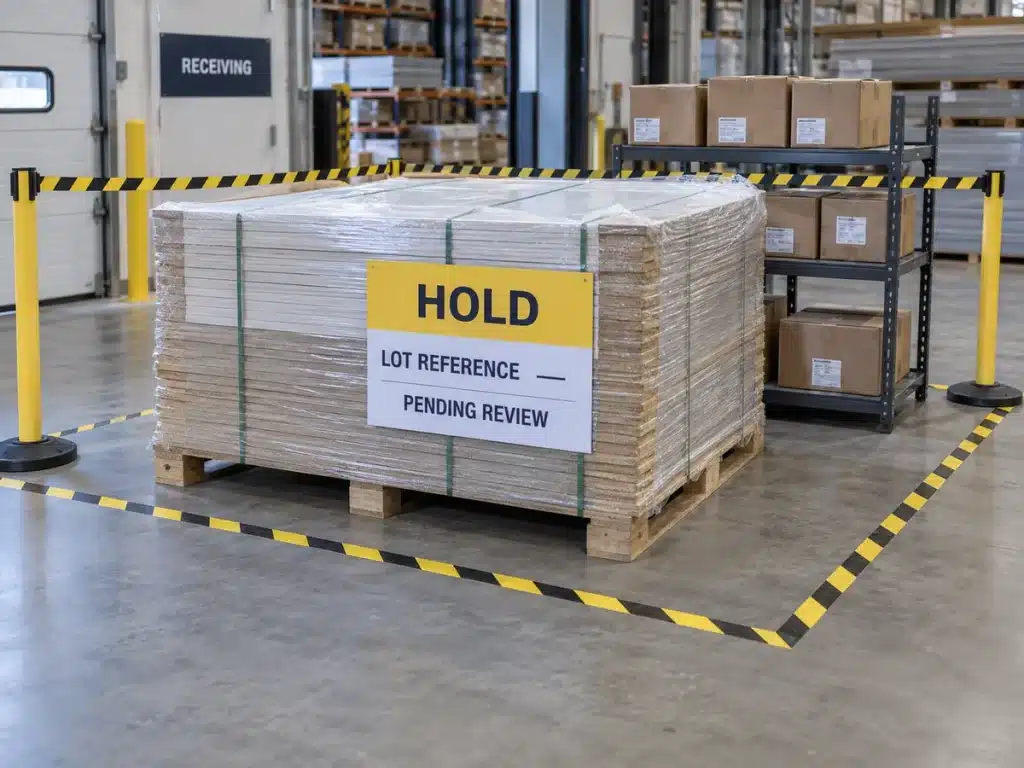
- Place unverified or failed material in a clearly marked physical or electronic hold status immediately.
- Record the exact requirement, actual condition, measurement, affected lot, suspected quantity, evidence, and date.
- Separate accepted, rejected, pending, and conditionally accepted material so status is visible to production and stores personnel.
- Issue a nonconformance report when formal tracking, supplier response, engineering review, or corrective action is required.
- Record the authorized disposition as release, rework, return, replacement, sorting, rejection, or approved use as is.
- For rework or sorting, define the instruction, owner, due date, evidence, and reinspection scope.
- Do not use supplier replacement or an informal message to overwrite the original failed result.
- Release the lot only after required findings, documents, tests, and approvals are complete or formally controlled as open conditions.
Inspection Record and Supplier Follow Up
- Sign or authenticate the report with the inspector, reviewer, decision authority, and relevant dates.
- Attach photographs, measurements, certificates, test reports, nonconformance records, approvals, and reinspection evidence.
- Connect the released quantity to the storage location, internal issue record, production batch, work order, and later traceability record.
- Track recurring defects, document gaps, response time, lot acceptance, and defects found after release by supplier and material type.
- Adjust future inspection frequency or supplier controls through a documented risk review rather than an informal assumption.
- Retain superseded requirements and earlier results when they explain the decision trail; do not replace history with the latest status only.
How to Set Inspection Criteria Before Delivery
Define the Lot and Risk Category
A lot must be specific enough that the sample and disposition apply to a known group of material. Separate receipts when different suppliers, factories, production dates, heats, batches, processes, or transport conditions could hide variation. Supplier history should influence inspection intensity, but it should not replace acceptance criteria. Use the building material supplier audit checklist to assess system-level capability separately from the decision on an individual incoming lot.
Increase control when the supplier is new, the material or process changed, the lot has mixed traceability, defects are difficult to detect later, or failure could affect safety, fit, function, appearance, schedule, or replacement cost. The project or factory procedure should define who can change the risk category and what evidence supports the change.
Translate Controlled Documents Into Measurable Checks
Turn every relevant requirement into a characteristic, method, tolerance or acceptance statement, sample rule, evidence field, and decision consequence. A technical submittal checklist helps identify the exact product and supporting documents, while the material sample approval form identifies the controlled visual or physical reference.
The building material ITP template can connect incoming inspection to later production, test, hold, witness, and release points. Do not ask the inspector to decide whether material is simply good quality. State what must be observed or measured and what result requires a hold.
Assign Decision Authority
Receiving staff may confirm quantity and packaging, quality staff may perform measurements, and engineering may review a technical deviation. The procedure should still name one authorized route for final release or disposition. Silence, production urgency, or material movement does not constitute approval.
Factory Incoming Inspection Workflow
Step 1 Hold and Identify the Lot
Place the receipt in a defined pending-inspection status. Confirm package count, visible transport condition, product identity, batch or lot references, and the internal receipt number before material is mixed with accepted stock.
Step 2 Review Documents and Inspection Readiness
Gather the current purchase order, drawings, specifications, submittals, samples, certificates, test requirements, and inspection plan. Resolve conflicting revisions and missing acceptance criteria before the inspector starts the affected check.
Step 3 Select Traceable Samples
Apply the approved selection method across the defined lot. Record the carton, pallet, batch, heat, serial, or other identity for each sample so the result can be connected to the material and any later corrective action.
Step 4 Inspect Measure and Test
Verify identity first, then condition, workmanship, dimensions, function, or laboratory evidence as required. Record actual results rather than pass only, especially for critical or disputed characteristics.
Step 5 Record Findings and Disposition
Separate conforming results from nonconformities and document each finding against the requirement. Assign the lot status, action owner, due date, closure evidence, and authorized decision route.
Step 6 Release Store and Trace
Release only the identified quantity covered by the decision. Update labels and electronic status, move material to the approved storage condition, and connect the inspection record to production use. For multi-category project packages, project material coordination helps keep product references, approvals, packing, and delivery records connected.
Sampling and Test Decisions
Sampling reduces inspection effort but does not prove that every uninspected unit conforms. The plan must define the lot, random or stratified selection method, sample size, defect classes or measurable criteria, and acceptance rule before the inspection. The AQL sampling plan for building materials explains how AQL-indexed plans should be documented without treating AQL as a guaranteed defect percentage.
| Condition | Possible approach | Required control |
| Critical identity or safety characteristic | Complete verification or another approved high-control method | State the requirement, method, authority, and consequence of one failure. |
| Stable repetitive lots from a controlled process | Defined acceptance-sampling plan | Use the stated standard and edition, lot definition, selection method, sample size, and accept or reject numbers. |
| Mixed batches or uncertain traceability | Stratify by batch or hold pending clarification | Do not let one combined sample hide a different process, date, heat, or supplier source. |
| Destructive or laboratory property | Planned sample sent to a qualified internal or external test route | Identify sample custody, method, report applicability, authorization, and remaining lot status. |
| Inconsistent sample results | Defined expanded inspection, segregation, or technical review | Retain the original results and document why the next inspection stage was selected. |
If an ISO 2859-1 sampling scheme is used, identify the edition and apply it through the organization’s approved procedure. The current ISO 2859-1:2026 covers AQL-indexed lot-by-lot inspection by attributes, but it does not choose the product-specific risk tolerance or define which characteristics are critical.
Handling Nonconforming Incoming Materials
Quarantine the Lot
Apply a visible hold tag, segregated location, blocked inventory status, or another controlled method that prevents production use. The status should show the lot or receipt reference, quantity, reason, date, and responsible owner. A report marked hold is ineffective if the material remains available for issue.
Write an Objective Nonconformance Record
State the unmet requirement and revision, actual condition or measurement, affected and suspected quantity, sample basis, photographs, immediate containment, and required response. Avoid vague descriptions such as poor quality or unacceptable. A reader who did not inspect the material should be able to understand the difference.
Control Disposition and Reinspection
Only the assigned authority should approve release, use as is, rework, sorting, return, replacement, or rejection. Rework and sorting require instructions and reinspection against the same acceptance basis. Supplier replacement closes the commercial shortage only after the replacement lot completes its required incoming checks.
Minimum Incoming Inspection Report Fields
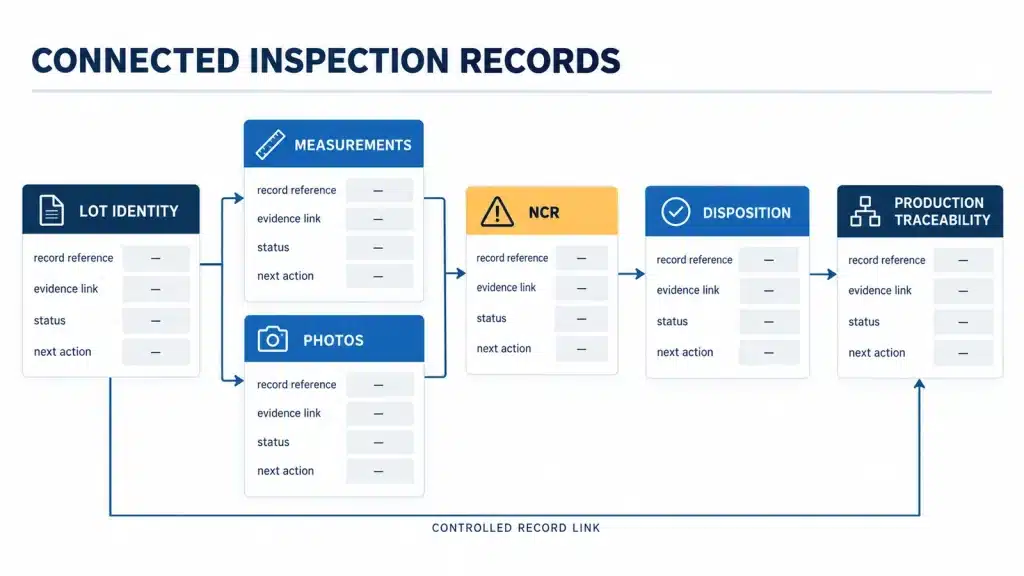
The report should contain enough information for another qualified person to reconstruct what was received, checked, found, and decided.
| Record group | Minimum fields |
| Receipt identity | Supplier, factory, purchase order, delivery note, receipt date, report number, inspector, and receiving location. |
| Material and lot | Item code, description, model or grade, quantity, lot, batch, heat, serial, manufacture date, shelf life, and internal ID. |
| Acceptance basis | Current purchase order, drawing, specification, technical submittal, approved sample, ITP, checklist, and revision. |
| Sampling and method | Lot definition, selection method, sample size, inspection or test method, instruments, conditions, and limitations. |
| Results and evidence | Characteristic, requirement, actual result, status, photographs, certificate or test-report reference, and attachment link. |
| Nonconformance and disposition | Finding ID, affected quantity, containment, action, owner, due date, approval, reinspection, closure evidence, and released quantity. |
| Traceability and follow up | Storage location, production issue or work order, supplier notification, corrective action, and trend or KPI category. |
Common Incoming Inspection Mistakes
- Starting the inspection without a clear lot definition or current controlled references.
- Using generic terms such as acceptable appearance without an approved sample, range, limit, or method.
- Accepting a supplier certificate that cannot be matched to the received product and lot.
- Letting the supplier select only convenient or good-looking samples.
- Choosing the sample size or AQL after defects are seen.
- Recording only pass or fail instead of actual values and objective evidence.
- Rounding borderline measurements into compliance or using an instrument that cannot resolve the tolerance.
- Failing to segregate unverified material while a document or technical decision remains open.
- Treating approved with comments or use as is as undefined informal statuses.
- Closing the original record when replacement material arrives instead of inspecting the replacement as a new lot.
- Tracking an overall supplier average that hides repeated defects in one material, process, factory, or batch.
Frequently Asked Questions
What Is a Factory Incoming Material Inspection Checklist?
It is a controlled record used to verify purchased raw materials, components, or assemblies when they arrive at a factory and before production use. It links the physical lot to purchase requirements, technical references, inspection results, evidence, and release or hold status.
When Should Incoming Inspection Take Place?
Perform it after receipt and before the material enters unrestricted storage or production. Document review, criteria, sampling, equipment preparation, and inspection authority should be established before the delivery arrives.
Is Incoming Inspection the Same as Pre Shipment Inspection?
No. Incoming inspection checks material received for use in production. Pre-shipment inspection checks finished goods, quantities, accessories, packing, and documents before dispatch. One does not replace the other.
What Should Be Checked First?
Start with receipt identity, package count, lot or batch information, visible transport condition, and document readiness. Confirm the correct material and controlled references before performing detailed visual, dimensional, functional, or laboratory checks.
How Is Sample Size Chosen?
Use the approved risk and sampling procedure for the defined lot. Consider characteristic criticality, lot structure, supplier and process history, detectability, test type, and the consequence of a missed defect. Define the rule before selecting samples.
What Happens When Incoming Material Fails Inspection?
Place the affected lot on hold, record the requirement and objective evidence, contain the suspected quantity, notify the responsible parties, and obtain an authorized disposition. Rework, sorting, replacement, or additional tests require documented closure and reinspection where applicable.
Are Supplier Certificates Enough?
Not by themselves. A certificate supports the record only when it matches the exact received product and lot and covers the required characteristic. Identity, quantity, condition, dimensions, packaging, traceability, and other specified checks may still be required.
Which Records Should Be Retained?
Retain the purchase and delivery records, controlled technical references, sample plan, measurements, instrument IDs, test reports, certificates, photographs, nonconformance records, decisions, reinspection evidence, released quantity, and traceability to storage and production use.
Conclusion
A reliable factory incoming material inspection checklist turns purchase and technical requirements into repeatable checks before materials enter production. It identifies the lot, uses current references, records objective results, controls uncertainty, and gives each release or rejection decision a traceable owner.
For building material orders that also require supplier-side product inspection and packing coordination, review Skyland Building’s Inspection and Packing service. To discuss the product schedule, approved references, inspection scope, packing requirements, or delivery plan, contact Skyland Building.
Technical References
- ISO 2859-1:2026 – Official reference for AQL-indexed lot-by-lot sampling procedures by attributes.
- NIST Metrological Traceability – Reference for traceability through a documented chain of calibrations.