A practical form for identifying physical samples, recording review decisions and keeping approved references connected to procurement and production
A material sample approval form records exactly which physical or controlled sample was reviewed, what characteristics it represented, which decision was returned and whether a separate release is still required. The form is useful only when the sample ID, product reference, location, revision, reviewer comments and retained control sample can all be traced to the same record.
This guide explains the form fields, sample numbering, review statuses, revision rules and a filled example. It is part of Skyland Building’s Drawings and Approvals resource hub. The accompanying Excel workbook includes a printable approval form, a sample register, a review and action log, controlled dropdowns, examples and a dashboard.
Written by Winston
Project Director at Skyland Building · 10+ Years of Building Materials Experience
Updated September 2026 · 18-minute read
Key Takeaways
- Use one unique sample ID and revision across the form, physical label, photographs, register, comments and retained sample.
- State what the reviewer is being asked to confirm. Appearance, technical compliance, commercial acceptance and production release are different decisions.
- Record the exact product, finish, color or pattern, size, supplier, intended location and applicable drawing or schedule reference.
- Keep the review status separate from the release status. An approved sample may still be waiting for dimensions, quantities, price, technical evidence or another project authorization.
- Preserve rejected and superseded revisions. Do not overwrite the decision trail when a sample changes.
- Retain a control sample or agreed range reference where the project needs a physical benchmark for production, inspection or installation.
- Use the project contract and approved procedure to define status terms, authority and release consequences. The template does not create contractual approval rights.
What a Material Sample Approval Form Records
A material sample approval form is the controlled record for one sample submission and its review. It connects a physical item or finish reference to a project, product, location, current documents, reviewer comments, formal status and any required follow-up. The completed form should let a procurement, factory, inspection or site team identify the current decision without reconstructing an email chain.
The form complements a broader material sample approval process. The process defines the route and responsibilities for many submissions. The form records one submission. The register then summarizes the current status of all forms. Keeping those three levels separate reduces duplicated data and makes revisions easier to control.
Form Register and Physical Sample
| Record | Primary purpose | Key control |
|---|---|---|
| Approval form | Documents one submitted sample, its review scope, comments, decision and release information | Issue a new revision when the proposed sample or decision basis changes |
| Sample register | Shows the current status, owner and due date for many sample records | Use the form ID and current revision as the register key |
| Physical sample | Demonstrates the characteristics visible or measurable from the submitted item | Apply a durable label that matches the form and register |
| Control sample or range | Provides a retained comparison reference for later production or inspection | Record custody, storage location and accepted variation |
What Sample Approval Can and Cannot Confirm
The form must describe the decision scope. A physical sample may demonstrate color, grain, texture, sheen, pattern, profile, edge treatment, workmanship or a stated dimension. It does not automatically prove code compliance, structural capacity, fire performance, emissions, durability, warranty coverage, compatibility with adjacent work or conformity of every production unit.
Product data, calculations, certificates, test reports and project-specific drawings answer different questions. Where the same custom item also requires dimensional and interface review, connect the sample record to the applicable shop drawing approval process instead of treating the finish decision as approval of the complete manufactured item.
When to Use Formal Sample Approval
Require a controlled form when a material decision can affect visible design quality, repeated finishes, custom production, interfaces, replacement matching, project cost or the construction programme. The project procedure should identify which items need a physical sample, a range set, a mock-up, product data only or another review route.
- Custom cabinetry, doors, furniture or metalwork with project-specific finishes.
- Tile, natural stone, timber and other products with visible batch or natural variation.
- Materials repeated across rooms, apartments, elevations or project phases.
- Proposed substitutions, changed manufacturers, revised colors or alternative constructions.
- Products for which procurement or production depends on a dated finish decision.
- Mock-ups or first-off units that will become the benchmark for later work.
Material Sample Approval Form Fields
The template separates submitter information, reviewer information and release information. This prevents a supplier description from being mistaken for a reviewer decision and prevents an approval status from being treated as an automatic instruction to start production.
| Field group | Recommended fields | Why it matters |
|---|---|---|
| Project and package | Project name, location, client or contract reference, work package and responsible organization | Places the submission in the correct project and scope |
| Submission control | Sample ID, submission number, revision, record status, submission date and required response date | Creates a searchable and revision-controlled record |
| Product identity | Category, item description, manufacturer, supplier, product or finish code and proposed alternative | Connects the sample to quotation, schedule and purchase information |
| Application | Room, zone, elevation, item mark, quantity basis and intended use | Defines where the reviewed sample may apply |
| Physical sample | Sample type, dimensions, label, counterpart count, photograph reference, batch or lot reference | Identifies the item actually reviewed |
| Appearance | Material, substrate, color, pattern, grain, texture, sheen, edge and expected variation | States which visible characteristics need a decision |
| Governing references | Specification, finish schedule, drawing, BOQ or material schedule, RFI and approved design reference with revisions | Shows the comparison basis used for review |
| Supporting evidence | Product data, test or compliance documents, drawings, certificates, installation information and mock-up references | Separates visual review from other required evidence |
| Review request | Requested decision, characteristics in scope, characteristics excluded and named decision authority | Prevents a limited review from being interpreted too broadly |
| Decision | Reviewer, organization, review date, status, consolidated comments and resubmission requirement | Records the formal response and unresolved work |
| Action control | Action, owner, due date, response, evidence and closure status | Keeps comments connected to verifiable follow-up |
| Release control | Release status, released scope, conditions, release authority and release date | States whether a separate next action may proceed |
| Control sample | Retained sample ID, custodian, storage location, accepted range and transfer record | Preserves the comparison reference for production and inspection |
| Revision relationship | Supersedes, superseded by, reason for revision and distribution list | Keeps obsolete references out of active use without deleting history |
Minimum Useful Record
For a small project, the minimum useful record is the project and package, unique sample ID, revision, exact product and finish, intended location, physical sample description, current reference documents, review scope, reviewer, decision status, comments, date and separate release status. If any of these details exist only in filenames or messages, they are likely to become detached from the sample.
Download the Material Sample Approval Form
XLSX template: printable approval form, sample register, review and action log, controlled status dropdowns, category guidance and dashboard.
Free download. No email required. Replace or delete the example records before project use.
How to Complete the Form
- Define the requested decision. State whether the reviewer is assessing color, texture, sheen, pattern, edge, workmanship, a range of variation or another clearly observable characteristic.
- Assign the identifier and revision. Use the same sample ID on the form, sample label, register, photograph and every response file. Start a new revision when the product, finish, location, scope or supporting basis changes.
- Identify the exact product. Record manufacturer, supplier, product code, finish code, substrate, size and any proposed substitution. Avoid category-only descriptions such as stone, tile or timber.
- Connect the intended application. List the room, elevation, area, item mark or repeated unit type to which the decision applies. Identify exceptions rather than implying that one sample applies everywhere.
- Reference current project information. Use the applicable drawing, finish schedule, specification, BOQ or product schedule revision. Mark missing information as pending instead of silently assuming it.
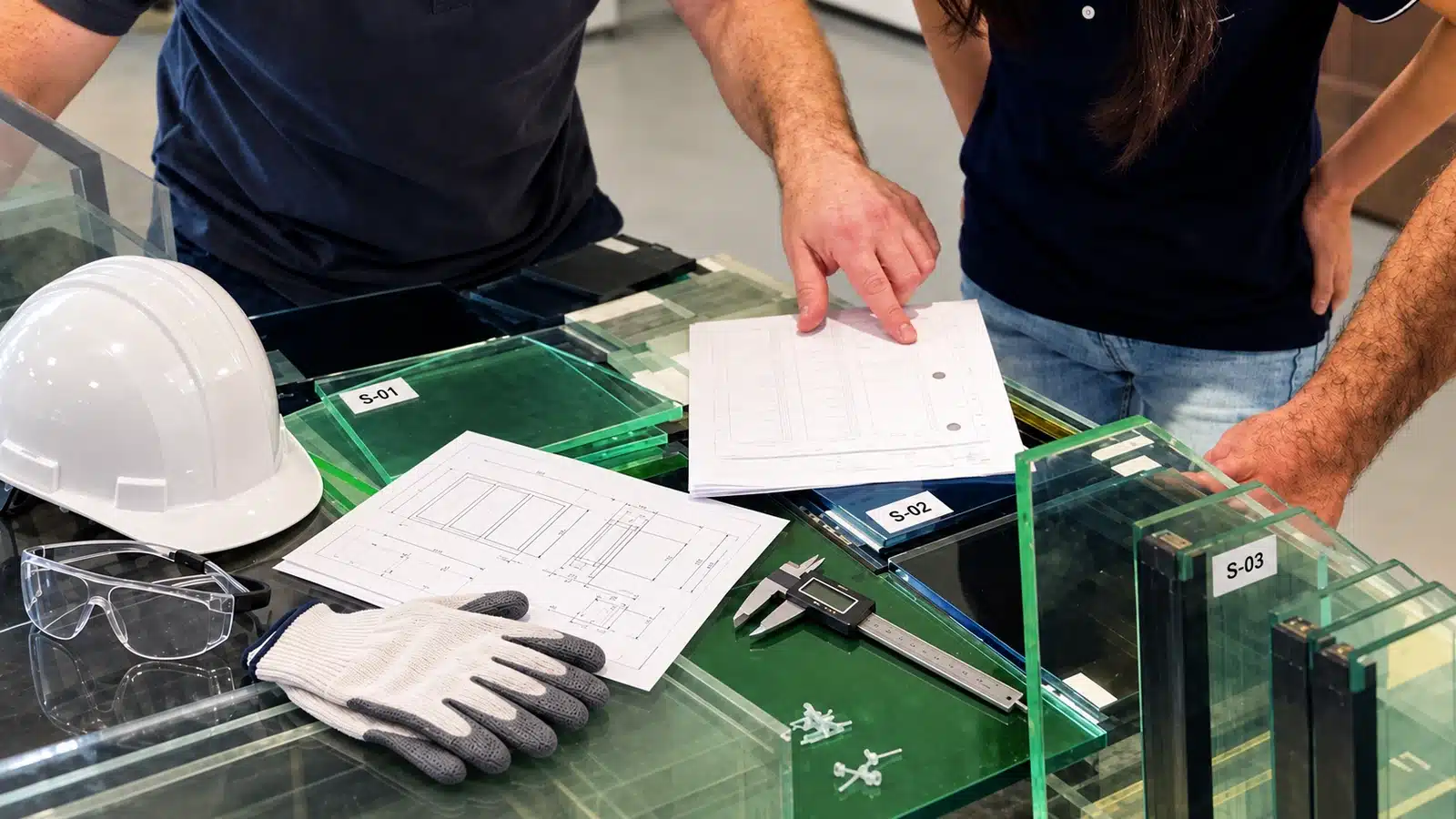
- Label and photograph the physical sample. Show the sample ID and revision on a durable label. Photograph the complete item and label, but retain the physical sample when screen color or scale is unreliable.
- Record one consolidated response. Combine comments from the authorized review route into one formal status. Assign each required action and state whether resubmission is necessary.
- Control release and retention. Record the permitted next action separately from the review status. Retain the approved control sample or range, communicate its location and withdraw superseded references from active use.

Sample Identification and Revision Control
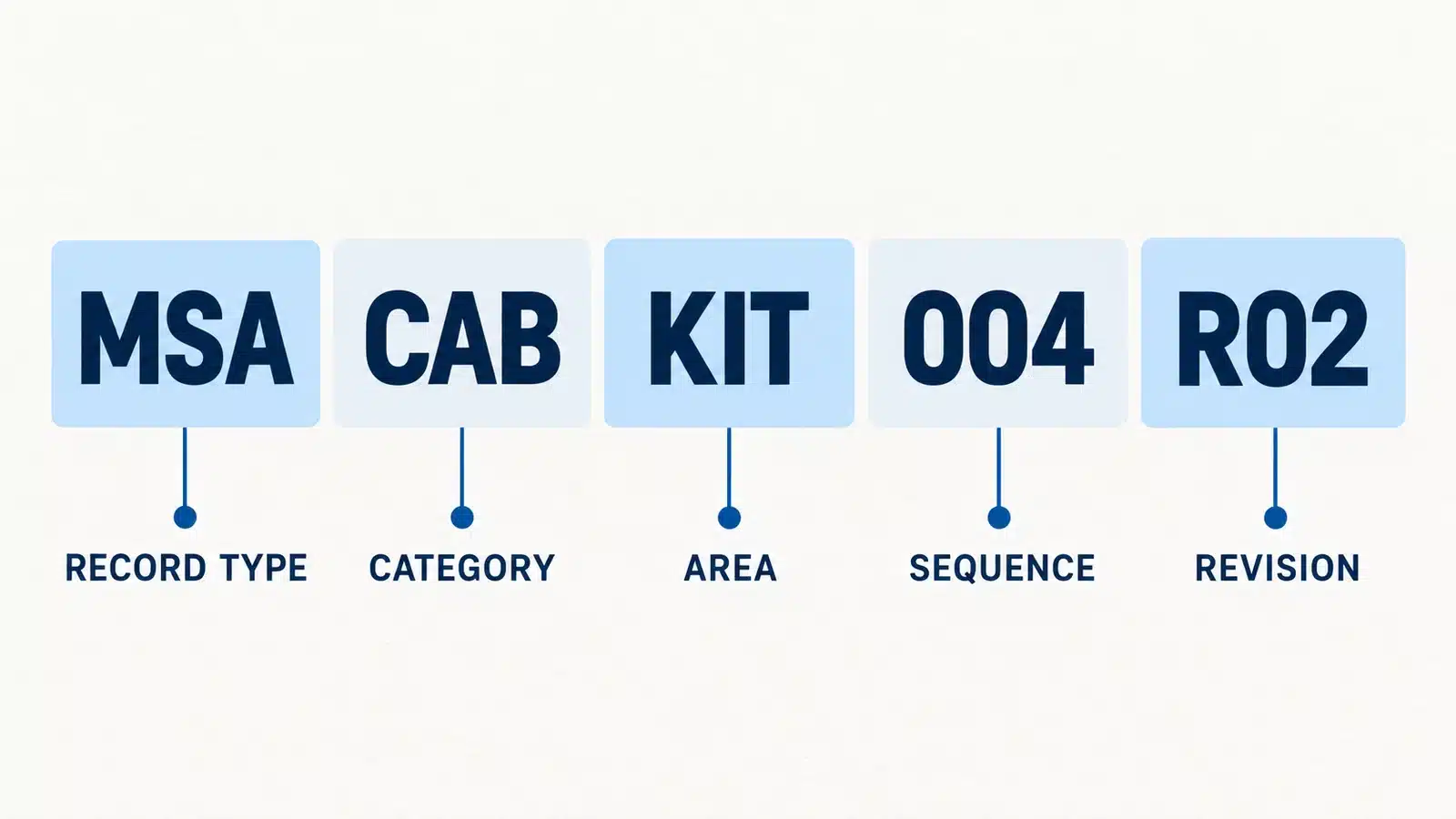
A sample ID should be short enough to place on the physical item and stable enough to remain useful across the form, register and document repository. The project can combine a document type, category, area, sequence and revision. There is no universal coding format, so the project naming procedure remains controlling.
| Example segment | Illustrative value | Meaning |
|---|---|---|
| Record type | MSA | Material sample approval |
| Category | CAB | Cabinetry package |
| Area | KIT | Kitchen area |
| Sequence | 004 | Fourth sample record in the selected series |
| Revision | R02 | Second controlled revision |
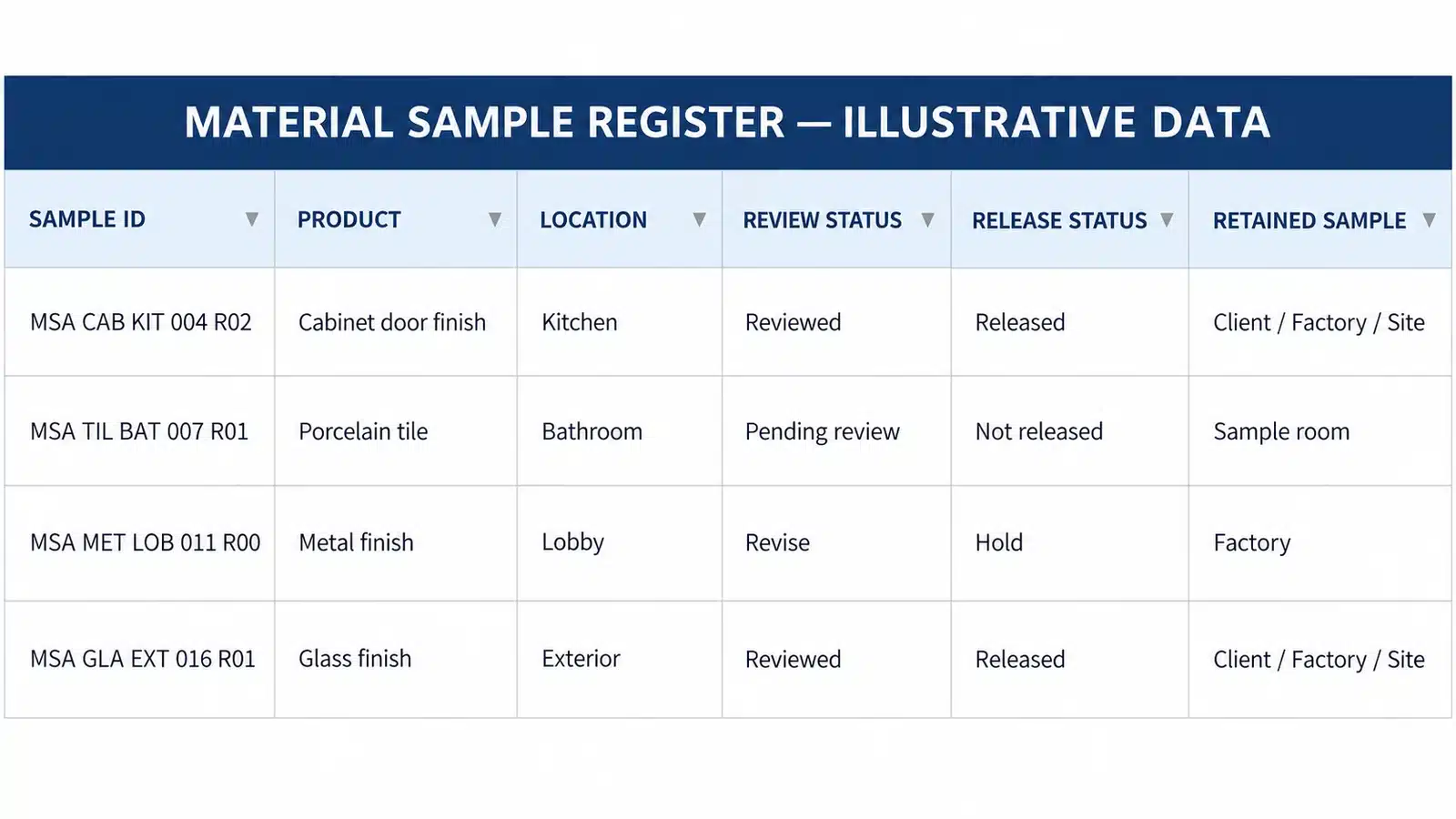
Illustrative code: MSA-CAB-KIT-004-R02. Record the reason for each revision and link it to the earlier submission. A new photograph or replacement sample should not inherit an old approval unless the authorized project route confirms that it represents the same accepted reference.
Approval Status and Release Status
Projects use different words, codes and consequences. Define each status before submissions begin. The table below is a working example only. The contract and approved procedure must state whether a status permits procurement, sample reproduction, limited fabrication, full production, shipment or installation.
| Example status | Working meaning | Required control |
|---|---|---|
| Draft | The submitter is preparing the record | Complete internal checks before formal submission |
| Submitted | The package has entered the controlled review route | Confirm receipt, reviewer and due date |
| Under Review | The decision is pending | Do not infer acceptance from elapsed time or informal comments |
| Approved | The submission is accepted within the recorded scope | Confirm the exact revision and any separate release gate |
| Approved with Comments | The decision includes stated conditions | Assign and close each condition; confirm whether resubmission or limited progress is allowed |
| Revise and Resubmit | Changes or additional evidence are required | Issue a new controlled revision and preserve the earlier record |
| Rejected | The proposal is not accepted for the stated application | Select or develop an alternative and use the normal review route |
| Superseded | A later controlled record replaces this revision | Remove obsolete references from active procurement and production use |
The Excel template therefore contains a separate release field. A sample can be approved for appearance while the next action remains not released because a drawing, quantity, technical document, price or commercial condition is unresolved. This separation is one of the most important controls in the workbook.
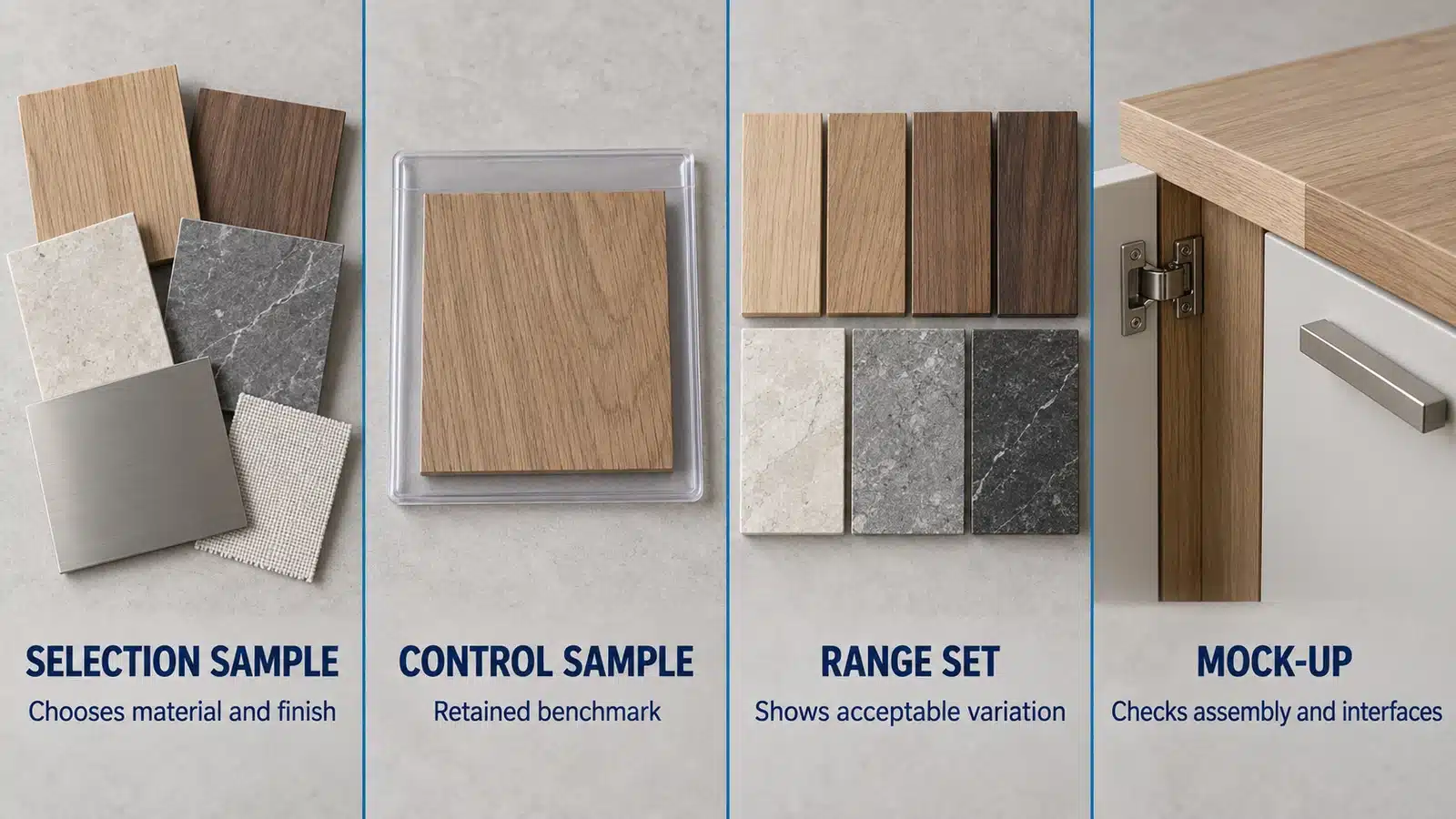
Selection Samples Range Samples and Control Samples
| Sample type | Primary use | Control requirement |
|---|---|---|
| Selection sample | Helps the team choose among proposed options | Do not treat a shortlisted option as the production reference |
| Approved control sample | Provides the retained reference for the characteristics within the approval scope | Record custodian, storage location, ID, revision and any accepted variation |
| Range sample or set | Shows acceptable natural or manufactured variation | Define which characteristics and limits the set represents |
| Mock up or first off | Shows scale, assembly, interfaces, workmanship or repeated production quality | State whether it is retained, incorporated into the work or replaced by another benchmark |
| Counterpart sample | Provides a corresponding reference at the client, contractor, factory or site | Label every counterpart and record where it is held |
Filled Material Sample Approval Form Example
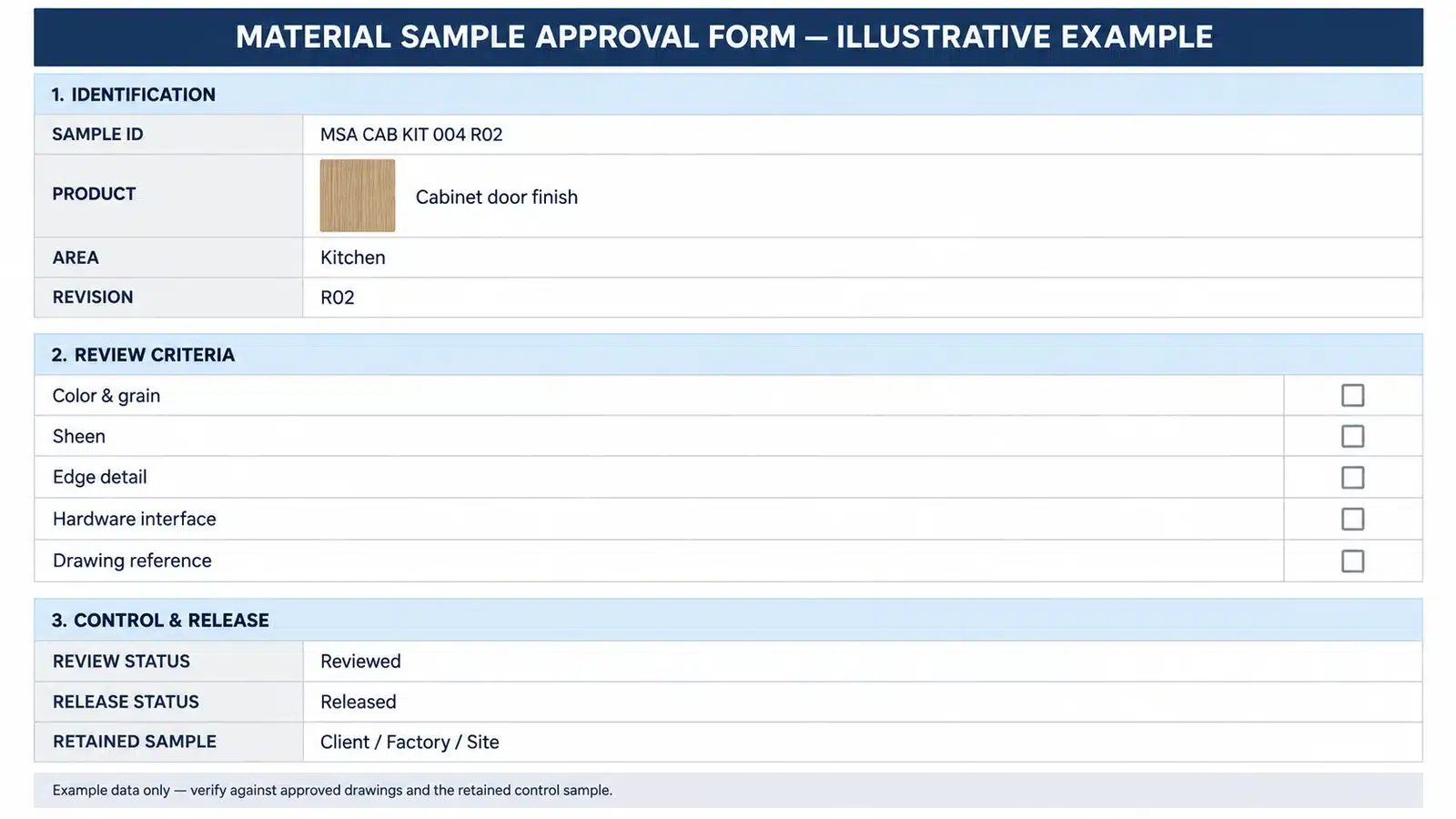
The example below shows how the fields relate. It is training data, not an issued project decision. Replace it with the project’s actual identifiers, documents, authority and status definitions.
| Form field | Illustrative entry |
|---|---|
| Record type | Example |
| Sample ID and revision | EX-MSA-CAB-KIT-004-R02 |
| Package | Kitchen cabinetry finish sample |
| Product identity | Oak veneer door panel on the proposed project substrate |
| Location | Illustrative kitchen type A |
| Characteristics in scope | Color direction, grain sequence, sheen and exposed edge treatment |
| References | Current project finish schedule and cabinet elevation to be inserted |
| Sample type | Range set with one proposed control sample |
| Supporting evidence | Labeled photographs, product data and finish reference |
| Review status | Approved with Comments as an illustrative training value only |
| Comments | Retain the accepted range set; show panel sequence in the next drawing revision |
| Release status | Not Released until the project records the required drawing and quantity decisions |
| Storage | Insert actual custodian and controlled storage location |
Using the Form for Different Material Categories
The core form can stay consistent while the review criteria change by product. For custom cabinetry and wardrobe packages, the record may focus on substrate, veneer or paint, sheen, grain direction, exposed edges and cabinet marks. For architectural ceramics, it may focus on collection, shade, caliber, finish, format, joints and batch range. For sintered stone slabs, it may also connect the slab image, pattern or vein direction, finish, thickness, fabrication layout and acceptable range.
| Category | Typical characteristics | Useful linked reference |
|---|---|---|
| Cabinetry and millwork | Substrate, veneer or laminate, color, sheen, grain direction, edge and panel sequence | Cabinet mark, room, elevation and approved finish code |
| Tile and ceramic surfaces | Collection, finish, format, shade, caliber, pattern, joint and trim | Area schedule, batch reference and layout direction |
| Natural or sintered stone | Slab reference, color or vein range, finish, thickness, edge and layout | Slab map, dry lay, room or elevation and fabrication drawing |
| Flooring | Species or decor, color range, texture, sheen, board size, grade and transition | Room, batch, laying direction and control board |
| Metal finishes and fixtures | Base metal, coating or plating, color, gloss, texture and visible component | Item code, mounting location, accessory set and counterpart sample |
| Soft finishes and furniture | Fabric or leather reference, dye lot, texture, pattern repeat, seam and edge detail | Furniture mark, room, range set and cleaning requirement |
Comments Actions and Resubmissions
A useful review comment names the affected characteristic or location, the observed difference, the required action, the responsible party and the evidence needed for closure. General comments such as revise, improve color or match design do not give the supplier a repeatable correction target.
- Keep the original reviewer comment visible and record the submitter response beside it.
- Assign one owner and due date to every blocking action.
- Identify the replacement sample or revised document that closes the comment.
- State whether the response requires a new physical sample, a document update or both.
- Do not edit the earlier status after resubmission. Link the new revision to the prior record.
- Keep contradictory reviewer comments out of the supplier instruction until the authorized coordinator resolves them.
Control Samples Production and Inspection
After the formal decision, identify which physical reference will be retained, who controls it and where it can be inspected. Where counterparts are held at different locations, label them as related samples and record any known limitation. Do not assume that two separately produced pieces are identical simply because they share a code.
Transfer the approved sample ID, revision, finish code, location and remaining conditions into the purchase order, production file and agreed inspection records. A pre-shipment inspection checklist is more reliable when the inspector can compare the product and packing references with the controlled sample record rather than an unlabeled image or informal message.
Common Material Sample Approval Form Mistakes
| Mistake | Why it causes problems | Better control |
|---|---|---|
| Using a description without a product or finish code | The approved sample cannot be matched confidently to purchasing or production | Use one stable identity across form, label, schedule and order |
| Leaving the intended location blank | A limited decision may be applied to unsuitable areas | Record room, elevation, item mark or repeated unit type |
| Treating a photograph as the physical reference | Screens and lighting may change color, texture and sheen | Retain a physical sample when the decision requires it |
| Combining status and production release | A visual approval may trigger premature ordering or fabrication | Use separate review and release fields |
| Using undefined approved with comments wording | Teams cannot tell whether action or resubmission is required | Define the status and record every condition |
| Overwriting rejected or superseded records | The revision and decision trail disappears | Create a new revision and preserve prior evidence |
| Failing to identify natural or batch variation | One small piece is treated as a guarantee of identical production | Use a range set, slab selection or project-defined variation criteria |
| Losing the retained control sample | Factory and site teams cannot compare later work with the reviewed reference | Record custodian, location, transfer and counterpart IDs |
| Using invented or generic compliance claims | The form overstates what was checked | Link only evidence that applies to the exact product and configuration |
How Skyland Supports Drawing and Sample Coordination
Skyland Building’s Drawing and Sample Coordination service can help organize available drawings, finish references, physical samples, review comments, revisions and release status for selected building material categories. The service scope depends on the project information and agreed responsibilities. Final design approval, local compliance and contractual release authority remain with the parties assigned by the project.
To review a project sample schedule, send your drawings, finish schedule, BOQ or product list. Include the project location, selected material categories, current revisions, required approval dates and the parties authorized to comment and release the next stage.
Conclusion
A useful material sample approval form gives every decision a stable identity. It connects the physical sample to the exact product, location, current project references, review scope, formal status, open actions, retained control sample and permitted next step. The separate release field prevents a finish approval from being interpreted as blanket permission to order, fabricate, ship or install.
Keep the form simple enough to complete, specific enough to support a decision and controlled enough to preserve its history. If the project team cannot answer which sample, which revision, which location, which characteristics and which release were approved, the record is not yet complete.
Frequently Asked Questions
What is a material sample approval form
It is a controlled record used to identify a proposed material or finish, link it to project requirements, collect reviewer comments and record a decision for a defined scope.
What is the difference between a sample form and a sample register
The form contains the complete record for one submission. The register summarizes identifiers, current revisions, owners, dates, statuses and next actions across many forms.
Does an approved sample confirm technical compliance
Not automatically. The decision covers only the characteristics and scope stated on the form. Specifications, product data, calculations, certificates, testing, shop drawings and inspections may still be required.
Does sample approval release production
Only when the project procedure and the recorded release field permit that action. A sample can be approved while production remains on hold for technical, commercial, quantity or drawing decisions.
What should approved with comments mean
It should mean only what the project procedure defines. The record must list the conditions, action owner, due date, resubmission requirement and whether any next action may proceed.
When should a range sample be used
Use a range set when the material has meaningful natural or manufactured variation that one small piece cannot represent. State which variation the set demonstrates and retain the agreed reference.
How should physical samples be labeled
Use the project, sample ID, revision, product or finish code and intended location where practical. The label, form, photograph and register should use the same identifier.
What happens when a sample is rejected
Record the reason and affected requirement, retain the rejected revision, assign the next action and submit a new controlled revision or alternative through the approved route.
How should an approved control sample be stored
Record the custodian, controlled location, ID, revision, condition and any counterpart samples. Protect it from damage, fading, contamination and unauthorized replacement.
Can one form cover several rooms or repeated units
Yes when the product, finish, interfaces and decision scope are genuinely the same. List the included locations and identify exceptions separately.
Reference and Project Note
Formal sample records and project-specific submittal procedures are established construction controls. The references below show examples of that practice. They do not replace the contract, approved specifications, local requirements or the authority assigned to the project team.
- United States General Services Administration Record of Sample Submittals Form 2401 — Official page for a formal construction sample submittal record.
- Whole Building Design Guide UFGS 01 33 00 Submittal Procedures — Official guide specification reference intended for project-specific editing and submittal control.
Project note: Every status, responsibility, review period, sample requirement and release consequence in this article is a working framework. The signed contract, approved drawings and specifications, project procedure, jurisdiction and assigned authority govern actual use.