
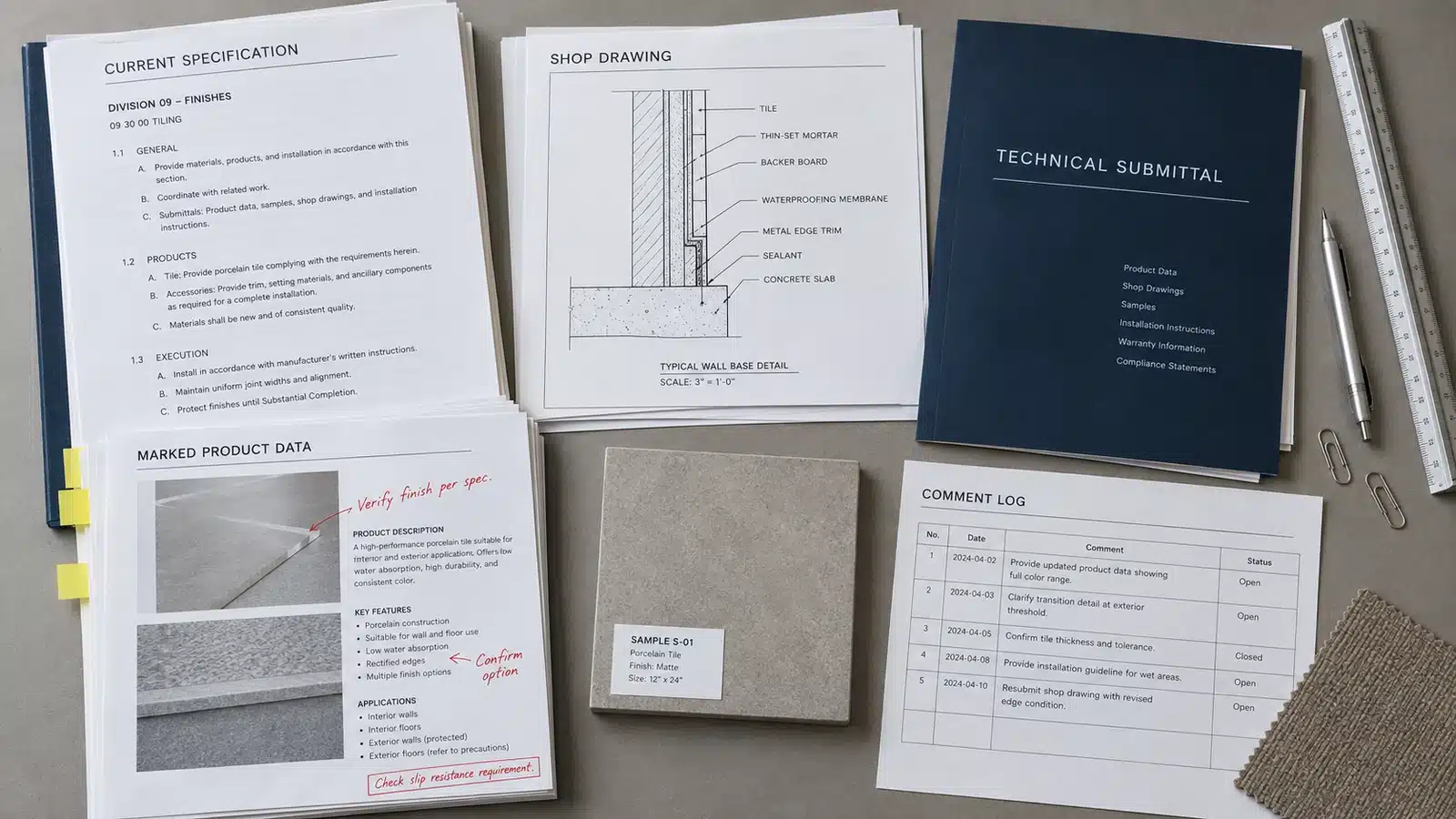
A technical submittal checklist confirms that a proposed product or system is identifiable, complete, coordinated and supported by the evidence required by the contract before it enters formal review. Start with the current specification and drawings, then verify the exact manufacturer, model, selected options, performance data, test reports, installation requirements, interface dimensions, samples and disclosed deviations. Record the responsible reviewer, status, revision and required-by date in the submittal register. The checklist does not replace the contract, design review or statutory approval; it creates a consistent precheck so incomplete packages are returned before they disrupt procurement or site work.
Written by Winston
Project Director at Skyland Building · 10+ Years of Building Materials Experience
Updated September 2026 · 23-minute read
Key Takeaways
- Check against the latest contract documents, not a generic product brochure or an earlier drawing revision.
- Identify the exact product, configuration and evidence that applies; mark irrelevant catalog options clearly.
- Review installation interfaces and adjacent work as well as standalone product performance.
- Disclose every deviation or proposed substitution instead of leaving reviewers to discover it.
- Use project-defined reviewers, status codes and release rules; approval language is not universal.
- Link the approved revision to procurement, inspection, delivery identification and field verification records.
What a Technical Submittal Checklist Covers
A technical submittal is the controlled package used to demonstrate how a proposed product, material, component or system addresses project requirements. It sits within the wider drawings, samples and approvals workflow. The checklist is a pre-review and coordination tool: it helps the submitting party assemble the right evidence and helps reviewers record what was checked, what remains open and which revision governs.
The contract, specification, approved project procedure and applicable law remain controlling. A checklist cannot assign design responsibility, waive a requirement or turn an information-only item into an approval item. Establish the project’s terminology and authority matrix before using any generic status label.
Submittal Types and Review Limits
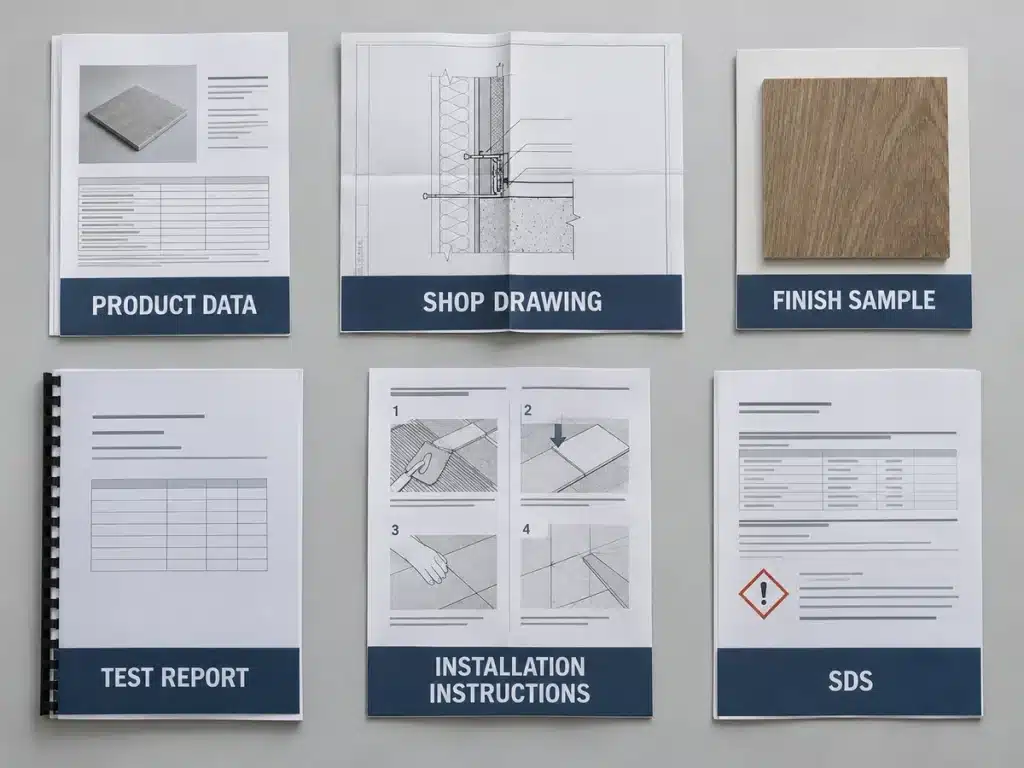
Keep document types distinct. A shop drawing review focuses on project-specific dimensions, fabrication and interfaces, while the material sample approval process controls stated visual or physical characteristics. Neither automatically proves every technical requirement.
| Submittal item | Primary purpose | Review boundary |
| Product data | Identify product, selected options, ratings and manufacturer information | Confirm the marked model and data apply to the proposed supply |
| Shop drawings | Show project-specific fabrication, dimensions, fixings and coordination | Review against design intent and interfaces; do not infer missing design checks |
| Samples or mock-ups | Set an agreed reference for stated appearance, workmanship or range | Limited to the characteristics and acceptance method identified by the project |
| Calculations and test reports | Support required design or performance criteria | Check scope, method, tested configuration and applicability to the proposed assembly |
| Manufacturer instructions and SDS | Define installation, handling, storage, maintenance and safety information | Use the current document for the exact product and jurisdictional context |
| O&M and closeout data | Preserve information needed for operation, maintenance, warranties and project records | Confirm timing, format and responsible recipient in project requirements |
Set Requirements Before Reviewing Documents
A strong review begins before the supplier sends a brochure. Convert the contract requirements into a controlled list of expected submittals, owners and dates. That prevents late discoveries, duplicated reviews and packages that cannot be traced to a specification clause.
1. Confirm the governing sources. Record the current specification section, clause, drawing number, detail and revision. Note approved addenda, requests for information and design changes that affect the item.
2. Define the package. List the required product data, shop drawings, samples, calculations, reports, certificates, instructions, sustainability documents and closeout information. Include only items required for the project.
3. Assign responsibility. Identify who prepares, prechecks, coordinates, reviews and records the decision. Use the contract and project procedure rather than assuming that every architect, engineer or owner reviews every item.
4. Control identification. Set the item number, specification reference, location, revision, transmittal number, document naming convention and status vocabulary before the first issue.
Use a shop drawing submittal register to connect each required item with a planned submit date, review period, approval-needed date and material-needed date. Align those fields with the construction procurement schedule so design decisions occur before purchasing, fabrication and shipment commitments.
For multi-category sourcing, carry the same references into the whole-house building materials RFQ. This makes technical expectations visible to bidders before quotations are compared.
Master Technical Submittal Checklist
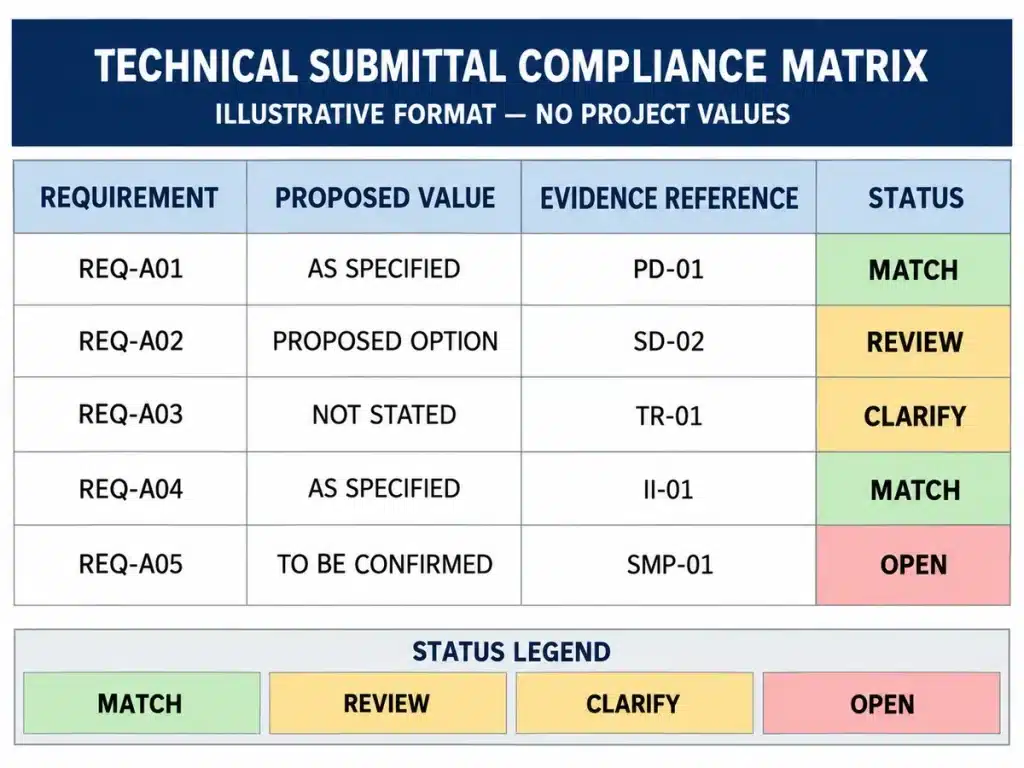
Use the following master checklist as a gate before formal submission. Add project-specific rows where the specification, local authority or approving party requires more evidence. A status such as Complete, Clarification Required or Not Applicable is more useful at this stage than pretending the technical decision has already been made.
| Review area | Confirm before submission | Evidence or record |
| Control and traceability | Item number, specification clause, drawing reference, location, revision, transmittal and required-by date are correct | Cover sheet and register entry |
| Product identity | Manufacturer, product name, model, size, finish, grade, accessories and selected options match the proposed supply | Marked product data and schedule |
| Technical criteria | Each required property is compared with the specification using the same units and stated test or calculation basis | Compliance matrix |
| Evidence applicability | Reports and certificates identify the tested product or assembly, issuing body, method, result and relevant date or validity | Reports, certificates and scope notes |
| Drawings and interfaces | Dimensions, tolerances, loads, fixings, openings, substrates, services, access and adjacent trade boundaries are coordinated | Shop drawing and coordination comments |
| Installation and use | Instructions cover storage, substrate preparation, environmental limits, sequence, sealants, fasteners, primers and maintenance access | Current manufacturer instructions |
| Safety and project-specific declarations | SDS, emissions, recycled content, environmental declarations or accessibility evidence are included only where applicable | Required safety or declaration files |
| Variations and substitutions | Every difference from the contract is clearly listed with technical, interface, schedule and commercial effects | Deviation or substitution statement |
| Review closeout | Comments are resolved, approver and status are recorded, superseded files are controlled and the approved revision is issued to the right teams | Comment log, register and controlled record |
Use the Checklist in a Controlled Review Workflow
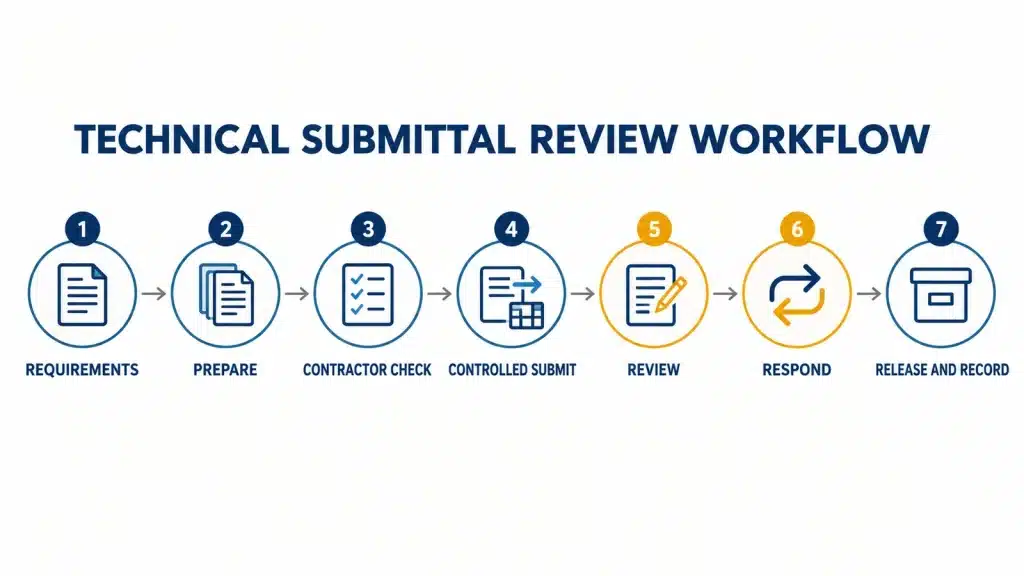
The technical submittal checklist works best as one gate in a documented sequence. The exact parties and durations will vary by project, but the control logic should remain visible.
1. Plan. Create the register, confirm required submittal types, assign owners and work backwards from the material-needed date.
2. Prepare. Collect current documents for the exact product and mark the selected model, configuration, finish and accessories.
3. Precheck. The contractor or designated coordinator compares the package with the specification, drawings and known interfaces before it reaches the formal reviewer.
4. Submit. Issue one controlled package with a unique transmittal and revision. Avoid mixed revisions, unmarked catalog pages and informal side-channel approvals.
5. Review. The assigned technical or design reviewers examine the matters within their scope and return consolidated, traceable comments.
6. Resolve. Respond to each comment, identify changes and resubmit the complete affected package when the project procedure requires it.
7. Release and record. Update the register, distribute the approved revision and link it to procurement, inspection and field verification records.
When many categories, designers and suppliers are involved, a single drawing and sample coordination service can help maintain the package index, comment log and decision trail without changing the reviewer responsibilities defined by the project.
Review Performance Evidence Without Overclaiming
A brochure statement is not a compliance comparison. Build a simple matrix that places the project requirement beside the submitted value, document reference and reviewer note. Use the exact units and conditions stated by each source. If the specification calls for a test standard, verify the standard edition or acceptance basis required by the project rather than substituting a similar marketing metric.
| Criterion | Contract source | Submitted evidence | Reviewer note |
| Model and configuration | Record clause and scheduled designation | Record exact product and selected options | Match or identify difference |
| Required performance | Record criterion, units and stated method | Record tested or calculated result and report reference | Confirm scope and applicability |
| Assembly components | Record required build-up, glass, hardware or accessories | List the proposed build-up and referenced drawing | Check like-for-like configuration |
| Installation conditions | Record substrate, fixing, environment and interface requirements | Reference current instructions and detail | Resolve conflict or missing information |
Check whether a report covers the product family or the exact submitted assembly. Review the specimen, size limits, component build-up, orientation, support conditions and exclusions that affect applicability. Do not convert a partial test, expired document or unrelated configuration into a blanket performance claim. Where professional design, calculations or local certification are required, use the qualified party and approval route named by the project.
Coordinate Drawings Interfaces and Installation
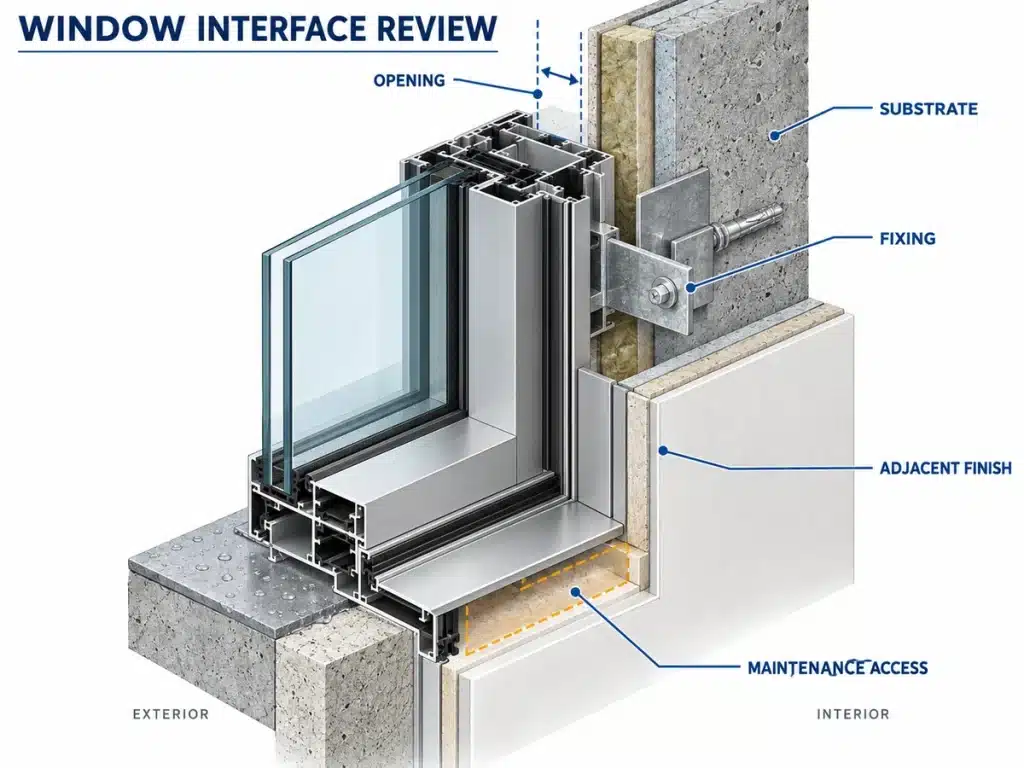
Many technically compliant products still fail at interfaces. Review the product in its installed context: the opening, substrate, structure, waterproofing, finishes, services, access and adjacent trades. Confirm who owns each dimension and detail, and identify information that must be verified on site before fabrication.
- Overall dimensions, clear openings, tolerances and setting-out references
- Structural supports, anchors, fasteners, embedments and design loads where applicable
- Substrate type, edge distances, fixing zones and required backing
- Movement joints, sealants, flashings, membranes and continuity of barriers
- Required access for installation, adjustment, cleaning, replacement and maintenance
- Interfaces with ceilings, floors, wall finishes, casework, plumbing, electrical and controls
- Packaging or modular constraints that affect lifting, access, sequencing and protection
Architects and project teams coordinating multiple material packages can also use the building materials for architects workflow to align schedules, drawings, samples and technical decisions across categories.
Use Samples and Mock Ups for the Right Decisions
A sample may establish color, texture, sheen, profile, workmanship or an agreed range, but it does not automatically prove structural, fire, thermal, acoustic, water or durability performance. State what the sample is intended to approve, how it is identified and whether it will be retained as the comparison reference. Natural materials and batch-sensitive finishes may require a range rather than one ideal piece.
Link the approved sample number and date to the technical package and finish schedule. If a mock-up demonstrates an interface or installation method, record its location, build-up, inspection result and whether it remains in the work. Do not let an aesthetic sign-off silently replace outstanding technical evidence.
Handle Deviations and Substitutions Openly
A proposed alternative should be visible at the front of the package, not buried in attachments. Identify the precise contract requirement, the proposed difference and the reason for the change. Then state the technical, interface, appearance, maintenance, schedule and commercial effects that are known. Unsupported claims such as equivalent or better should be replaced by a criterion-by-criterion comparison.
- Reference the affected specification clause, drawing, schedule and prior decision.
- Describe the proposed product and every material difference from the specified basis.
- Attach evidence for the same criteria used to evaluate the original requirement.
- Identify knock-on effects for dimensions, fixings, adjacent trades, samples, warranties and maintenance.
- Record who is authorized to accept or reject the variation and whether a revised price or schedule decision is separate.
Interpret Review Status According to Project Rules
Status labels and their contractual effects differ between owners, consultants, jurisdictions and delivery methods. The table below shows common operational interpretations only. The approved project procedure and contract must define whether work may proceed, whether resubmission is required and who carries responsibility for corrections.
| Example status | Common operational meaning | Typical next action |
| Approved or accepted | The named reviewer has completed the defined review with no recorded correction | Proceed only within the scope and release rules stated by the project |
| Approved as noted | The review contains corrections or qualifications that may not require another formal cycle | Confirm the submitting party accepts and incorporates every note before release |
| Revise and resubmit | The package is incomplete, unclear or does not demonstrate compliance | Address comments and submit a controlled revised package before the affected work proceeds |
| Rejected or not approved | The proposal does not meet the stated review basis or cannot be accepted as submitted | Select a compliant solution or follow the project variation process |
| Received or information only | The item is recorded without the same approval action applied to review items | Retain the record and comply with any project-specific response or notice requirements |
A review normally does not erase the contractor, supplier, fabricator or designer responsibilities assigned elsewhere. Equally, an information-only notation should not be represented as technical approval. Write the actual project definition beside each status in the register.
Keep the Register Aligned With Procurement and Field Control
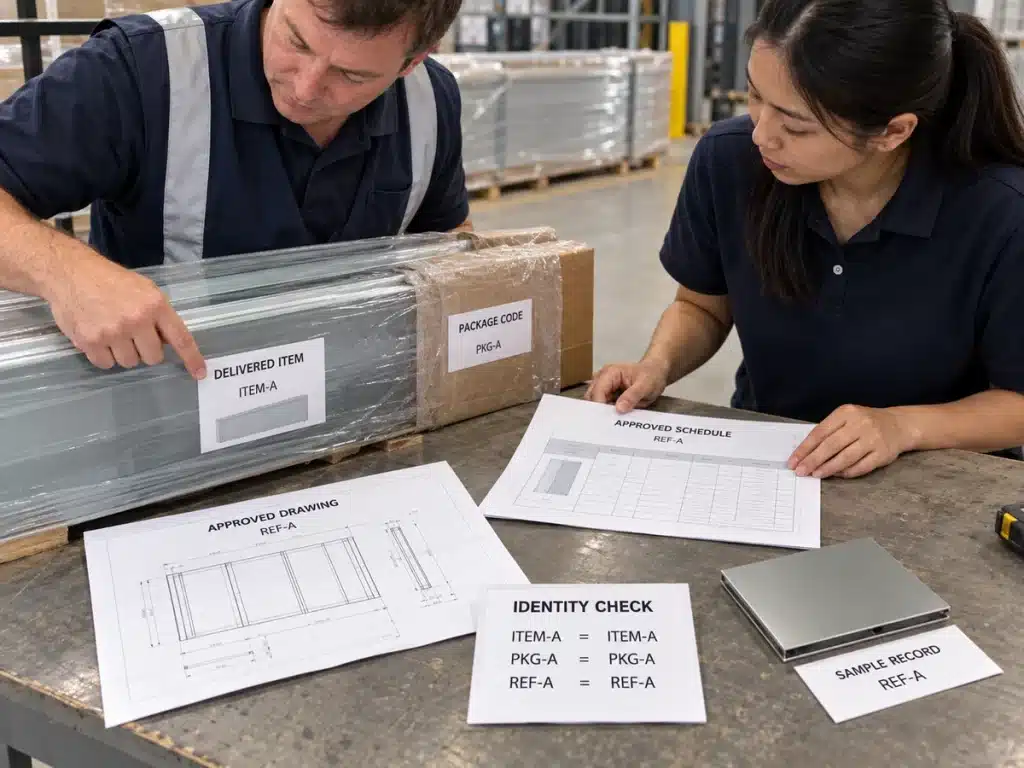
Submittals become useful when their status drives the next controlled action. The register should show planned and actual submit dates, review status, revision, approval-needed date and material-needed date. For large coordinated packages, project material coordination should use the same item codes across the schedule, drawings, sample log, purchase order and inspection records.
Do not release purchase, fabrication or installation merely because a document was uploaded. Apply the release condition defined by the project. When the requirement changes, supersede the affected package visibly, review the impact on related items and prevent obsolete files from reaching procurement or site teams.
Before dispatch, compare the approved product identity and agreed inspection points with the pre-shipment inspection checklist. Carry the same item, room, elevation or package codes into building materials packing and labeling so delivered goods can be traced back to the approved revision.
Final Pre Release Checklist
Before changing a package to its project-defined release status, confirm all applicable items below:
☐ Current specification, drawings, schedules and approved changes were used
☐ Item number, location, revision and transmittal are unique and consistent
☐ Exact manufacturer, model, configuration, finish and accessories are marked
☐ Required values are compared criterion by criterion in consistent units
☐ Reports, certificates and calculations apply to the proposed product or assembly
☐ Dimensions, fixings, substrates, services and adjacent trade interfaces are coordinated
☐ Installation, storage, handling, maintenance and safety information is complete where required
☐ Samples or mock-ups are identified by scope, reference number and acceptance record
☐ Deviations and substitutions are disclosed with known impacts
☐ Comments are closed or carried forward visibly under the project procedure
☐ Reviewer, status, action date and next responsible party are recorded
☐ Approved and superseded revisions are distributed and controlled correctly
Common Causes of Returned or Delayed Submittals
- Sending an entire catalog without marking the proposed model and options
- Using a superseded specification, drawing or product data revision
- Leaving specification criteria to be inferred instead of providing a comparison
- Submitting a test report for a different size, build-up, component or support condition
- Omitting dimensions, fixings, substrate information or adjacent trade interfaces
- Combining unrelated items or revisions in one uncontrolled package
- Hiding a substitution, deviation or exception in technical attachments
- Treating a sample sign-off, receipt acknowledgement or informal email as full technical approval
- Failing to answer prior comments or show what changed in a resubmission
- Approving after procurement or fabrication has already removed practical choice
Frequently Asked Questions
What Should a Technical Submittal Checklist Include?
It should include document control, product identity, selected configuration, specification references, performance criteria, supporting evidence, installation instructions, drawing interfaces, samples, deviations, reviewer responsibilities, status, dates and record-distribution requirements. Add or remove fields to match the project contract and procedure.
Is a Technical Submittal the Same as a Shop Drawing?
No. A shop drawing is one possible component of a technical submittal package. The package may also include product data, samples, calculations, test reports, certificates, manufacturer instructions, safety information and closeout data. Each document answers a different review question.
Who Reviews Technical Submittals?
The project contract and submittal procedure should name the preparer, contractor prechecker, technical reviewer, designer, owner representative or authority for each item. Not every party reviews every submittal. Use an authority matrix and the register to avoid assumptions or duplicated comments.
Can Work Proceed With Approved as Noted?
Only if the project’s defined status rules allow it and every note is accepted and incorporated. Some procedures permit work to proceed without another submission; others require a corrected record copy or formal resubmission. Check the contract instead of relying on the wording alone.
Are Product Samples Enough for Technical Approval?
Usually not. Samples are valuable for the characteristics expressly identified for review, such as color, texture, profile or workmanship. Technical performance normally requires the relevant data, drawings, calculations, test evidence or certification specified by the project.
How Should Submittals Link to Procurement?
Work backwards from the material-needed date and include preparation, internal check, formal review, resubmission, ordering, production, inspection and transport time. The register and procurement schedule should use the same item codes and show the release condition that must be met before purchasing or fabrication.
What Records Should Be Kept After Approval?
Retain the approved package, transmittal, comments, responses, status and date, plus the applicable sample or mock-up record. Link the controlled revision to the order, inspection, packing identification, delivery and field verification records. Keep superseded versions clearly separated from current construction information.
Conclusion
A useful technical submittal checklist turns scattered brochures, drawings and reports into a traceable decision package. The greatest value comes from checking the exact product against current project requirements, coordinating interfaces, declaring differences and linking the approved revision to procurement and site control. Keep the checklist project-specific, and let the contract define responsibilities and release rules.
If your project needs help structuring multi-category material schedules, drawings, samples and supplier documents, contact Skyland Building with the project scope, current drawings and required decision dates.
Technical and SEO References
- UFGS 01 33 00 Submittal Procedures — Primary technical reference for submittal types, preparation, registers, variations, review actions and records. Project-specific documents still govern.
- USACE ER 415-1-10 Contractor Submittal Procedures — Supplementary government reference for contractor submittal administration.
- OSHA Hazard Communication Safety Data Sheets — Reference for the role and standardized content of Safety Data Sheets where applicable.
- Google Search Central title link guidance — Supports concise, descriptive and non-stuffed title recommendations.
- Google Search Central snippet guidance — Explains that snippets are generated primarily from page content and may use the meta description.
- Google Search Central link best practices — Supports crawlable links and descriptive anchor text.
- Google Search Central image SEO guidance — Supports standard image elements, descriptive alt text and responsive image delivery.