
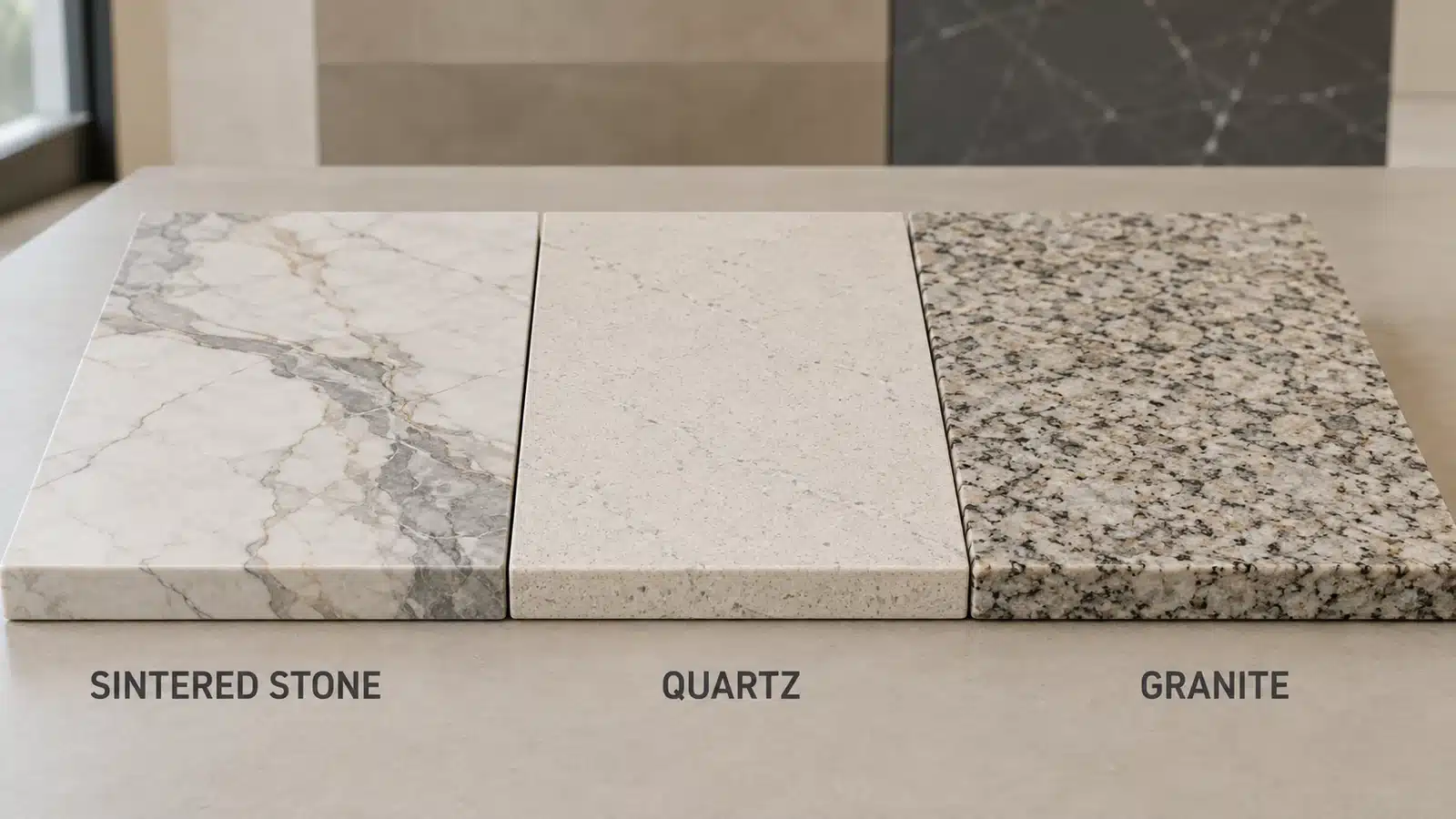
A practical countertop comparison for heat, stains, UV exposure, appearance, fabrication, maintenance, and installed cost.
Quick answer: in a sintered stone vs quartz vs granite comparison, sintered stone is usually the strongest starting point for high heat, low water absorption, and sun-exposed applications; quartz is a practical indoor choice when consistent color and easy routine care matter; granite is the natural-stone choice when unique veining and long service life are priorities. No material wins every category. The exact product, slab, finish, edge detail, support, fabricator, and warranty determine the final result.
Use this guide to shortlist a material, then confirm the selected product data and fabrication method. Category-level claims should never replace the manufacturer’s technical sheet, the actual slab inspection, or the project’s shop drawings.
Written by Winston
Project Director at Skyland Building · 10+ Years of Building Materials Experience
Updated September 2026 · 16-minute read
Key Takeaways
- Choose by exposure first: indoor or outdoor, heat, sunlight, moisture, cleaning, impact, and expected traffic.
- Sintered stone typically leads for heat and UV exposure, but edges and cutouts still require skilled fabrication and handling.
- Quartz is nonporous and visually consistent, but ordinary indoor quartz should not be assumed suitable for outdoor use or direct high heat.
- Granite provides genuine natural variation. Sealing is product-specific: many slabs may not need it, while more absorbent stones can benefit from it.
- All three can chip at exposed edges or stressed openings. Support, seam planning, cutout radii, and installation quality matter as much as the material name.
- Compare itemized installed quotations, not slab prices alone. Fabrication, waste, access, reinforcement, delivery, and installation can change the ranking.
Sintered Stone vs Quartz vs Granite: Quick Comparison
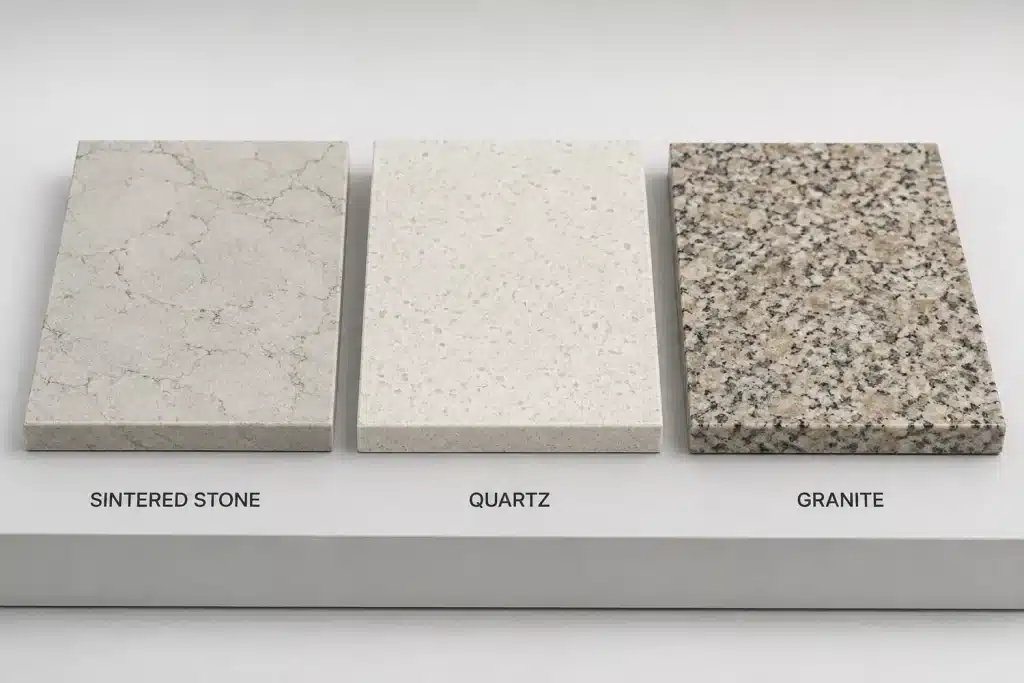
The table gives a practical direction for countertop selection. Ratings vary by manufacturer, product line, stone type, finish, thickness, test method, and installation, so verify every shortlisted product against the intended application.
| Decision factor | Sintered stone | Quartz | Granite |
| What it is | Mineral-based manufactured slab consolidated with heat and pressure; formulations vary. | Engineered slab made with mineral aggregate, pigments, and polymer binder; composition varies. | Natural igneous stone quarried and finished as individual slabs. |
| Heat | Generally excellent, subject to product data and installation details. | Good for normal indoor use; use trivets and protect from prolonged high heat. | Generally strong, but use trivets to reduce thermal shock and protect finishes. |
| UV / outdoor use | Often a strong option when the exact product is approved for exterior exposure. | Use outdoors only when the specific product and warranty permit it. | Often suitable with the right stone, finish, detailing, climate review, and care. |
| Stains / water | Typically very low absorption and does not require routine sealing. | Nonporous surface; routine sealing is generally not required. | Absorption varies. Test or confirm whether the selected slab needs a sealer. |
| Scratches / abrasion | Usually very high resistance; cutting boards still protect knives and finish. | Good daily resistance, but sharp tools and abrasives can mark some finishes. | Hard and durable; resistance varies with mineral composition and finish. |
| Impact / edge chips | Face is durable, but thin edges, corners, and cutouts need careful detailing. | Can chip at edges and openings; repair color may remain visible. | Can chip or crack at stressed areas; some repairs can remain visible. |
| Appearance | Controlled colors and printed or through-body designs, depending on product. | Consistent colors and repeatable engineered patterns. | One-of-a-kind mineral movement, color, fissures, and natural variation. |
| Fabrication | Specialist tooling and handling are especially important for thin slabs and complex cutouts. | Established fabrication network in many markets; heat and support rules still apply. | Established stone fabrication methods; slab condition and natural features need review. |
| Maintenance | Simple routine cleaning with product-approved methods. | Simple routine cleaning; protect from high heat and harsh chemicals. | Simple routine cleaning; sealer and cleaner requirements are slab-specific. |
| Best starting point | Outdoor kitchens, high-heat zones, thin visual profiles, and coordinated large surfaces. | Indoor kitchens, repeated units, predictable color, and low routine maintenance. | Premium natural interiors, unique slabs, and projects that value geological character. |
Fast choice: start with sintered stone for exterior exposure or demanding heat conditions, quartz for a consistent indoor palette, and granite for authentic natural variation. Then screen the candidate for local fabrication skill, available slab sizes, support, warranty, and installed cost.
What Are Sintered Stone, Quartz, and Granite?
Understanding how the three materials are made explains most of the practical differences in sintered stone vs quartz vs granite: resin affects heat and UV limits; natural porosity affects stain control; and slab construction affects edge work, pattern repeatability, and repair.
Sintered stone
Sintered stone is a manufactured mineral surface formed through high pressure and heat. It does not rely on the same polymer-binder structure as conventional engineered quartz. Product families differ in composition, thickness, surface decoration, reinforcement, edge options, and approved applications. Review the available sintered stone slab formats and applications together with the technical data for the exact color, thickness, and finish being quoted.
Its low absorption, heat resistance, and potential UV stability make it attractive for kitchens, bathrooms, furniture, wall panels, and selected exterior uses. Those strengths do not eliminate fabrication risk: thin material, sharp internal corners, unsupported cutouts, and exposed edges require the approved tooling, radii, reinforcement, and handling method.
Quartz
Quartz countertops are engineered from mineral aggregate, pigments, and polymer binder. The controlled manufacturing process supports consistent colors and repeatable patterns, which is useful for multi-unit apartments, hotels, and long kitchen runs. The nonporous surface generally does not need sealing and is easy to clean with the manufacturer’s approved products.
The polymer component is also why heat and sunlight need product-specific review. Use trivets, follow appliance clearances, and do not treat an indoor quartz color as exterior-grade unless the manufacturer expressly approves and warrants that application. Outdoor quartz collections exist, so the accurate rule is “verify the product,” not “all quartz fails outdoors.”
Granite
Granite is natural igneous stone. Every slab can differ in color, crystal structure, movement, fissures, absorption, and finish response. That variation creates character, but it means a small sample cannot fully represent an island, bookmatch, waterfall edge, or multi-slab installation. Approve the actual slabs and their layout before cutting.
Sealing should be decided for the selected stone rather than prescribed automatically. The Natural Stone Institute guidance on sealing stone countertops notes that many granite countertops do not need sealing. Ask the supplier or fabricator to assess the actual slab, finish, use, and sealer compatibility instead of setting a universal resealing interval.
Performance Differences That Matter in Use
Heat, sunlight, and outdoor exposure
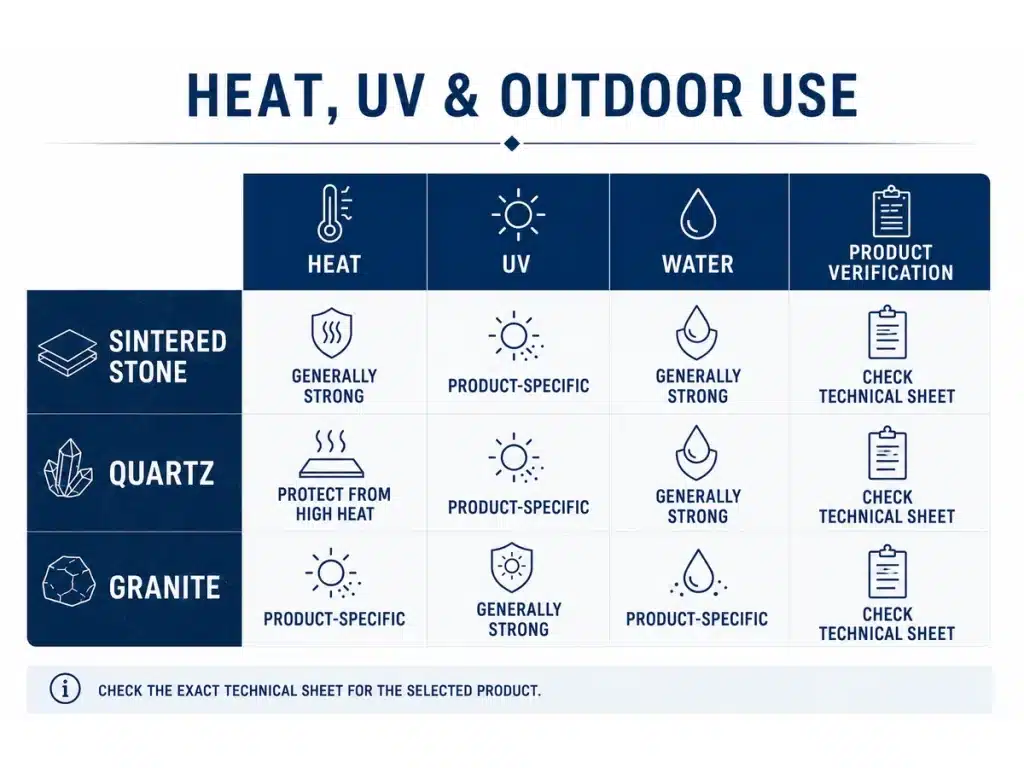
Sintered stone and granite are usually the first materials to investigate for high-heat or outdoor countertops. Even then, the entire assembly matters: substrate, adhesive or fixing method, joints, support, dark-color heat gain, drainage, freeze-thaw exposure, and appliance clearances must suit the climate and application.
Quartz performs well in normal indoor kitchens but should be protected from prolonged direct heat. Exterior use is product-specific. Confirm UV classification, permitted temperature range, warranty, installation instructions, and whether the named color and thickness are included. A general brand statement is not enough.
Stains, scratches, and daily cleaning
Sintered stone and quartz are normally low-maintenance because their surfaces have very low water absorption. Granite care depends more on the selected stone and finish. For all three, wipe spills promptly, use a soft cloth and an approved neutral cleaner, and avoid unapproved acids, solvents, waxes, and aggressive abrasives.
Scratch resistance protects the surface, not the knife or every finish. Use cutting boards. Matte, textured, or high-gloss surfaces can show metal marks, grease, fingerprints, or abrasion differently even when the underlying material is hard.
Chips, cracks, and repair expectations
No slab is impact-proof. Exposed corners, narrow strips between cutouts, sink rails, cooktop openings, unsupported overhangs, and transport edges are common risk points. A dense surface can resist scratching while still chipping after a concentrated impact.
Repairability depends on color, pattern, finish, damage location, and installer skill. Filled chips may remain visible; cracks caused by movement or poor support can return unless the cause is corrected. If future matching is important, record the product, batch, slab photographs, layout, and finish, and keep suitable spare material where practical.
Appearance and Design Flexibility
Sintered stone and quartz give designers more control over color consistency. Granite offers the least repeatability and the most authentic natural variation. Neither approach is automatically more premium: the right choice depends on whether the design needs identical rooms, controlled vein direction, or a one-of-a-kind focal slab.
Review full slabs under project lighting. Confirm whether the pattern continues through the slab body or is mainly surface decoration, how a polished edge differs from the face, and whether printed veining aligns across miters. For granite, map natural fissures and movement; for all materials, approve seam locations, waterfall returns, backsplash transitions, and bookmatching before cutting.
Countertops also have to coordinate with cabinets, sinks, appliances, and wall finishes. The cabinet material selection guide explains why the box, door, finish, edge, hardware, and countertop interface should be specified separately. For a complete kitchen package, review the custom cabinetry scope together with the countertop support, overhang, cutout, and installation requirements.
Cost, Fabrication, and Installation
There is no reliable global price winner. Quartz spans broad entry-to-premium ranges; granite varies by source, rarity, slab quality, and freight; and sintered stone may carry specialist fabrication or handling costs in markets with fewer experienced fabricators. A premium color in any category can cost more than a standard option in another.
Request one itemized installed quotation basis: usable slab area, waste, slab count, thickness, finish, edge profile, miters, sink and appliance cutouts, drain grooves, reinforcement, template, shop drawings, delivery, access, lifting, installation, protection, tax, warranty, and exclusions. Compare replacement risk and lead time as well as the initial price.
Fabrication skill and silica-dust control
Choose a fabricator with documented experience in the exact material and detail. Confirm tooling, cutting and drilling methods, minimum internal radii, edge polishing, reinforcement, seam tolerances, lifting frames, site access, and repair procedure before the slab is released.
Cutting, grinding, and polishing stone products can create hazardous respirable crystalline silica dust. Require compliance with the applicable workplace rules and an effective exposure-control plan. The NIOSH/OSHA countertop silica hazard alert is a useful safety reference; this article is not a fabrication-safety procedure.
Support, seams, and site readiness
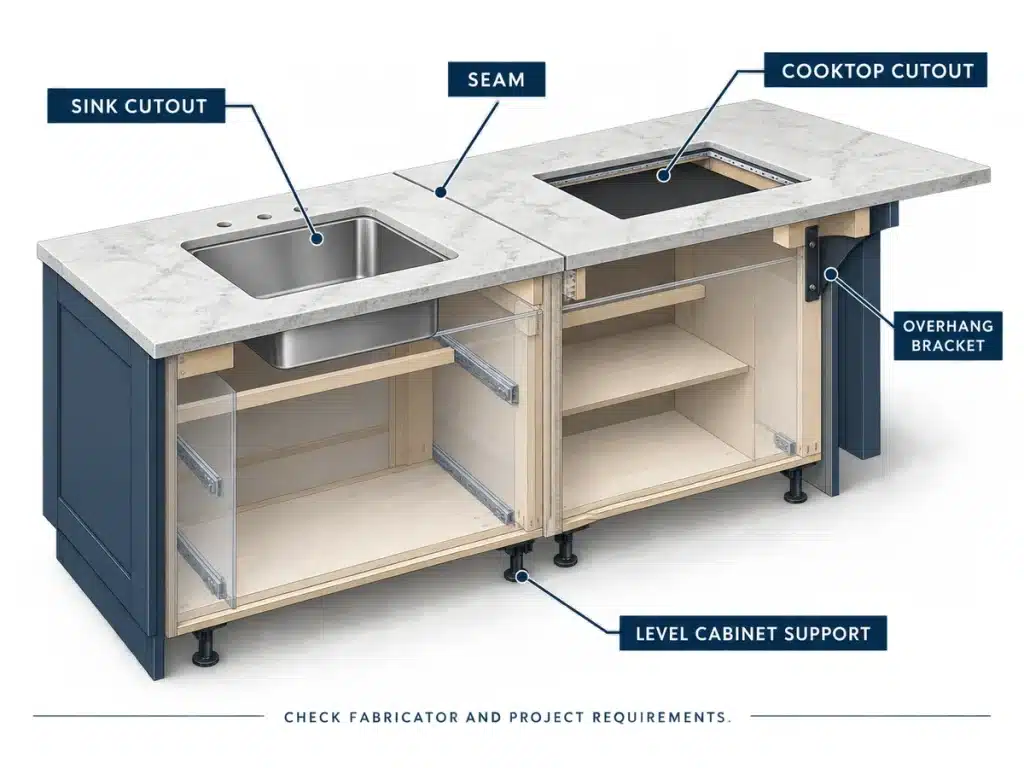
Cabinet and substrate levels, span limits, overhangs, brackets, appliance clearances, wall conditions, sink fixings, movement joints, and access routes should be checked before templating. Do not cut from an uncoordinated drawing or assume the slab can correct an uneven base. Large islands and thin slabs may need engineered support and lifting plans.
Which Countertop Material Is Best for Your Project?
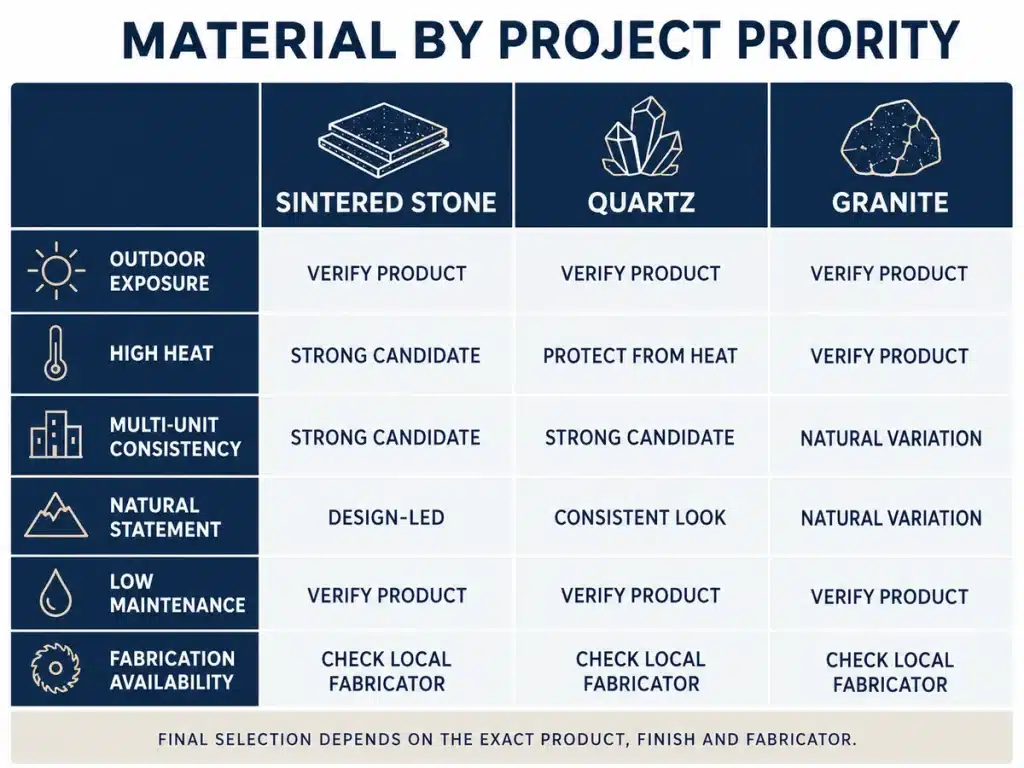
A practical sintered stone vs quartz vs granite decision starts with the project’s non-negotiable condition, not a showroom ranking. Use the following as a shortlist, then verify the actual product and installed assembly.
| Project priority | Best starting point | Why | Verify before approval |
| Outdoor kitchen or strong sun | Sintered stone; suitable granite | Both can suit UV and weather exposure when properly specified. | Exact exterior approval, climate, dark-color heat gain, support, fixing, drainage, and warranty. |
| Frequent hot cookware | Sintered stone; granite | Strong category-level heat performance. | Product limits, thermal-shock risk, cutout clearances, trivets, and installation method. |
| Consistent multi-unit interiors | Quartz; sintered stone | Controlled colors and repeated patterns simplify approvals and replacements. | Batch range, slab-to-slab match, vein direction, future availability, and room mock-up. |
| Unique natural statement slab | Granite | Every slab has individual mineral movement and color. | Actual slab selection, layout, fissures, finish, seams, absorption, and spare strategy. |
| Low routine maintenance | Quartz; sintered stone | Nonporous or very-low-absorption surfaces generally need no routine sealing. | Approved cleaners, heat limits, textured-finish care, and warranty exclusions. |
| Complex local fabrication | Material with strongest qualified local fabricator | Execution quality can outweigh a small material-performance advantage. | References for similar details, tooling, mock-up, tolerances, access, repair, and installation warranty. |
| Budget-led project | Compare all three on one installed scope | Material and labor markets can reverse generic price assumptions. | Slab yield, waste, cutouts, edges, freight, installation, tax, exclusions, and replacement lead time. |
How to Choose in Seven Steps
- Define the use. Record indoor or outdoor location, heat sources, sunlight, moisture, traffic, cleaning products, impact risks, and expected service life.
- Set pass-or-fail requirements. Identify mandatory product data, destination standards, slip or hygiene needs where relevant, warranty, and project documentation.
- Shortlist actual products. Compare named colors, thicknesses, finishes, slab sizes, test data, stock or production status, and local fabrication capability.
- Review full-size appearance. Approve actual granite slabs or a documented manufactured-surface batch range, then map vein direction, seams, miters, and visible edges.
- Coordinate the assembly. Check cabinets, substrate, support, sinks, appliances, services, overhangs, movement, access, handling, and installation sequence.
- Compare installed quotations. Normalize scope, waste, fabrication, delivery, lifting, installation, warranty, exclusions, replacement availability, and lead time.
- Freeze the release package. Record the approved slab or product code, sample, layout, shop drawing, edge, cutouts, support, finish, care instructions, and inspection criteria.
Use a controlled material sample approval process for color, texture, finish, edge, and allowable variation. Then connect the final slab layout and interfaces to the shop drawing approval process before fabrication release.
Countertop Approval Checklist Before Fabrication

Approval should cover the installed assembly, not only a small color chip. Record each item against a controlled revision and identify who can authorize fabrication.
| Approval item | Minimum record | Release question |
| Product and slab | Manufacturer or quarry/source, product or stone name, slab IDs or batch, thickness, finish, quantity, and current availability. | Is the exact supplied material identified and reserved? |
| Appearance | Full-slab images or physical review, approved range, vein direction, bookmatch, seam map, backsplash, and waterfall layout. | Will the cut pieces match the approved visual intent? |
| Fabrication | Dimensions, template basis, edge profile, miters, cutouts, radii, holes, drainer details, joints, tolerances, and reinforcement. | Can the fabricator produce every detail within the product rules? |
| Support and interfaces | Cabinet levels, spans, overhang brackets, substrate, wall, sink, appliance, plumbing, movement, and access coordination. | Is the base ready and are responsibilities clear? |
| Care and warranty | Approved cleaners, heat protection, sealing decision where applicable, exterior limits, repair route, exclusions, and handover data. | Do the owner and installer understand the operating limits? |
| Inspection and delivery | Factory inspection points, finished dimensions, appearance criteria, A-frame or crate protection, labels, lifting, route, and site receipt. | Can the correct undamaged pieces reach the correct area safely? |
For projects combining cabinetry, surfaces, sanitary ware, and other finishes, use the whole-house building materials checklist to confirm adjacent scope and interfaces. Before dispatch, adapt the pre-shipment inspection checklist to verify slab identity, finished pieces, dimensions, appearance, labels, protection, and release records.
Common Selection Mistakes
- Choosing from a small sample without reviewing the full slab, pattern scale, batch range, or actual granite variation.
- Using universal rankings such as “scratch-proof,” “heat-proof,” “maintenance-free,” or “outdoor-safe” without exact product data.
- Assuming every granite needs regular sealing or that every quartz product is unsuitable outdoors.
- Comparing slab prices while ignoring yield, waste, cutouts, edge work, reinforcement, freight, access, and installation.
- Approving a color before coordinating seams, vein direction, edge appearance, cabinet support, sinks, and appliances.
- Selecting a material that local fabricators cannot execute reliably for the required size, thickness, and detail.
- Releasing fabrication from obsolete drawings or before site dimensions and responsibilities are confirmed.
Frequently Asked Questions
What is the biggest difference in sintered stone vs quartz vs granite?
Sintered stone is a heat-consolidated manufactured mineral surface, quartz is an engineered mineral-and-polymer surface, and granite is natural quarried stone. That difference drives heat and UV behavior, pattern consistency, porosity, fabrication, and maintenance.
Is sintered stone better than quartz?
It is often the stronger starting point for high heat, exterior exposure, and very low water absorption. Quartz can be easier to source and fabricate in some markets and offers consistent indoor designs. The better choice depends on the exact product, application, installer, and budget.
Is sintered stone better than granite?
Sintered stone offers controlled appearance and typically very low absorption, while granite offers genuine natural variation and established stone character. Both can suit demanding countertops when the slab, support, fabrication, and use are appropriate.
Which material is most heat resistant?
Sintered stone and granite generally perform better than conventional quartz under high heat. Still use trivets, follow appliance clearances, and verify product-specific thermal limits and installation instructions.
Can quartz be used for an outdoor kitchen?
Only when the specific quartz product, color, thickness, installation, and warranty are approved for outdoor exposure. Do not extend an indoor product claim to sunlight, weather, or temperature cycling without written confirmation.
Does granite always need sealing?
No. Granite absorption varies, and many countertops may not need a sealer. Ask the supplier or fabricator to assess the actual slab and finish and to document any sealer product, application, and maintenance requirement.
Which countertop material is cheapest?
There is no universal answer. Local slab availability, color, thickness, yield, fabrication skill, cutouts, edge profiles, freight, access, and installation can change the ranking. Compare itemized installed quotations on the same scope.
Which material is easiest to repair?
Repair depends more on the damage, pattern, finish, and specialist skill than on a simple category ranking. Small chips may be fillable in all three, but a perfectly invisible repair is not guaranteed. Correct movement or support problems before repairing a crack.
Conclusion
The best result from a sintered stone vs quartz vs granite comparison is not one universal winner. Choose sintered stone when verified heat, UV, low absorption, or thin-format performance leads the brief; choose quartz for controlled indoor appearance and straightforward care; choose granite for natural variation and a unique slab. Then protect the decision with product data, a full-slab review, qualified fabrication, coordinated shop drawings, and a complete installed quotation.
For a villa, apartment, hotel, or commercial project, share the countertop areas, drawings, cabinet layouts, finish references, project location, and target dates when you request a project quotation. Final selection and pricing should remain subject to the exact product, availability, fabrication details, site conditions, and project approvals.
Next Steps for Your Project
Topic hub: Product Selection Guides
Relevant product pages: Sintered Stone Slabs · Heavy-Duty Granite · Premium Quartzite
Related guides: Material Sample Approval Process · Pre-Shipment Inspection Checklist
Related service: Drawing & Sample Coordination