

A design freeze checklist helps a project team confirm that a building material package is defined well enough to move into procurement or production without hidden technical, commercial, or coordination gaps. It brings drawings, approved samples, specifications, bills of materials, compliance evidence, manufacturing controls, inspection requirements, packing, and post-freeze changes into one controlled release decision.
This guide is part of Skyland Building’s Drawings & Approvals resource hub and is intended for developers, contractors, consultants, procurement teams, factories, and quality inspectors coordinating project-specific material packages.
Scope note: This checklist supports coordination and production release. It does not replace contract approvals, local code review, or the responsibilities of the project designer, engineer, consultant, client, or approving authority.
Written by Winston
Project Director at Skyland Building · 10+ Years of Building Materials Experience
Updated September 2026 · 21-minute read
Key takeaways
A design freeze is more than a final sign-off. It is the point at which the product definition, evidence, responsibilities, and production conditions are clear enough to support a controlled release.
- Define exactly which product version, variants, and applications are being frozen.
- Reconcile drawings, specifications, materials, quantities, and documentation.
- Confirm that the selected design can be produced consistently and inspected objectively.
- Complete prototype, performance, compliance, supplier, and logistics checks before release.
- Control every post-freeze change through documented review and approval.
Design freeze checklist at a glance
Use these control points as the front page of the design freeze review. The detailed checks and evidence requirements are explained in the sections that follow.
| Review area | Evidence to confirm | Release test |
|---|---|---|
| Scope and variants | Product family, revision, sizes, finishes, locations, exclusions | Is the exact frozen boundary unambiguous? |
| Drawings and interfaces | Current drawings, dimensions, tolerances, openings, fixing details | Do all interfaces match the coordinated project information? |
| Specifications and BOM | Specification clauses, schedules, bill of materials, accessories | Do documents, quantities, codes, and finishes describe the same version? |
| Samples and finishes | Approved sample IDs, finish boards, mock-ups, deviation records | Can production and inspection trace appearance decisions to a controlled reference? |
| Compliance and tests | Applicable standards, certificates, reports, calculations, limitations | Does the evidence cover the actual product configuration and application? |
| Manufacturability | Tooling, process capability, capacity, work instructions, risk controls | Can the factory make the design consistently within the required tolerances? |
| Quality readiness | ITP, hold points, sampling, acceptance criteria, NCR process | Can an inspector make an objective release decision? |
| Packing and logistics | Labels, protection, package codes, loading plan, delivery sequence | Will the correct material remain protected and identifiable to site? |
| Approval and change control | Approvers, revision, effective date, conditions, change request route | Is there one controlled source of truth and an auditable change process? |
Release rule: Use Approved only when all required evidence is complete. Use Approved with conditions only when the condition, affected scope, owner, due date, and production hold boundary are explicitly recorded.
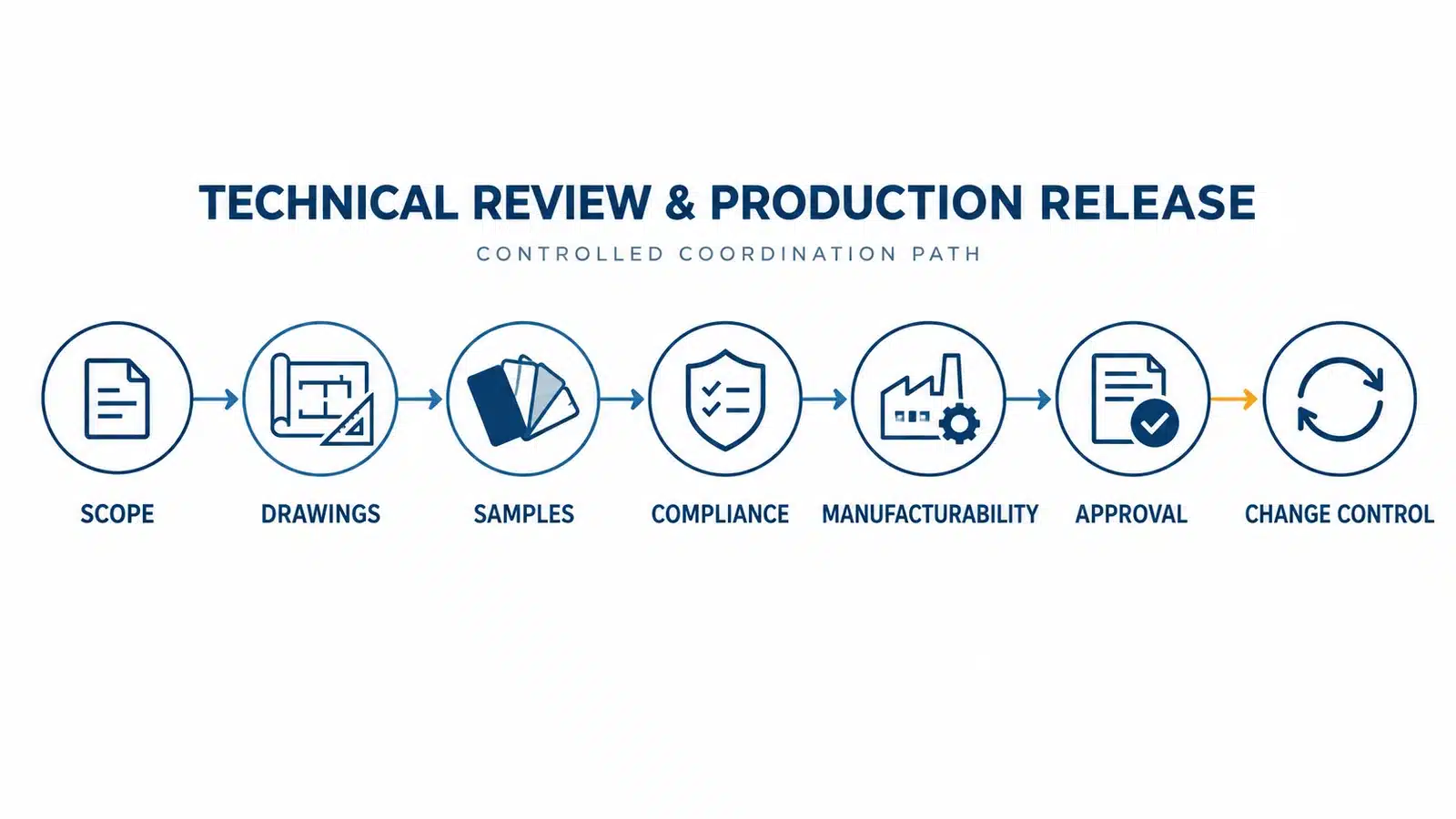
What design freeze means for a building material package
A design freeze creates a controlled baseline for the next authorized stage. It does not mean that every project decision is permanently closed or that no later change is possible. It means the released product definition is sufficiently complete, traceable, and approved for a named purpose, and any later change must be assessed before it enters purchasing or production.
Projects may use staged or partial freezes. For example, a team may release standard cabinet carcasses while keeping appliance cut-outs on hold, or release window frame profiles while a special glazing build-up remains unresolved. The record must identify what is frozen, what is excluded, which downstream activities may proceed, and which activities remain blocked.
A sample approval, shop drawing approval, prototype acceptance, and design freeze are related but not interchangeable. A sample may approve color and texture; a shop drawing may approve coordination; a prototype may validate a defined function. The design freeze links those decisions to the complete controlled package and its production-release conditions.
Define the design freeze scope and approval criteria
The first step in a design freeze checklist is to establish what the decision actually covers. A building material package may include multiple sizes, finishes, installation conditions, or project phases, so a broad approval can hide important open decisions. The team should define the frozen boundary, the evidence required to cross it, and the people authorized to approve it. This creates a usable baseline rather than a vague agreement that the design is “nearly finished.”
Identify the product version, variants, and intended applications
Name the exact product family, revision, variants, and intended applications under review. Record dimensions, finishes, performance classes, installation environments, and any project-specific adaptations. If one variant remains unresolved, separate it from the approved scope instead of allowing it to travel under the same approval reference.
Set measurable design freeze entry and exit criteria
Entry criteria describe what must be available before the review begins, such as coordinated drawings, a current bill of materials, approved samples, and identified test requirements. Exit criteria should be observable: decisions are recorded, required evidence is complete, open items have owners and dates, and the released package carries a revision number. Measurable criteria prevent premature release when schedule pressure is high.
Assign owners for design, engineering, manufacturing, and quality approvals
A freeze should identify who owns technical design, engineering coordination, manufacturing feasibility, quality acceptance, procurement, and client or consultant approval. Responsibility must include both the decision and the evidence supporting it. A single approval meeting is not enough if no one is accountable for maintaining the resulting record.
Document unresolved risks, assumptions, and approved deviations
Not every uncertainty must stop a release, but every accepted uncertainty must be visible. Record assumptions about site dimensions, interfaces, quantities, finishes, lead times, or testing, then state who accepted the risk and what would trigger further review. Approved deviations should refer to the affected drawing, specification, or purchase requirement rather than living only in meeting minutes.
Verify drawings, specifications, and product data
Once the scope is clear, the technical package needs a disciplined comparison. A design can appear approved while its CAD files, schedules, product data, and written instructions still describe different versions. Check the information as a connected set, not as isolated documents. Use a controlled shop drawing approval process to track revision identifiers, dates, comments, resubmissions, and the relationship between appearance approval and technical compliance.
Confirm final CAD files, drawings, dimensions, and tolerances
Confirm that the current CAD files and issued drawings show the same dimensions, interfaces, tolerances, details, and revision status. Compare critical openings, fixing points, clearances, and installation zones against the latest architectural and engineering information. A drawing is not final merely because it has a recent date; its references must also agree with the approved product definition.
Reconcile the bill of materials with the latest design revision
The bill of materials should be rebuilt or checked against the frozen drawings, not copied forward from an earlier estimate. Verify quantities, accessories, hardware, finish codes, packaging units, and replacement allowances. Where procurement is coordinated across categories, a documented BOQ and RFQ review can expose missing specifications, exclusions, alternates, and quantity gaps before orders are released.
Review installation details, performance requirements, and usage instructions
Installation details should explain the conditions under which the product is expected to perform. Check substrates, fixing methods, tolerances at interfaces, sequencing, maintenance needs, and any limits on use. Instructions should match the actual product configuration, including accessories and field adjustments that the installer will encounter.
Check that labels, packaging artwork, and technical documentation match the frozen design
Labels and packaging are part of the released product, especially when multiple variants will move through a shared supply chain. Compare product names, codes, quantities, handling instructions, warnings, and destination references with the approved data. Technical documents should use the same revision and terminology so that a factory, inspector, and site team are not working from subtly different descriptions.
Validate material selection and compliance requirements
Material approval must cover more than visual preference. The selected grade, finish, color, and performance evidence need to suit the intended application and the governing project requirements. Product certifications and test values should be checked for the specific item, because a general statement about a product category does not automatically apply to every variant. This is also where substitutions and alternatives receive formal boundaries.
Link every finish decision to the controlled sample record. The material sample approval process explains how to define sample scope, review criteria, comments, resubmission, and final status.
Use a consistent material sample approval form to record sample ID, product reference, finish, reviewer comments, conditions, and linked drawing revisions.
Confirm material grades, finishes, colors, and approved alternatives
Record the exact material grade, coating or finish, color reference, texture, and sample identifier. If an alternative is allowed, define its acceptable range and the approval needed before use. A sample can confirm appearance, but it should not be treated as proof that the technical specification, dimensions, or performance requirements have been met.
Verify structural, thermal, acoustic, fire, moisture, or durability requirements
Translate each relevant performance requirement into evidence and an acceptance method. Depending on the application, that may include structural capacity, thermal behavior, acoustic performance, fire classification, moisture resistance, or durability testing. Avoid accepting a certificate or report without checking its scope, tested assembly, dimensions, conditions, and relationship to the frozen product.
Check applicable building codes, standards, certifications, and test documentation
List the codes, standards, approvals, and test reports that govern the project location and use. Check issue dates, validity, product references, and any limitations stated in the documentation. For contract-grade materials, the compliance file should make it easy to trace each requirement to a particular report, certificate, inspection, or approved technical statement.
Review environmental, safety, and sustainability requirements
Environmental and safety review can affect both selection and production. Consider restricted substances, worker handling, indoor-use requirements, waste controls, maintenance chemicals, and project sustainability criteria. Keep these requirements beside the material record so they remain visible during purchasing, inspection, packing, and installation rather than becoming a late documentation exercise.
Check manufacturability before production release
A technically attractive design still needs a credible production route. Review the equipment, tooling, sequence, capacity, quality controls, and supply constraints before authorizing manufacture. This is especially important for custom building materials, where a small change in finish, interface, or quantity can alter production timing and inspection needs. Skyland Building’s Drawing & Sample Coordination service connects approved drawings, samples, product references, and revision status before production release.
Assess tooling, molds, fixtures, equipment, and production capacity
Confirm that the required tooling, molds, jigs, fixtures, machinery, and skilled labor are available for the planned production window. Check whether the same resources are committed to other projects and whether a custom tool requires approval or trial time. Capacity should be assessed against the actual quantity, variant mix, inspection plan, and delivery sequence rather than against a nominal factory output.
Confirm tolerances are achievable with the intended process
Compare specified tolerances with demonstrated process capability and the measurement method that will be used. Consider material movement, finishing variation, assembly fit, temperature, moisture, and the precision of site interfaces. If a tolerance cannot be measured consistently, it is not yet a useful acceptance criterion; revise the requirement or improve the process before release.
Review assembly steps, work instructions, and error-proofing controls
Walk through the assembly sequence from incoming components to finished packing. Work instructions should identify orientation, hardware, fasteners, finish protection, inspection points, and rework limits. Simple error-proofing controls—such as keyed parts, scan checks, reference samples, or separated variant bins—can prevent a correct component from being installed in the wrong configuration.
Identify production risks that could affect quality, cost, or lead time
Bring manufacturing risks into the same decision record as design risks. Look for single-source materials, long-lead hardware, difficult finishes, high scrap exposure, manual operations, inspection bottlenecks, and dependencies on late site information. The risk review should end with an owner, mitigation, and decision date, not just a severity rating.
Complete prototype and performance validation
Prototypes and pilot units are useful because they expose the difference between an approved model and a buildable, installable product. Validation should compare the physical result with the frozen definition and the intended use. The evidence should be organized so that a reviewer can see what was tested, under which conditions, and what conclusions are justified.
Compare prototypes or pilot units against the approved design
Inspect the prototype against the controlled drawings, materials, finish references, interfaces, and installation details. Note both dimensional differences and practical observations, such as access for fastening, protection during handling, or the clarity of assembly instructions. A pilot unit that differs from the released design should be treated as evidence for a decision, not silently accepted as an informal substitute.
Review dimensional inspection and material test results
Review inspection records for sampling method, instruments, calibration status, measured values, and acceptance limits. Material test results should identify the sample, batch, method, laboratory or source, and applicable requirement. Where results are close to a limit, document the engineering interpretation and any additional controls rather than relying on a pass/fail label alone.
Conduct functional, load, weathering, aging, or installation tests as required
Select tests according to the product’s intended application and risk profile. Functional checks may be enough for one component, while another may require load, weathering, aging, moisture, fire, acoustic, or full installation testing. The test plan should state the sequence, conditions, acceptance criteria, and owner of the final review before the work starts.
Resolve nonconformities and document any accepted limitations
Every failed result or deviation needs a disposition: correction, retest, concession, redesign, or rejection. Record the affected units and documents, the cause where known, and the evidence supporting closure. If a limitation is accepted, state where it applies and communicate it to procurement, production, inspection, and installation teams.
Prepare suppliers, quality controls, and production logistics
A design freeze is only practical when the supply chain can act on it. Suppliers need the same controlled references as the internal team, while inspectors need criteria that can be applied to actual lots and variants. Packaging, storage, and transport also deserve review because damage or misidentification can undo a technically correct production run. Define shipment release evidence with the pre-shipment inspection checklist before inspection begins.
Approve suppliers, subcontractors, and critical component sources
Confirm the approved supplier or subcontractor for each critical material, component, finish, and process. Check that their quotation, samples, technical submissions, and manufacturing route correspond to the frozen revision. Any permitted source substitution should follow a documented equivalence review rather than an informal purchasing decision.
Define incoming inspection, in-process checks, and final acceptance criteria
Create a building material inspection and test plan that follows the product through incoming checks, in-process hold points, dimensional and visual inspection, and final review of finishes, accessories, packing, and documentation. The acceptance record should state sampling, measurement method, defect classification, evidence, and decision authority.
Confirm packaging, storage, transportation, and handling requirements
Packaging must protect the actual material and preserve its identification through consolidation, storage, loading, and site delivery. Define separators, corner protection, moisture controls, crate or carton requirements, stacking limits, lifting points, and package labels. A controlled packing and labeling workflow should connect approved product references with destination, room, unit, or installation sequence.
Align production forecasts, minimum order quantities, and procurement lead times
Translate the frozen scope into a construction procurement schedule with quantities by variant, approval gates, minimum order quantities, production duration, inspection dates, shipping windows, and site-readiness assumptions. Identify which items can be consolidated and which must follow a phase-specific sequence. Update the forecast only through controlled changes.
Approve the freeze and control changes afterward
The final review should close the loop between technical approval and operational release. Participants need enough time to challenge gaps, but the outcome must be a clear decision with a controlled record. A design freeze does not mean that no future change is possible; it means future change carries visible impact, authority, and traceability. The approved product definition becomes the common reference for designers, engineers, clients, suppliers, inspectors, and site teams.
Hold a cross-functional design freeze review
Bring design, engineering, manufacturing, quality, procurement, logistics, installation, and the approval authority into one structured review. Walk through the scope, evidence, open risks, supplier readiness, production route, inspection plan, and delivery assumptions. The chair should end with a recorded decision: approved, approved with listed conditions, or not ready.
Capture signatures, approvals, revision numbers, and effective dates
The approval record should identify each approver, role, authenticated approval, document revision, and effective date. Link the decision to the product variant and project or package reference. A controlled shop drawing submittal register helps prevent an earlier review or sample approval from being mistaken for the current release.
Archive superseded files and release one controlled source of truth
Move superseded drawings, schedules, samples, specifications, and instructions into an archive with clear status. Release one controlled package for production and identify where it is stored. The objective is not merely tidy file management; it is to prevent a factory, buyer, inspector, or installer from selecting an obsolete reference.
Establish an engineering change process for post-freeze modifications
Define how a proposed change is raised, evaluated, priced, tested, approved, and communicated. The assessment should cover design intent, compliance, tooling, material availability, quality criteria, schedule, procurement, packaging, and site impact. No change should enter production simply because it appears in an email or an updated drawing without a corresponding change record.
Communicate the frozen design and escalation path to production teams
Issue the frozen package with practical instructions for access, revision checking, inspection, and escalation. Production teams should know whom to contact when a discrepancy appears and what to do with affected work while the decision is pending. A short briefing, controlled reference set, and visible escalation route are often more effective than sending a large document bundle without context.
Design freeze register fields
The freeze record should allow a later buyer, factory engineer, inspector, or site team to understand exactly what was released and what remained open without reconstructing the decision from email threads.
| Field | What to record | Why it matters |
|---|---|---|
| Package and item | Project, package, product family, variant, location, quantity | Defines the decision boundary |
| Freeze level | Full, partial, prototype, procurement, tooling, or production release | Prevents approval from being used for the wrong next stage |
| Controlled documents | Drawing, specification, schedule, BOM, revision, date, storage link | Creates one traceable source of truth |
| Approved sample | Sample ID, finish, color, supplier, approval date, limitations | Connects appearance to a physical reference |
| Compliance evidence | Requirement, report or certificate, tested configuration, validity | Shows that evidence applies to the frozen product |
| Production readiness | Supplier, tooling, process, capacity, work instruction, trial status | Confirms the design can be manufactured consistently |
| Inspection controls | ITP, hold points, sample size, acceptance limits, records | Makes release decisions objective |
| Conditions and open items | Affected scope, action, owner, due date, hold boundary | Stops an unresolved item from becoming an assumed approval |
| Approval record | Decision, approvers, roles, effective date, signatures or authenticated records | Makes authority and timing auditable |
| Change control | Request ID, reason, affected documents, cost, schedule, test, approval | Protects the baseline after release |
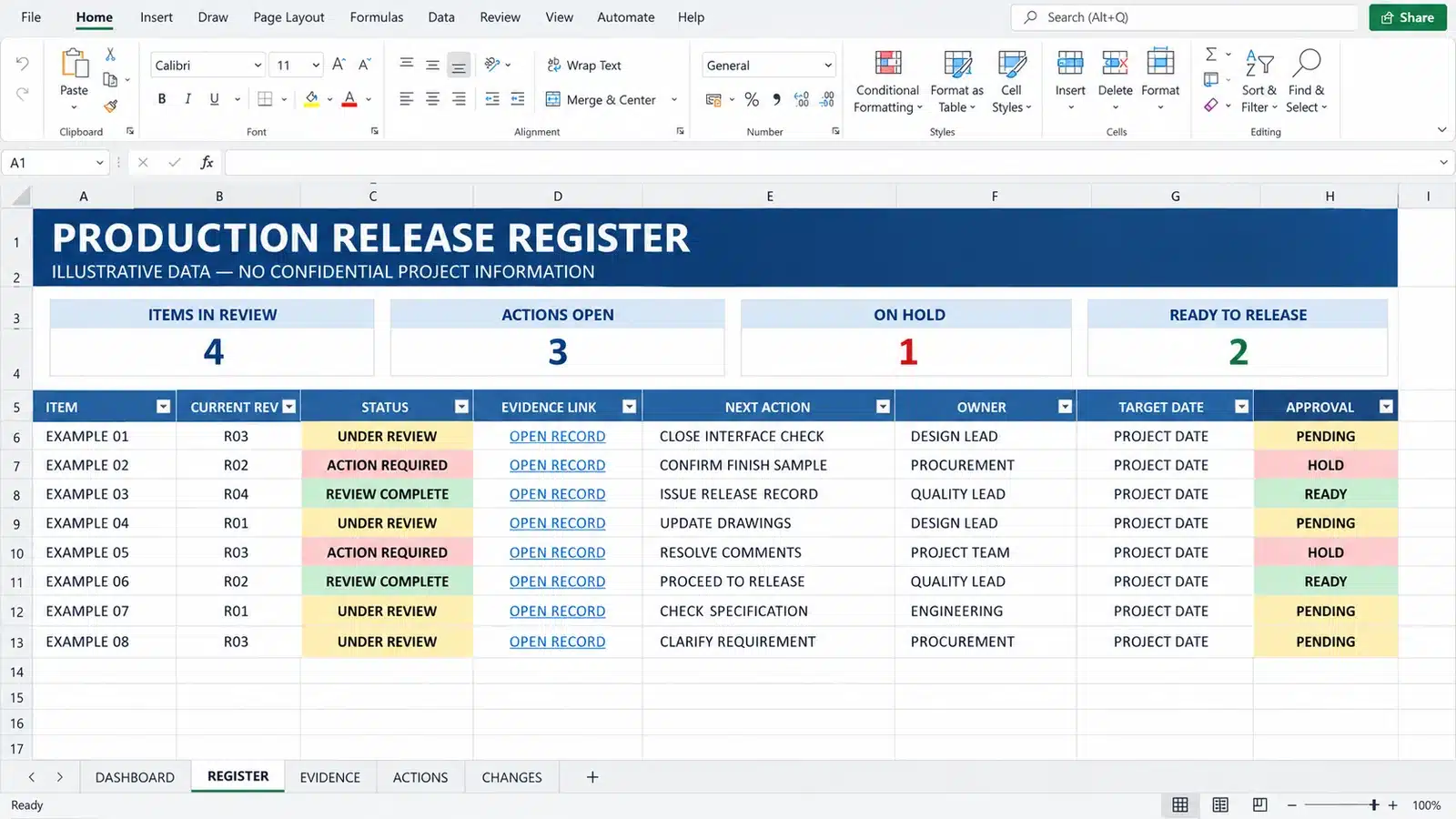
Worked design freeze example
Illustrative example: A repeat-apartment custom cabinetry package has approved layouts, carcass materials, finish samples, hardware, and typical elevations. Final site dimensions for two unit types and appliance cut-outs for one kitchen type remain unresolved. The team should not label the entire package Approved for production.
| Decision | Recorded scope | Production instruction |
|---|---|---|
| Approved | Standard carcass panels and internal shelves that are unaffected by site dimensions | May proceed using the named drawing and BOM revisions |
| Approved with conditions | Typical door fronts and hardware after final finish-board cross-check | Release only after the sample ID and drawing revision are linked |
| On hold | End panels, fillers, worktop interfaces, appliance cut-outs, and affected unit types | Do not manufacture until site dimensions and appliance data are approved |
| Change trigger | Any alteration to appliance model, opening size, finish, hardware, or apartment mix | Raise a change request and assess drawings, BOM, cost, schedule, tests, packing, and installation impact |
Why this works: The partial freeze creates a usable release without disguising unresolved interfaces. Each team can see what may proceed, what remains blocked, and what evidence closes the hold.
Common design freeze failures and corrections
Most freeze failures are traceability or boundary failures rather than a lack of meetings. Correct them before the decision enters purchasing or production.
| Failure | Resulting risk | Correction |
|---|---|---|
| An approved sample is not linked to a product code and drawing revision | The factory copies the appearance onto the wrong configuration | Record sample ID, product, finish, drawing, approver, date, and limitations together |
| The BOQ is based on an obsolete layout | Quantities, accessories, and pricing no longer match the frozen design | Reconcile the BOM and BOQ against the exact released drawings before order |
| A test report covers a different size or assembly | Compliance is assumed without evidence for the actual product | Check scope, tested configuration, dimensions, conditions, validity, and stated limitations |
| A verbal post-freeze instruction enters production | Cost, performance, inspection, and schedule impacts are hidden | Stop affected work and use the documented change process before release |
| Superseded files remain in the live production folder | Buyers, factories, or inspectors use the wrong revision | Archive superseded files and release one controlled reference set |
Design freeze should create a controlled production baseline
A sound design freeze turns a complex building material package into a controlled production reference. When scope, technical data, materials, compliance, manufacturability, validation, suppliers, logistics, and change control are reviewed together, the team can release with fewer hidden assumptions and a clearer path from approved design to physical delivery.
Frequently Asked Questions
What is a design freeze?
A design freeze is a formal milestone at which the product definition is approved for the next stage, usually production, validation, procurement, or release. Changes after that point require documented evaluation and authorization.
When should a design freeze happen?
It should happen after the design package, performance requirements, material decisions, manufacturing route, and required evidence are sufficiently complete to support the planned release. The exact timing depends on product complexity and project risk.
Does a design freeze mean no changes are allowed?
No. It means changes are no longer treated as routine iteration. Each proposed modification should be assessed for technical, compliance, cost, schedule, production, and installation impact before approval.
Who should approve a design freeze?
Approval normally involves the functions responsible for design, engineering, manufacturing, quality, procurement, and project or client authority. The required signatories should be defined before the review.
What documents belong in a design freeze package?
Typical contents include controlled drawings, CAD files, specifications, bills of materials, approved samples, test evidence, compliance documents, installation information, inspection criteria, packaging details, and the approval record.
How are open risks handled at design freeze?
Open risks should be documented with an owner, mitigation, due date, affected scope, and approval status. A risk may be accepted only when the responsible authority understands its consequences and any required controls are recorded.
What is the difference between a prototype approval and a design freeze?
Prototype approval confirms that a sample or pilot unit has been reviewed for defined purposes. A design freeze approves the broader controlled product definition, including documents, materials, production conditions, acceptance criteria, and authorized change controls.
Related products, guides, services, and project case
Use these links when the design freeze moves from general controls into product-specific coordination, approval evidence, production follow-up, and project delivery.
Relevant product packages
- Coordinate profiles, glazing, hardware, openings, test evidence, finish samples, and installation interfaces for aluminum window and door systems.
- Link elevations, site dimensions, board materials, finishes, hardware, appliance interfaces, and packing codes for custom cabinetry.
- Confirm slab selection, finish, thickness, edge details, cut-outs, support, fabrication drawings, samples, and protection for sintered stone slabs.
Related guides and service
- Control comments, resubmissions, status, and release records with the shop drawing approval process.
- Define sample criteria and keep physical references traceable through the material sample approval process.
- Coordinate revisions, approvals, samples, and release status through Drawing & Sample Coordination.
- See how cabinetry, wooden doors, tile, and sanitary ware were coordinated across repeat apartment packages in the Kenya apartment materials project.
Plan design freeze and production release with Skyland
If your project needs coordinated drawings, samples, specifications, bills of materials, production controls, inspection criteria, and shipment preparation across multiple material categories, Skyland can help define the release package and keep revisions visible through execution. Send your BOQ, drawings, or product list for a project-specific review.