A practical framework for verifying supplier identity, factory capability, quality controls, traceability, packing readiness and corrective actions
A building material supplier audit checklist turns a factory visit or document review into a traceable qualification record. It defines what the auditor should verify, which evidence supports each answer, how gaps are classified and what must happen before a sourcing or order-release decision is made.
This guide explains how to prepare and conduct the audit, use the 80-question Excel workbook and follow findings through closure. It belongs to Skyland Building’s Procurement and Sourcing resource hub. The template is designed for project teams reviewing manufacturers, trading companies, integrated suppliers and the actual factories or subcontractors that will handle the proposed building materials.
Start with the contracting entity, proposed factory, product scope and evidence request. A polished company profile does not replace records tied to the actual facility and process.
Key Takeaways
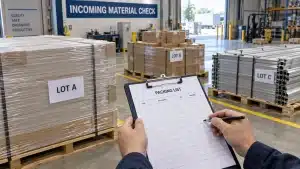
Define the product, facility, project requirements and decision the
audit must support before asking questions.Verify the legal entity, bank beneficiary, factory address and
manufacturing responsibility as separate facts. They may not be the same
organization or location.Follow evidence through the process: current specifications, incoming
materials, production records, inspection results, traceability, release
and packing.Record objective evidence and its limitations. A certificate, policy
or sample record is useful only when its identity, scope, validity and
relevance can be confirmed.Classify findings consistently, but do not allow an average score to
conceal a critical legal, safety, falsification, traceability or
product-conformity risk.Assign containment, corrective action, owner, due date and
verification evidence. A submitted procedure is not the same as an
implemented correction.Treat the workbook as a project tool, not a certification, legal
opinion or guarantee that every supplied unit will conform.
What Is a Building Material Supplier Audit
A supplier audit is a structured review of the organization, facility, people, processes and records that may affect a proposed supply scope. It asks whether the supplier can translate the project’s drawings, specifications, quantities, samples, approvals and delivery requirements into controlled purchasing, production, inspection and shipment activities.
The audit is deeper than an online supplier search and broader than a finished-goods inspection. Use the building materials sourcing guide to build and verify a shortlist, then use this checklist to examine the evidence behind the shortlisted supplier’s claims. A later pre-shipment inspection checks an identified lot of goods. The two controls answer different questions and may both be required.
Supplier Audit Factory Audit and Product Inspection
| Review | Primary question | Typical evidence | Main limitation |
|---|---|---|---|
| Supplier audit | Can this organization and supply chain control the proposed scope? | Legal identity, responsibilities, quality system, capacity, outsourced processes, records and corrective actions | Does not prove conformity of every future unit |
| Factory audit | Can this facility and its processes manufacture or handle the identified product? | Equipment, operators, work instructions, process records, maintenance, inspection and storage | May not cover the commercial entity or other factories |
| Product inspection | Does the presented lot meet defined acceptance criteria at this stage? | Samples, measurements, visual and functional checks, quantity, labels and packing | Does not establish the supplier’s wider management capability |
What the Audit Can and Cannot Decide
The audit can support prequalification, tender evaluation, conditional approval, order controls, monitoring frequency or a decision to obtain more evidence. It cannot transfer design, code, contractual, customs, labor, environmental or legal responsibilities from the appointed project professionals and responsible parties. A favorable audit also does not authorize production unless the required drawings, samples, quantities, specifications and commercial terms are separately approved.
When to Audit a Building Material Supplier
Use a risk-based trigger rather than auditing every purchase to the same depth. A desktop review may be proportionate for a low-risk standard item with credible records. A site audit is more useful when the scope is custom, high-value, schedule-critical, difficult to replace, regulated or dependent on several factories.
Before onboarding an unfamiliar supplier or paying a material deposit
for a custom order.Before awarding a multi-category package in which one company manages
partner factories or outsourced processes.When the proposed product, facility, ownership, bank beneficiary,
subcontractor or process has changed.After recurring defects, missed milestones, document inconsistencies,
complaints or weak corrective actions.Before a major repeat order when earlier evidence is outdated or the
consequences of failure have increased.When the buyer needs to verify whether a claimed capacity, test
route, traceability system or export process exists in practice.
An integrated partner may coordinate several factories. The audit should therefore test the controls described in the one-stop building materials supplier guide and identify which activities are direct, outsourced or managed by another legal entity.
Choose the Right Audit Format
| Format | Useful when | Minimum output |
|---|---|---|
| Desktop prequalification | The initial decision is whether to shortlist or request more evidence | Identity check, scope fit, document gaps and risk-based next step |
| Remote video audit | Travel is impractical and the facility can show live records, areas and processes | Agenda, live evidence log, screenshots or authorized records and unresolved items |
| On-site initial audit | The supplier or facility is new, custom or high risk | Opening meeting, process walk, sampled records, interviews, findings and closing meeting |
| Focused follow-up | Specific findings, changes or new processes need verification | Defined closure evidence and a clear statement of what was and was not rechecked |
| Surveillance audit | An approved supplier requires periodic or performance-triggered monitoring | Trend review, changed risks, sampled controls and revised monitoring plan |
Prepare the Audit Scope and Evidence Request
A generic factory checklist creates generic answers. Build the audit scope from the current procurement package and identify the requirements that could change the supplier decision. The auditor should know the proposed products, quantity or order scale, destination, required milestones, customization, critical interfaces and evidence that must exist before the audit begins.
Use the controlled product descriptions and responsibility boundaries established in the whole-house building materials RFQ guide. Stable item references, drawings, specifications, sample requirements and response fields make audit questions more testable. If the project scope is still incomplete, record the gap instead of treating the supplier’s assumption as an approved requirement.
Information to Send Before the Audit
Audit purpose, scope, date, locations, working language,
confidentiality arrangements and required attendees.Project brief, product schedule, BOQ or quantity basis, current
specifications and relevant drawings.Required standards, destination-market documentation and
client-specific qualification criteria.Requested records, sampling period and examples of recent completed
records with confidential data removed where necessary.Proposed agenda, production processes to be observed and any safety
or access requirements for the visit.
Evidence Pack to Request
| Evidence group | Examples to request | What to verify |
|---|---|---|
| Identity and scope | Registration, business license, site address, organization chart, bank-beneficiary details | Names, locations, activities, ownership of responsibilities and mismatches |
| Product and experience | Product range, similar orders, reference records, technical team and equipment list | Relevance to the proposed material, configuration, scale and schedule |
| Quality controls | Manual, procedures, inspection plans, records, calibration register, complaints and CAPA | Current use, traceability, review, closure and implementation |
| Supply chain | Approved-source list, purchase records, incoming inspection, outsourced-process controls | Identity of actual sources and how changes or nonconformity are controlled |
| Operations and delivery | Capacity basis, production plan, maintenance, warehouse, packing and loading records | Evidence behind schedule claims and product protection through dispatch |
| Compliance | Applicable permits, certificates, reports, training and incident records | Legal entity, facility, product, model, scope, issuer, dates and project relevance |

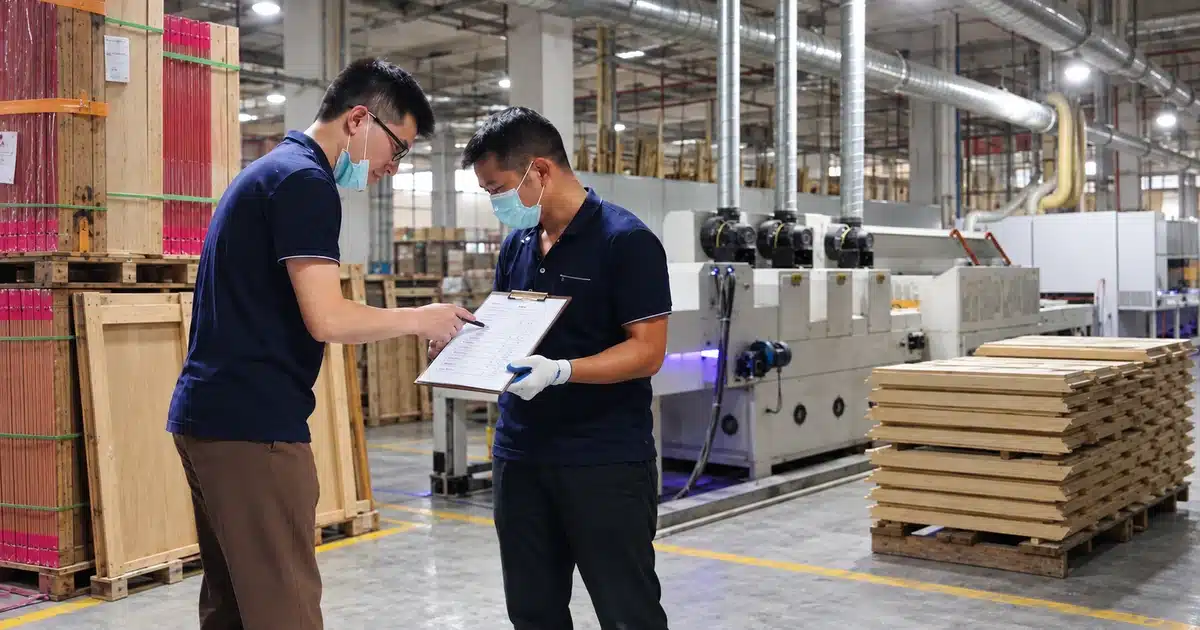
Walk the facility in process order. Compare interviews, documents and live conditions instead of scoring the presentation alone.
Building Material Supplier Audit Checklist
The downloadable workbook contains 80 audit questions grouped into 14 areas. Apply only the questions relevant to the product, facility and decision. For every answer, record the evidence reference or explain why the evidence was not available. A blank answer should not be interpreted as conformity.
1 Legal identity and facility
Confirm the contracting entity, registration, address, ownership, bank beneficiary, actual manufacturing site and permitted activities.
2 Organization and responsibility
Identify accountable commercial, technical, purchasing, production, quality and logistics roles, including deputies and escalation routes.
3 Product scope and similar experience
Verify comparable products, configurations, materials, order scale, destination requirements, references and technical competence.
4 Drawings specifications samples and change control
Check how current requirements reach work areas, how revisions are identified and how substitutions or changes are approved.
5 Supplier and incoming material control
Review source approval, purchase specifications, incoming checks, certificates, batch identity, segregation and rejected inputs.
6 Production planning and process control
Test the route from order review through work instructions, in-process checks, rework control, status identification and release.
7 Equipment maintenance and calibration
Verify capability, preventive maintenance, breakdown control and the status and traceability of monitoring or measuring equipment.
8 Inspection testing and release
Review inspection plans, methods, acceptance criteria, sampling basis, competence, records, failed results and release authority.
9 Traceability and record control
Trace a selected finished item back to the applicable order, revision, inputs, process, inspection and packing records.
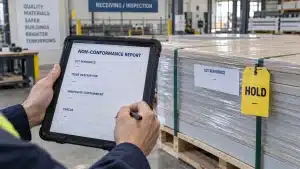
10 Nonconformance complaints and corrective action
Follow a recent issue from containment through root cause, action, verification and closure; look for recurring patterns.
11 Outsourced process and subcontractor control
Identify partner factories and special processes, approval criteria, issued requirements, monitoring, changes and incoming verification.
12 Storage packing loading and export readiness
Review protection, environmental needs, status separation, labels, countability, package references, loading controls and dispatch records.
13 Capacity continuity and schedule
Compare stated capacity and lead time with equipment, staffing, shifts, current commitments, bottlenecks, contingencies and approval dependencies.
14 Safety environment labor and legal compliance
Review applicable facility controls and records at a depth proportionate to the product, location and buyer’s obligations.
Product controls should follow the real category. For example, audit the drawing, process and inspection evidence relevant to aluminum window systems, the finish and hardware controls for custom cabinetry, or the body, glaze, batch and packing controls for architectural ceramics. Do not apply one generic checklist as if these products have identical risks.
Download the Supplier Audit Checklist Excel Template
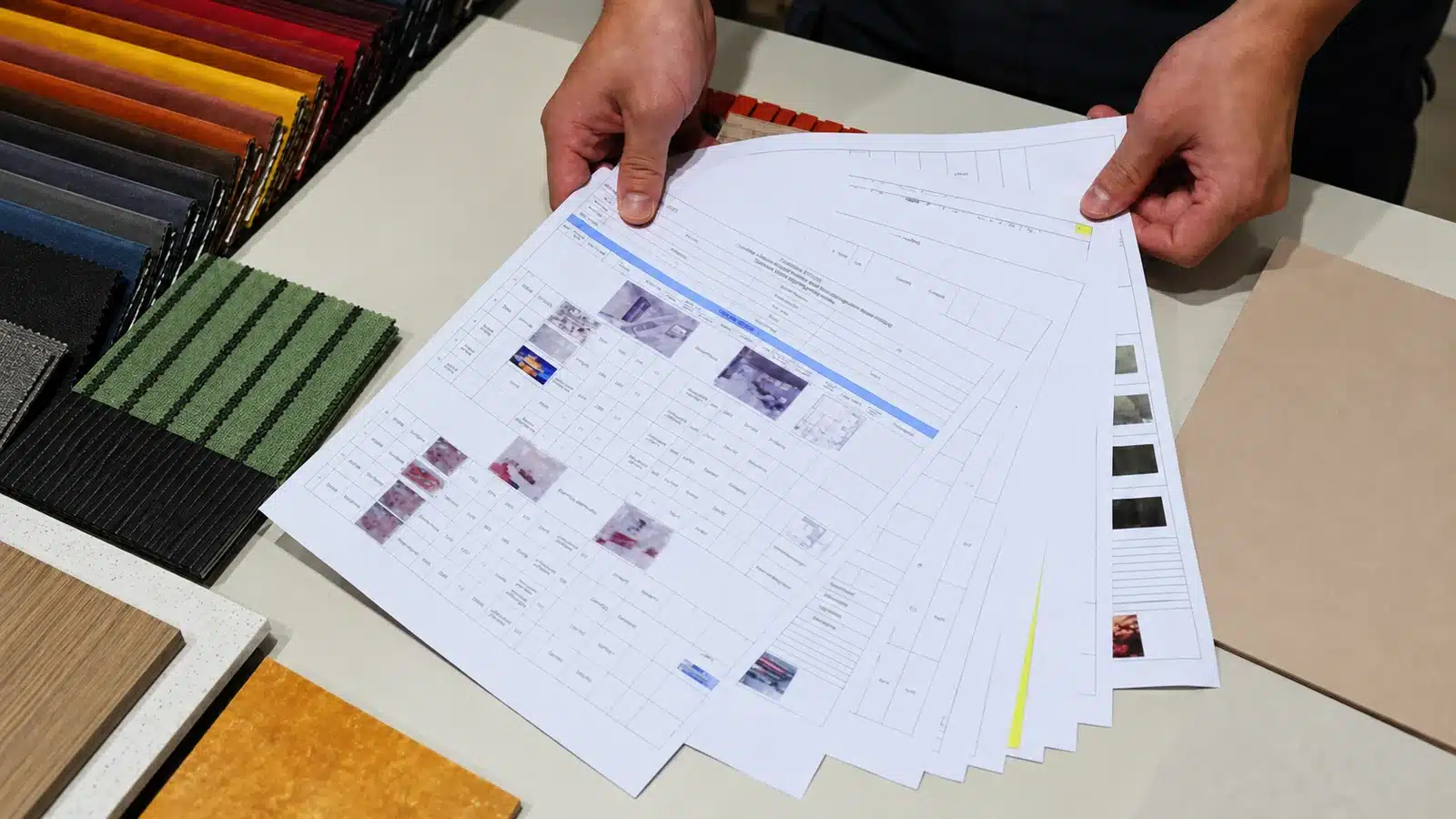
The editable workbook organizes the audit into six connected sheets: Instructions, Dashboard, Supplier Profile, Audit Checklist, Findings and Actions, and Lists and Definitions. It includes controlled dropdowns, 80 prewritten questions, evidence references, finding classifications, corrective-action tracking, formula-based coverage and risk summaries, and example entries marked for deletion.
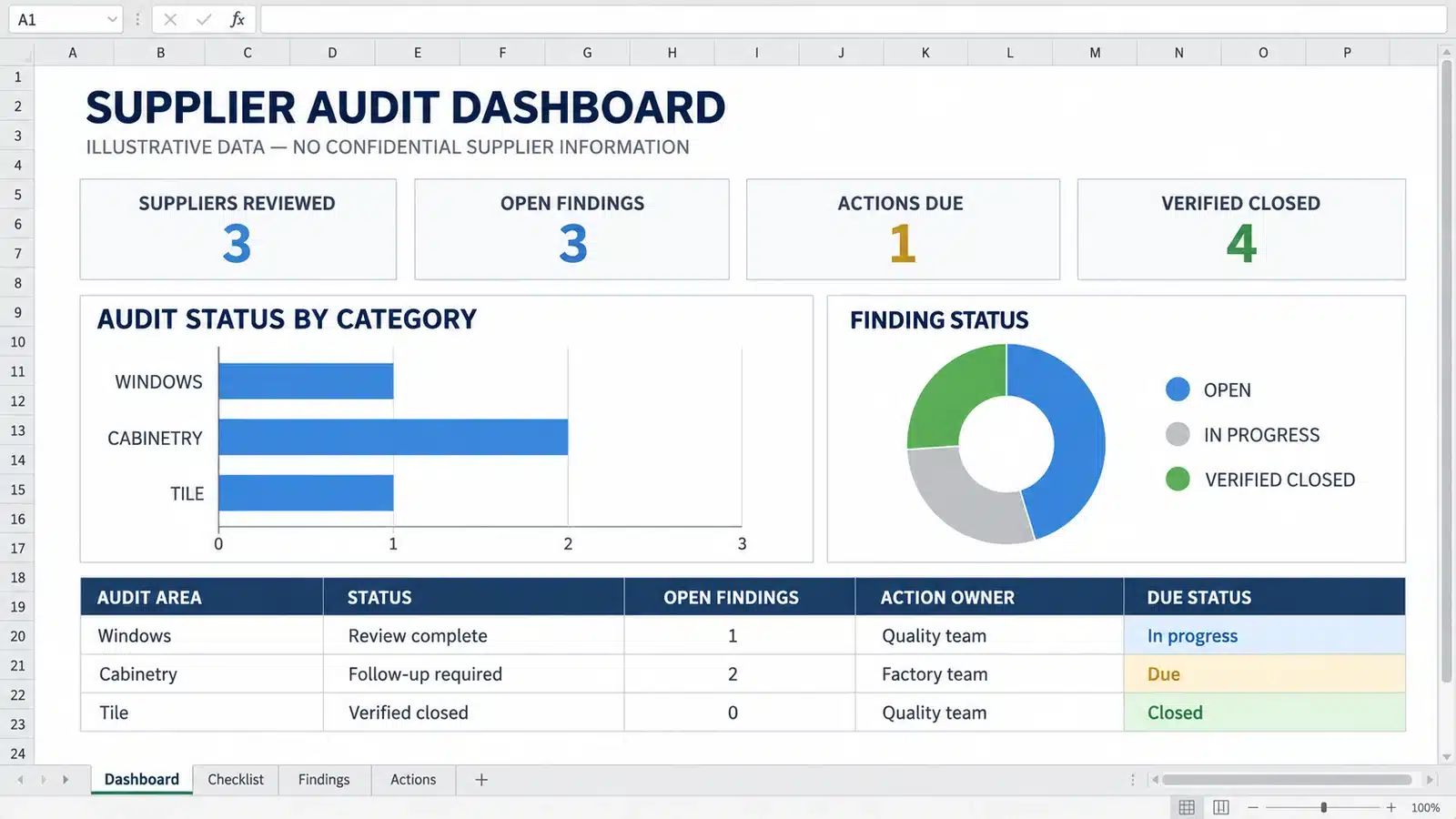
Direct Excel download. No email address is required. Delete the clearly marked training example before using the workbook for a live audit.
Download the Building Material Supplier Audit Checklist Excel Template
How to Use the Excel Supplier Audit Checklist
Read the Instructions sheet and agree the audit purpose, decision
authority, rating terms and evidence rules.Complete Supplier Profile with the project, audit ID, supplier legal
name, facility, audit type, products, proposed scope, auditors and known
outsourced processes.In Audit Checklist, mark each question Required, If Applicable or
N/A. Record a result only after reviewing relevant evidence.Use the Evidence Ref and Finding ID columns to connect checklist
answers to files, photographs, interview notes and the Findings and
Actions sheet.For every observation or nonconformity, describe the requirement,
observed condition and affected scope. Assign containment and corrective
action separately where needed.Review Dashboard for completion, finding counts and areas requiring
attention. Treat the score as an indicator, not an automatic supplier
approval.Verify implementation before closing an action. Record who verified
it, when, by which method and what evidence was accepted.Save the issued workbook with a controlled audit ID and date.
Preserve earlier versions rather than overwriting the decision
trail.
Record Objective Evidence
Objective evidence is specific enough for another reviewer to understand what was checked. Record the document title or number, revision or date, sampled transaction or lot, location, interview role, photograph reference and any limit on access. Avoid conclusions such as “good system” without the observation that supports them.
| Weak note | Stronger audit record |
|---|---|
| Certificate checked | ISO 9001 certificate reviewed; legal entity, site and scope recorded; expiry and issuing body noted; product relevance still requires project review. |
| Capacity is enough | Supplier presented Line 2 schedule and three-month load plan; current committed hours, planned shifts and stated output basis recorded; peak-period assumption remains to be confirmed. |
| Traceability works | Selected packed item PK-014 traced to work order, current drawing revision, incoming batch reference, in-process check and final release record. |
| Packing is good | Sample crate inspected against issued packing method; surface separation, corner protection, moisture barrier, item label and packing-list reference recorded. |
Classify Results and Prevent Score Masking
Use one defined result for each applicable audit question. The workbook uses Conforming, Observation, Minor NC, Major NC, Critical NC, Not Verified and N/A. These labels should be adapted to the project’s approved audit procedure before use.
| Result | Practical meaning | Typical next step |
|---|---|---|
| Conforming | Relevant evidence supports the stated criterion for the sampled scope | Retain evidence reference and continue monitoring as planned |
| Observation | No confirmed nonconformity, but a weakness or emerging risk warrants attention | Record improvement or monitoring action where appropriate |
| Minor NC | Localized failure that does not appear to undermine the full control or create immediate severe exposure | Correct within an agreed period and verify closure |
| Major NC | Systemic or significant failure that can undermine conformity, traceability, capability or delivery | Escalate the sourcing or release decision and require verified action |
| Critical NC | Potentially unacceptable legal, safety, falsification or severe product risk under the project’s criteria | Stop the affected decision or release and escalate immediately |
| Not Verified | The question was relevant, but adequate evidence was unavailable or access was limited | Keep the assessment incomplete and obtain defined evidence |
| N/A | The criterion does not apply to the identified scope | Record the reason when the exclusion is not self-evident |
The dashboard assigns 3 points to Conforming, 2 to Observation, 1 to Minor NC and 0 to Major NC, Critical NC or Not Verified. N/A is excluded. This creates an indicative conformity percentage, but the attention status separately surfaces critical findings, major findings, evidence gaps and incomplete coverage. Project teams should never use a high average to override an unacceptable individual finding.
Write a Clear Finding
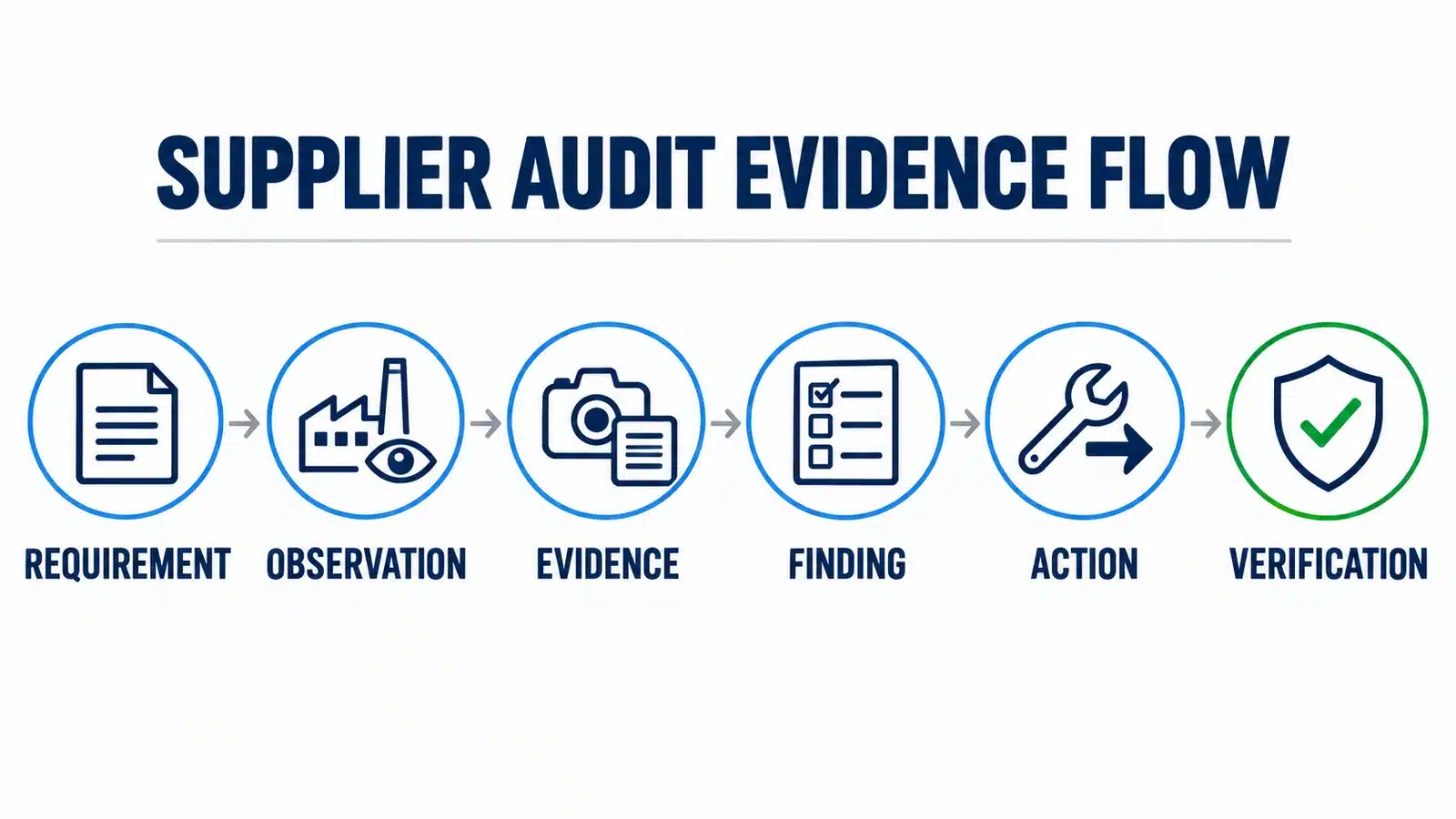
A useful finding has four parts: the applicable criterion, the observed condition, the objective evidence and the affected scope. Separate facts from interpretation. If the auditor cannot verify a required record, say what was requested, what was provided and why verification remains incomplete.
| Element | Example |
|---|---|
| Criterion | Current approved drawing revision must be available at the production workstation. |
| Observed condition | The cutting station displayed revision B while the released job package identified revision C. |
| Evidence | Work order WO-EXAMPLE-01, drawing DR-EXAMPLE-02 and workstation copy reviewed during the walk-through. |
| Affected scope | One sampled custom cabinet order; extent across other open orders not verified. |
| Classification | Major NC for the training example because uncontrolled revisions could affect repeated custom production. |
Training example only. Replace the classification and wording with the project’s actual criteria and evidence.
Supplier Audit Red Flags
The contracting name, business registration, factory signage, invoice
issuer and bank beneficiary do not align and no transparent relationship
is documented.The supplier will not identify the actual manufacturing site, partner
factory or outsourced special process before order award.Certificates or test reports show a different legal entity, product,
model, facility, standard, date or scope from the proposed supply.Capacity claims cannot be reconciled to equipment, staffing, shifts,
current orders, bottlenecks and approval dependencies.Operators use uncontrolled drawings, screenshots, chat messages or
verbal instructions instead of the current released information.Incoming materials, work in progress, rejected goods and released
goods cannot be distinguished or traced by practical references.Calibration labels or records are missing, expired or unrelated to
the measuring equipment used for acceptance decisions.The supplier presents rework as corrective action but cannot show
root cause, system change or effectiveness verification.The audit route is tightly staged, relevant areas are inaccessible,
interviews are prevented or requested records are repeatedly substituted
with presentations.Packing is generic and cannot connect units or packages to the item,
room, opening, finish, batch or loading plan required by the
project.
Filled Supplier Audit Finding Example
The workbook contains one clearly marked example in the Findings and Actions sheet. It demonstrates the link between an audit question, evidence, containment, corrective action and closure. Delete the example before using the file for a live supplier.
| Field | Illustrative entry |
|---|---|
| Finding ID | EXAMPLE-F-001 |
| Audit reference | DC-03 |
| Result | Major NC |
| Observed condition | One sampled workstation held an earlier drawing revision than the released order package. |
| Immediate containment | Pause affected cutting activity and confirm the current revision at all related workstations. |
| Corrective action | Revise document-distribution control, remove superseded copies, train responsible staff and audit open work orders. |
| Verification | Review updated procedure and distribution record; sample workstations and two open orders before closure. |
| Status | Open – training example |
Corrective Action and Follow Up
Containment protects the immediate project or lot. Corrective action addresses the cause of the control failure. The two should not be merged into a vague promise. Agree the responsible person, due date, required evidence and verification method according to risk and the next procurement milestone.
Confirm the affected products, lots, orders, locations and records
before defining containment.Require root-cause analysis proportionate to the finding; do not
accept “operator error” without examining the system that allowed
it.Specify evidence of implementation, such as revised controls, records
generated under the new process, training, equipment work or sampled
output.Verify effectiveness, not document submission alone. Recheck live
practice, records, product or a subsequent order as appropriate.Record the residual risk and the project decision: continue
monitoring, conditionally proceed, hold an activity, require re-audit or
reject the proposed scope.
If the supplier proceeds to production, connect audit actions to the project’s construction procurement schedule, approval gates and inspection plan. Open actions that affect drawings, samples, incoming materials, critical processes, release or packing should remain visible before the next milestone.
Adapt the Audit by Product Category
| Product group | Additional evidence to sample |
|---|---|
| Windows doors and glazing | System and glass identity, profile source, fabrication drawings, hardware, drainage, sealants, process checks, performance documents and frame protection |
| Cabinetry joinery and furniture | Panel and veneer source, moisture control, edge and finish process, hardware, CNC data, assembly checks, sample control, flat-pack or assembled protection |
| Tile stone and surface materials | Body or quarry source, batch or slab identity, finish and color range, calibration, dimensional checks, shade segregation, edge protection and crate orientation |
| Sanitary ware and fittings | Model and component identity, glaze or finish controls, dimensional and functional checks, connection compatibility, accessories, internal cushioning and carton labels |
| Lighting and electrical accessories | Component source, electrical design control, testing equipment, applicable reports, production tests, labeling, traceability and packaging |
Use the broader construction quality control checklist to connect supplier evidence to project inspection stages. The supplier audit evaluates capability and controls; the project inspection plan defines what the specific materials must demonstrate at each stage.
Common Supplier Audit Mistakes
Auditing without a defined product scope
A factory may look capable while lacking the exact process, material control, test route or capacity needed for the proposed item.
Scoring policies instead of implementation
A written procedure is weak evidence if operators, records and live conditions do not show that it is used.
Treating certificates as universal proof
Verify entity, site, scope, product relevance, validity and issuer. Management-system certification does not prove every product claim.
Accepting staged records only
Sample records across dates, orders, products and outcomes, including a failed case and a closed corrective action.
Ignoring outsourced processes
Special finishes, glass processing, hardware, testing, packing or entire product categories may be controlled outside the visited site.
Using one score as the approval decision
Keep critical findings, major findings and evidence gaps visible outside the average.
Closing actions on promises
Verify implementation and effectiveness with evidence generated after the action.
Failing to connect the audit to the project
Open findings must affect qualification, contract controls, inspection points, payments, release or monitoring where relevant.
How Skyland Supports Supplier and Project Coordination
Skyland Building’s project material coordination service organizes available drawings, BOQs, product schedules, finish references, approvals, supplier updates and delivery requirements around one project scope. Where agreed, supplier information and open audit actions can be connected to those controlled references rather than maintained as an isolated report.
After production, the inspection and packing service can connect identified goods, current approved references, issue records, package protection and labels to the next logistics handover. Audit support and product inspection remain scope-specific; they do not replace the project team’s approval, engineering, legal or code responsibilities.
Review Skyland’s coordinated building material product categories to identify the factories, evidence and inspection controls that may be required for a multi-category package.
Conclusion
A useful building material supplier audit starts with the proposed project scope and ends with a documented decision and verified follow-up. The strongest records connect each conclusion to a specific criterion, sampled evidence, affected product or process and responsible action. Use the Excel checklist to keep those connections visible, then adapt the depth of review to the real material, facility, destination and consequence of failure.
Need help organizing a multi-category supplier review? Send Skyland your drawings, BOQ or product list together with the proposed supplier or factory information. The team can review the available scope and clarify an appropriate coordination, audit-evidence or inspection next step.
Frequently Asked Questions
What is a building material supplier audit checklist?
It is a structured list of questions and evidence fields used to review a supplier’s identity, facility, responsibilities, capability, quality controls, supply chain, operations, records and follow-up for an identified material scope.
Is a supplier audit the same as ISO certification?
No. A buyer or second-party audit supports a sourcing decision for a defined scope. Certification is a separate conformity-assessment activity. ISO 19011 provides audit guidance but does not itself lead to certification.
When should a factory audit be completed?
Complete it before a material commitment when supplier or product risk justifies it, and repeat or focus the review after significant changes, recurring failures, weak corrective actions or an increase in project consequence.
Can a trading company pass a supplier audit?
Yes, if its role is transparent and the audit verifies how it controls technical requirements, partner factories, quality records, changes, inspections, packing and delivery. The actual manufacturing facilities may still require separate review.
What evidence should an auditor sample?
Sample current project documents, purchase and incoming records, production instructions, inspection and test records, calibration, traceability, nonconformance, complaints, corrective actions, maintenance, capacity, storage, packing and dispatch records according to scope.
How should Not Verified be treated?
It means the criterion was relevant but adequate evidence was unavailable or access was limited. Keep the assessment incomplete and define the evidence or follow-up needed; do not convert the gap into a conforming score.
Can a supplier proceed with open findings?
That depends on the project’s approved criteria, the affected scope, containment and decision authority. Critical or major findings may require a hold or escalation. Minor items may be managed through conditional action and verified follow-up.
How often should an approved supplier be re-audited?
Set the interval from product and facility risk, performance history, changes, order value, consequences of failure and earlier findings. Use performance or change triggers rather than one universal calendar interval.
Does the Excel score automatically approve a supplier?
No. The score is an indicative summary. The dashboard separately flags critical findings, major findings, evidence gaps and incomplete coverage so the responsible project team can make a documented decision.
Reference and Project Note
This article and workbook are practical procurement tools. They do not reproduce a standard, create certification or replace project-specific legal, code, engineering, environmental, labor, financial or contractual review. Audit criteria, evidence rights, confidentiality, status meanings, decision authority and corrective-action consequences should be defined in the applicable project documents and professional appointments.
ISO 19011:2026
Guidelines for auditing management systems — official ISO
overview of audit principles, audit programmes, management-system audits
and auditor competence; ISO states that using ISO 19011 does not itself
lead to certificationISO 9000
family Quality management — official ISO overview of
quality-management-system standards and principles; use the current
project requirements and verify the scope and relevance of any supplier
certificate