

A practical framework for hotel developers, designers, contractors, and procurement teams
Planning a hotel project means coordinating hundreds of repeatable items across guestrooms, bathrooms, corridors, public areas, and back-of-house spaces. This hotel building materials procurement guide explains how to turn drawings and brand requirements into an approved, traceable supply plan—from the bill of quantities (BOQ) and samples to mock-up approval, production quality control, shipping, and site handover.
Written by Winston
Project Director at Skyland Building · 10+ Years of Building Materials Experience
Updated July 2026 · 20-minute read
Scope note: This guide focuses on fixed and semi-fixed building materials and selected FF&E for hotel construction or renovation. The architect, engineers, hotel brand, operator, contractor, local authority, and procurement team still retain the approvals assigned to them in the project contracts.
Key takeaways
- Freeze scope, specifications, and approval responsibilities before asking suppliers for final pricing.
- Separate building materials, FF&E, and OS&E so that every item has one owner, one budget line, and one delivery plan.
- Approve samples, shop drawings, technical data, and a mock-up room before releasing repeat quantities.
- Compare total landed cost and project risk, not only the factory unit price.
- Use documented quality gates from first article through pre-shipment inspection and site receiving.
- Link production and shipment releases to the construction sequence, access plan, storage capacity, and installation readiness.
What hotel building materials procurement includes
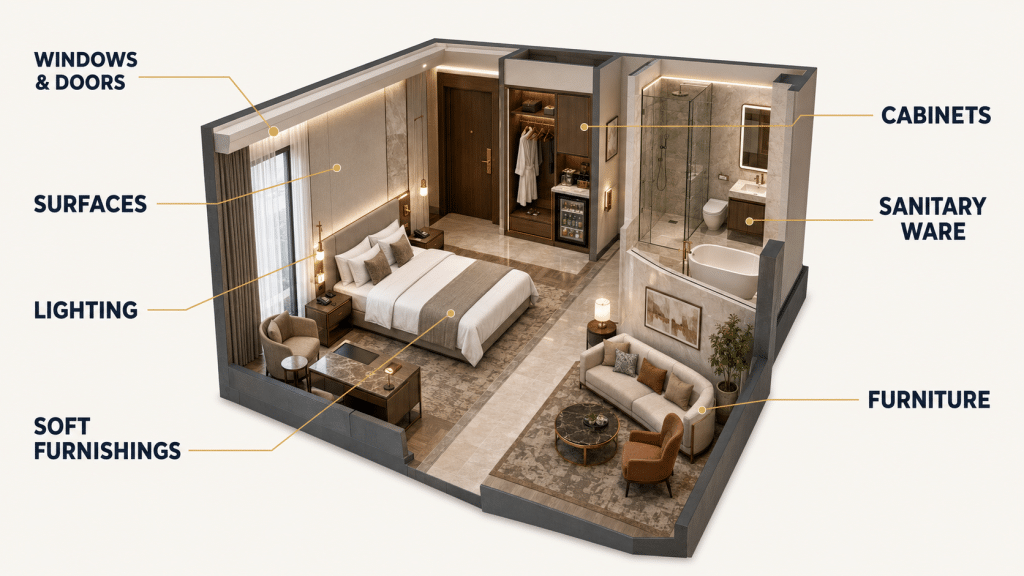
Hotel procurement often combines architectural products, interior finishes, fixed joinery, and selected furniture or decorative packages. For guestroom and public-area schedules, treat bespoke bed systems, bespoke wardrobes, luxury dining tables, and acoustic slatted wood wall panels as separate line items because dimensions, finishes, hardware, acoustic requirements, packaging, and room or zone labels differ. Skyland’s building material categories can be organized by room type and project zone, but the contract must state where the supplier’s scope stops and where the general contractor, specialist installer, FF&E buyer, or operator takes over.
Table 1. Set scope boundaries before the RFQ
| Scope | Typical examples | Responsibility check |
| Building materials and architectural products | Windows and doors; tiles, stone, and flooring; sanitary ware; fixed cabinetry and millwork; stairs and railings; selected lighting systems. | Coordinate with architectural, structural, MEP, fire/life-safety, accessibility, and local-code requirements as applicable. |
| FF&E | Guestroom and public-area furniture; decorative lighting; mirrors; curtains and soft furnishings; selected loose equipment. | Confirm brand, interior designer, operator, durability, maintenance, fire-performance, and installation approvals. |
| OS&E | Linens, amenities, tableware, kitchen smallwares, housekeeping tools, and other operating supplies. | Usually procured separately by the hotel operator or specialist OS&E team; confirm exclusions in writing. |
Important: The labels FF&E and OS&E do not have identical boundaries in every contract. Place each item once in a responsibility matrix that names the specifier, approver, buyer, shipper, receiver, installer, and warranty owner.
Why hotel material procurement is different
A hotel is not simply a large residential project. Repetition, operating requirements, brand approvals, and opening dates change the consequences of every procurement decision.
- Repeatability risk: A defect in one approved detail may be repeated across dozens or hundreds of keys.
- Operational performance: Finishes must support cleaning, maintenance, replacement, and guest comfort—not only the design render.
- Multiple decision-makers: Owner, brand, operator, designer, consultants, contractor, and procurement manager may all have approval roles.
- Long-lead packages: Custom windows, doors, cabinetry, stone, lighting, and furniture require time for drawings, samples, testing, production, and transport.
- Live-site constraints: Renovations may need floor-by-floor deliveries, guest-route separation, limited work windows, and temporary storage.
Start with a procurement brief, not a request for price
A useful quotation is only possible when suppliers price the same scope. Before issuing an RFQ, combine the architectural information, room data, performance requirements, commercial assumptions, and delivery constraints into one controlled procurement brief.
- Hotel type, service level, new-build or renovation status, project location, and intended opening or handover date.
- Key count, room-type mix, accessible-room requirements, public-area scope, and back-of-house scope.
- Current architectural, interior, reflected-ceiling, door, window, room-finish, and MEP interface drawings.
- BOQ or quantity take-off with units, room/zone allocation, calculated waste or spares, and revision number.
- Finish schedule, reference images, approved sample codes, hardware schedule, and performance specifications.
- Applicable project standards, test reports, labeling, fire/life-safety, accessibility, energy, and environmental documentation requested by the design team or authority.
- Sample, shop-drawing, mock-up, and approval process, including named decision-makers and response dates.
- Required-on-site dates, permitted partial deliveries, destination, site access, unloading, storage, and installation responsibilities.
- Warranty, spare-parts, maintenance-document, training, and closeout requirements.
For category planning, use the Whole House Building Materials Checklist as a starting inventory, then adapt it to hotel room types, public areas, brand standards, and contract responsibilities.
Eight-step hotel building materials procurement process
Use release gates rather than treating procurement as one purchase order. Each step should produce a controlled output that the next step can rely on.
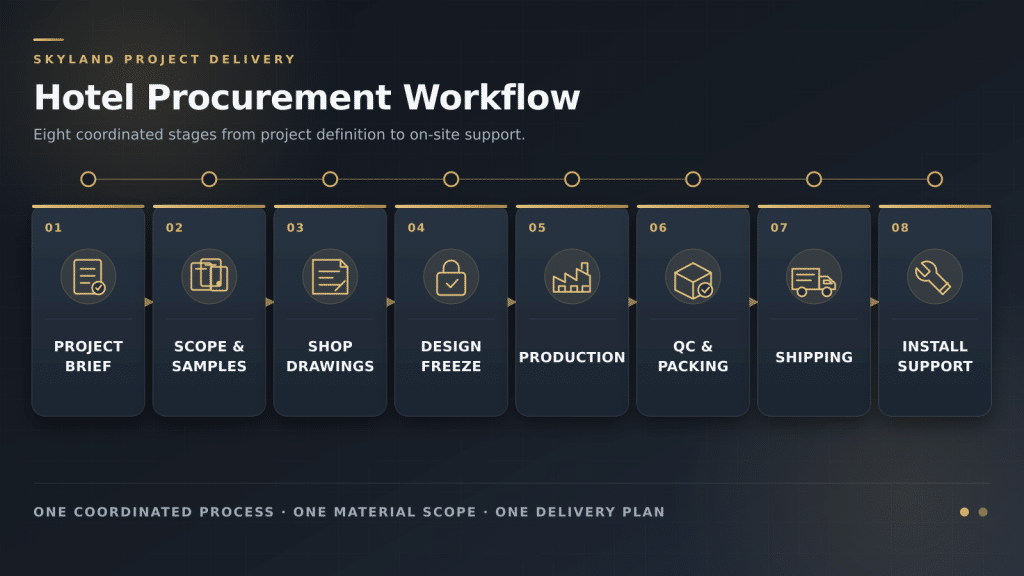
Step 1: Define scope and responsibility
Create a procurement responsibility matrix. For every package, identify who specifies, approves, buys, inspects, ships, receives, installs, commissions, and owns the warranty. Record exclusions such as structural work, MEP connections, local permits, specialist testing, or site installation instead of leaving them implicit.
Step 2: Build the BOQ and specification matrix
Link each line item to a drawing, room type, finish code, performance requirement, quantity basis, and required-on-site date. Use one master item code across quotations, samples, shop drawings, production lists, packing lists, and receiving records. A controlled matrix prevents the same product from acquiring different names in different files.
Step 3: Prequalify suppliers before detailed pricing
Shortlist suppliers with relevant production capability, documented quality processes, appropriate compliance evidence, capacity for the required volume, and experience with comparable custom work. A showroom or broad catalog is not evidence that a factory can execute the project-specific details.
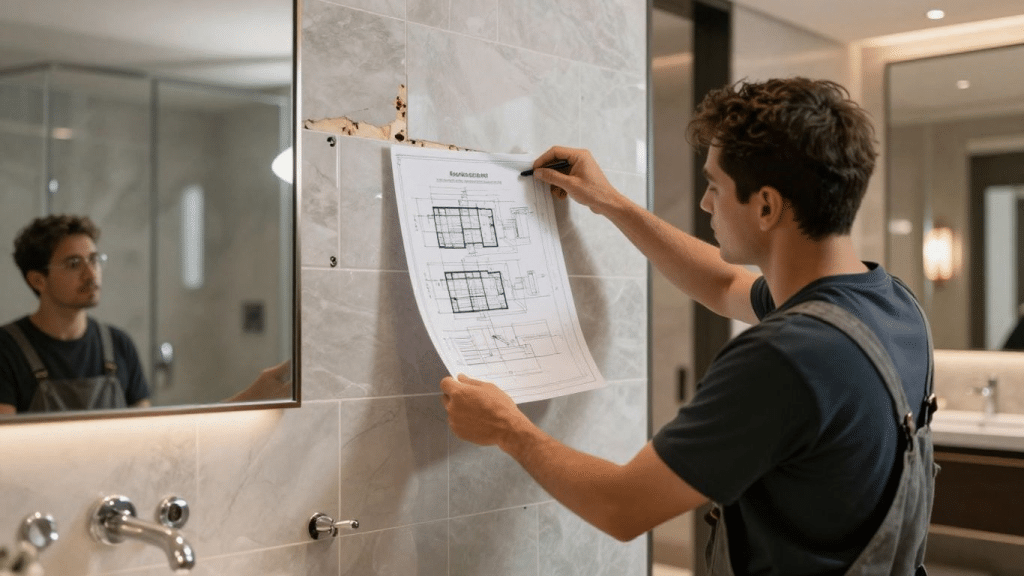
Step 4: Approve samples, shop drawings, and the mock-up room
Review samples and technical submissions together. Confirm dimensions, finishes, interfaces, hardware, maintenance access, electrical requirements, and installation tolerances before constructing a full-scale mock-up or model room. Record every comment in an approval log. The approved mock-up should become the reference for repeat guestrooms, but only after open items are closed and the design team issues a clear release.
Step 5: Compare total landed cost and commercial terms
Normalize quotations before comparison. Check that every supplier includes the same material grade, finish, hardware, testing, packaging, quantity, spare allowance, delivery point, and warranty. State the Incoterms rule and named place precisely, then align payment milestones with approvals, production evidence, inspection, and shipping documents.
Step 6: Plan production and quality gates
Issue an approved-for-production package that contains the latest drawings, sample references, quantities, tolerances, labels, and packing instructions. Define hold points for first article, in-process inspection, finish or batch review, functional checks, pre-assembly where relevant, and pre-shipment release. Changes after release require written approval and impact review.

Step 7: Pack, consolidate, and ship by installation sequence
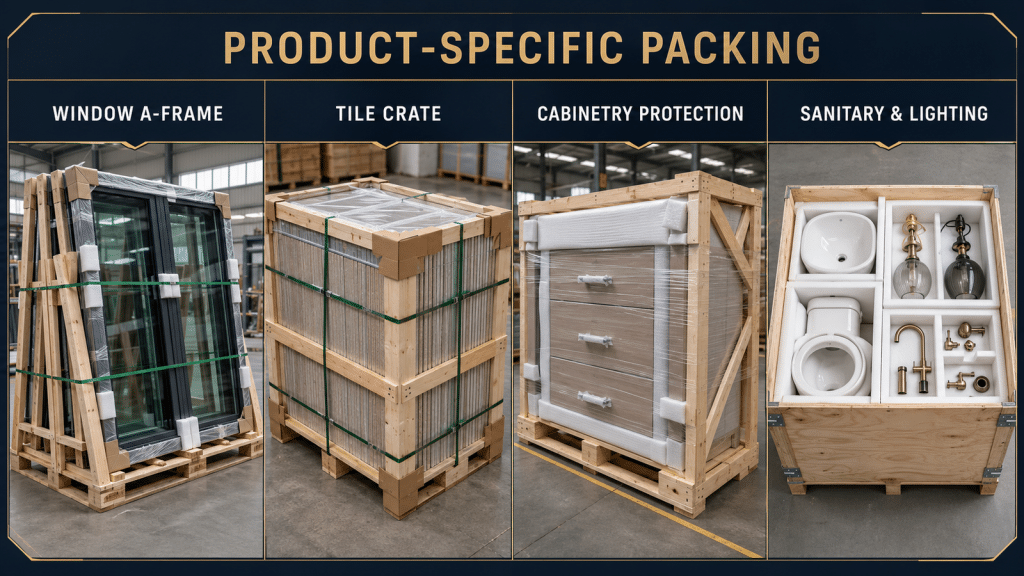
Specify product-specific protection, crate or pallet identifiers, handling marks, packing lists, and photo records. Where several categories are consolidated, plan container loading around weight distribution, product fragility, unloading order, and site priorities. Room- or zone-based labels can reduce sorting time when the shipment reaches the hotel.
Step 8: Receive, install, close out, and protect the warranty
Arrange labor, lifting equipment, protected storage, and inspection space before arrival. Check package count, condition, labels, batch or finish references, and visible damage before materials are distributed. Quarantine nonconforming items, issue a documented report, and close the project with warranties, maintenance instructions, spare parts, approved drawings, and replacement-item records.
Build a procurement schedule around approval gates
Lead time is more than factory production. Reverse-plan from the required-on-site date and include design information, supplier questions, sample transit, review cycles, mock-up correction, testing, manufacturing, inspection, packing, vessel or truck booking, customs, last-mile delivery, and site float. Do not publish generic week counts as promises; update the schedule from confirmed project data.
Table 2. Example hotel procurement control schedule
| Phase | Required output | Approval gate | Release condition |
| Scope setup | Responsibility matrix and package list | Owner / PM / design team | No duplicated or unowned scope |
| RFQ issue | BOQ, specifications, drawings, commercial schedule | Procurement manager | Bidders price the same revision |
| Technical review | Compliance matrix, deviations, shop drawings | Design team / consultants | Interfaces and exceptions resolved |
| Samples | Labeled physical samples and data sheets | Designer / brand / operator as assigned | Finish and performance references recorded |
| Mock-up | Completed room or critical assembly | Project approval team | Comments closed before repeat release |
| Production | Approved-for-production package and QC plan | Buyer / supplier / inspector | First article and hold points accepted |
| Shipment | Inspection report, packing list, loading plan, documents | Authorized release party | Nonconformities closed or dispositioned |
| Site closeout | Receiving records, warranties, spares, manuals | Contractor / owner / operator | Handover package complete |
How to evaluate hotel building material suppliers
Supplier selection should test both capability and project control. Ask for evidence that can be verified, not a collection of logos. When sourcing internationally, the guide to sourcing building materials from China provides additional questions for factory due diligence and cross-border coordination.
Table 3. Supplier prequalification matrix
| Evaluation area | Evidence to request | What to verify |
| Scope fit | Product list, factory process map, reference projects | The actual production site can make the specified product and volume |
| Engineering | Shop-drawing samples, technical team profile, RFI process | Interfaces, tolerances, and revisions can be controlled |
| Quality system | Quality plan, inspection records, calibration and NCR examples | Controls are used in production, not only described in a brochure |
| Compliance | Current test reports, certificates, labels, issuing-body details | Product, model, size, configuration, standard, scope, and validity match the project |
| Capacity and schedule | Production plan, key equipment, workload, subcontract list | Capacity and outsourced processes are transparent |
| Sample and mock-up | Sample register, prototype plan, approval response | Approved references can be repeated at production scale |
| Packaging and logistics | Packing drawings, labels, loading examples, export records | Protection and documentation suit the transport route and site |
| Commercial and after-sales | Quotation exclusions, warranty, spares, claims process | Responsibilities remain clear after shipment |
Certification note: ISO 9001 relates to a quality management system; it is not a universal product approval. Verify the certificate issuer, scope, validity, and production site, then separately verify every product-specific test or approval required by the project.
Set material-specific quality checks
A generic factory inspection cannot replace product-specific acceptance criteria. The project team should define measurable checks from the approved specification, drawings, samples, applicable standards, and local authority requirements.
Table 4. Typical quality-control focus by hotel material category
| Category | Key checks | Records to retain |
| Windows and doors | Dimensions; profile and glass build-up; hardware; gaskets and seals; finish; drainage; operation; project-specified performance and labels. | Approved drawings, material records, test reports, inspection results, hardware list, serial or batch data where used. |
| Tiles, stone, and flooring | Size and thickness; caliber or batch; shade and texture; edge and surface condition; layout; backing; project-specified slip, absorption, wear, or finish data. | Sample codes, batch records, layout or cutting drawings, technical data, packing and crate list. |
| Cabinetry and casegoods | Overall and opening dimensions; substrate; veneer or laminate; color and gloss; edge treatment; hardware; assembly; interfaces and service access. | Shop drawings, approved finish sample, hardware schedule, first-article report, room or item labels. |
| Sanitary ware and fittings | Model and finish; connection dimensions; accessories; operating function; water-use or pressure data and approvals when specified; replacement parts. | Data sheets, approval documents, model list, inspection photos, spare-parts and warranty list. |
| Lighting and electrical items | Voltage and frequency; driver; dimming or controls; CCT and CRI; finish; mounting; IP or other project ratings; required electrical and fire documentation. | Approved schedule, sample, photometric or technical data where required, certificates, wiring and installation information. |
| Furniture and soft furnishings | Dimensions; structure and stability; joinery; finish; upholstery and textile references; hardware; comfort; project-specified durability and fire performance. | Approved drawings, control sample, test records where required, room list, care and maintenance information. |
Compare total landed cost, not only unit price
The lowest quoted product price can become the most expensive option after omissions, rework, separate shipments, storage, or replacement. Build one landed-cost model for each compliant bid and record assumptions next to the numbers.
Table 5. Cost components for a comparable bid
| Cost component | Include in the comparison |
| Product | Approved materials, finishes, hardware, accessories, quantities, waste or spare allowance, and stated exclusions. |
| Development | Samples, mock-up items, shop drawings, molds or tooling, testing, and approvals. |
| Quality | Factory visits, third-party inspection, laboratory testing, reinspection, and corrective work. |
| Packaging | Crates, pallets, A-frames, moisture protection, corner protection, labels, and special handling. |
| Transport | Factory pickup, export handling, main carriage, cargo insurance, destination handling, customs broker, duties and taxes. |
| Site | Last-mile delivery, permits, lifting, unloading, storage, demurrage or detention exposure, installation, commissioning, and protection. |
| Lifecycle | Maintenance, consumables, replacement availability, spare parts, warranty response, energy or water performance where relevant. |
Value engineering should preserve the required function, compliance, maintainability, visual intent, and guest experience. Every proposed substitution should show the technical difference, visual difference, cost effect, schedule effect, maintenance effect, and approval status. Do not release it on a verbal agreement.
Plan packaging, consolidation, and international logistics
Shipping is part of the product design. A finished item can meet the drawing and still arrive unusable if the protection, loading, moisture control, or handling plan does not match its risk profile.
- Use A-frames or engineered supports for glazed units where appropriate, rigid crates for stone or fragile tiles, corner and face protection for cabinetry, and compartmentalized cartons for smaller sanitary or lighting items.
- Label every package with project, category, item code, room or zone, quantity, gross weight, dimensions, handling marks, and packing-list reference.
- Create a container or truck loading plan that considers weight, center of gravity, securement, fragility, unloading order, and site priorities.
- Photograph packing and loading, record seal numbers where used, and reconcile the commercial invoice, packing list, bill of lading or waybill, certificates, and other destination-required documents.
- State the exact Incoterms 2020 rule and named place. Incoterms allocate selected obligations, costs, and risk between buyer and seller; they do not replace the sales contract or determine tariff rates.
For a detailed factory-to-site checklist, see Transporting Construction Materials.
Reference: ICC Incoterms rules explain the recognized trade terms and the allocation of buyer and seller obligations.
Control receiving, installation, and handover
Delivery is a quality gate, not the end of procurement. The receiving team needs the packing list, approved item schedule, inspection criteria, photo process, nonconformance route, and protected storage plan before the truck or container arrives.
- Confirm access, delivery window, lifting equipment, labor, traffic controls, storage area, weather protection, and safe unloading method.
- Count packages before distribution and check exterior condition, impact indicators where used, moisture exposure, labels, and seals.
- Open an agreed sample of packages promptly and inspect priority or fragile items while carrier and insurance notification windows are still available.
- Separate accepted, damaged, short, and pending-inspection items. Issue a dated nonconformance report with item code, quantity, evidence, responsibility, and required action.
- Approve the first installed item or room before repeating installation. Protect finished work from later trades.
- Close out with as-built or final approved drawings, warranties, maintenance instructions, spare parts, test and commissioning records, and a replacement-item register.
Common hotel procurement mistakes
- Requesting final prices before the scope, quantities, finishes, interfaces, and delivery assumptions are stable.
- Allowing building materials, FF&E, OS&E, installation, and commissioning responsibilities to overlap or fall between contracts.
- Selecting a supplier mainly on unit price without normalizing specifications, exclusions, quality, logistics, and after-sales support.
- Releasing bulk production before samples, shop drawings, performance documents, and the mock-up are approved.
- Accepting undocumented substitutions or approvals through informal messages that do not update the controlled schedule.
- Using vague terms such as ‘high quality’ instead of measurable acceptance criteria and approved reference samples.
- Scheduling production and shipping independently from room turnover, site access, storage, and installation readiness.
- Ignoring duties, destination charges, insurance, last-mile constraints, demurrage, storage, spares, maintenance, or replacement availability.
How Skyland supports hotel building material procurement
Skyland Building, a sub-brand of George House Material, coordinates selected multi-category building materials and interior products for international hotel new-build and renovation projects. Depending on the approved scope, packages may include windows and doors, cabinetry, tiles and stone, flooring, sanitary ware, stairs and railings, lighting, furniture, and soft furnishings.
- Review drawings, room schedules, finish references, BOQs, and delivery priorities to identify missing information and scope interfaces.
- Coordinate product selection, samples, technical data, 2D/3D product drawings, and shop-drawing submissions.
- Organize custom manufacturing, production updates, documented quality checks, product-specific packing, and consolidated shipping planning.
- Provide product installation guidance and closeout information within the agreed supply scope.
Service boundary: Skyland does not replace the project’s licensed architect, engineers, code consultants, hotel brand, general contractor, customs broker, or local authority. Project-specific compliance, design approval, import requirements, installation, and commissioning responsibilities must be assigned in the contract.
For a coordinated quotation, send project location, hotel type and key count, drawings, room schedule, BOQ, finish references, required standards, target budget, and required-on-site dates. Contact Skyland Building to review the procurement scope before final pricing.
Hotel building materials procurement checklist
Use this checklist as a release review. Add project-specific requirements rather than treating it as a substitute for the drawings, specifications, contracts, or local codes.
Design and scope
- Room types, public areas, back-of-house areas, accessible rooms, and renovation phases are identified.
- Building materials, FF&E, OS&E, installation, commissioning, and warranty responsibilities are assigned.
- BOQ lines reference current drawings, finish codes, room or zone locations, units, quantities, and revision dates.
- Performance, compliance, maintenance, and brand requirements are written for each package.
Commercial and supplier review
- Bidders receive the same RFQ package and disclose exclusions, deviations, subcontracted processes, and quotation validity.
- Supplier capability, production site, quality process, capacity, schedule, compliance evidence, references, and after-sales support are verified.
- Quotations are normalized to total landed cost, and the Incoterms rule and named place are stated precisely.
- Payment milestones, change control, inspection rights, claims, warranty, spares, and document deliverables are contractual.
Pre-production approval
- Samples are labeled with project, supplier, product code, finish, date, and approval status.
- Shop drawings and technical data resolve dimensions, tolerances, interfaces, hardware, connections, and installation requirements.
- The mock-up room or critical assembly is reviewed by the assigned approvers, and comments are closed.
- The approved-for-production package and change-control process are issued in writing.
Production and logistics
- Quality plan, first-article checks, in-process hold points, pre-shipment inspection, and nonconformance process are agreed.
- Production status and forecast completion dates are updated against the site program.
- Packing method, labels, handling marks, room or zone allocation, loading plan, documents, insurance, and shipment release are approved.
- Site access, unloading equipment, labor, storage, delivery sequence, and installation readiness are confirmed before dispatch.
Receiving and closeout
- Receiving records capture package counts, condition, damage, shortages, batch or finish references, photos, and actions.
- The first installed item or room is checked before repeat installation.
- Nonconformities are closed with documented repair, replacement, concession, or other approved disposition.
- Warranties, maintenance information, spares, approved drawings, certificates, test records, and replacement references are handed over.
Frequently asked questions
When should hotel building materials procurement start?
Start during design development, when room types, material intent, performance requirements, and major interfaces are clear enough for supplier input. Long-lead packages should be identified early, but final production should wait for controlled approvals.
What documents are needed for a hotel material quotation?
At minimum, provide the project location, hotel type and key count, current drawings, room schedule, BOQ or quantity basis, finish schedule, technical requirements, approval process, required-on-site dates, delivery point, and requested commercial terms.
What is the difference between building materials, FF&E, and OS&E?
Building materials and architectural products are generally incorporated into the building or fixed fit-out. FF&E covers furniture, fixtures, and equipment with a longer asset life. OS&E supports day-to-day operation. Contract definitions vary, so confirm the responsibility matrix for the specific project.
Why is a hotel mock-up room important?
It tests how drawings, finishes, lighting, sanitary items, cabinetry, furniture, clearances, controls, maintenance access, and installation methods work together before the same decisions are repeated across many rooms.
Is one-stop procurement always better than separate suppliers?
A coordinated supplier can reduce interfaces, duplicate communication, separate inspections, and fragmented shipping, but only when it has credible category capability and transparent controls. Specialist packages may still need separate suppliers. Choose the structure that best manages the project’s risk.
How should hotel material lead time be calculated?
Count information release, supplier clarification, samples, shop drawings, approval cycles, mock-up correction, testing, production, inspection, packing, booking, transit, customs, last-mile delivery, and site float—not only factory days.
How do imported materials meet local codes?
The project team must identify the exact jurisdiction, product configuration, applicable standards, test or certification evidence, labeling, and approval route. Verify documents before award and again before shipment; supplier claims alone are not sufficient.
How should substitutions be controlled?
Require a written substitution request that compares the approved and proposed products, including technical performance, appearance, dimensions, interfaces, maintenance, compliance, cost, schedule, and sample status. Update the controlled documents only after authorized approval.
How many spare materials should a hotel order?
There is no universal percentage. Set the quantity by damage risk, batch variation, future replacement difficulty, room count, maintenance strategy, lead time, storage limits, and contract requirements. Record spares as separate BOQ lines.
Which Incoterms rule should a hotel project use?
The right rule depends on transport mode, buyer and seller capability, export and import arrangements, insurance, and the desired delivery and risk-transfer point. Use the current ICC rules, name the place precisely, and align the rule with the sales contract and logistics plan.
Turn the guide into project release gates
A useful hotel building materials procurement guide does more than list products. It connects design information, responsibility, approvals, supplier capability, cost, quality, logistics, installation, and closeout in one traceable workflow. When each release is supported by current documents and objective evidence, the project is less exposed to repeated defects, late substitutions, fragmented shipments, and avoidable site delays.
Next step: Compile the project brief and send Skyland Building the drawings, room schedule, BOQ, finish references, project location, and target delivery dates for a coordinated scope review.
Next Steps for Your Project
Topic hub: BOQ & Project Planning Guides
Relevant product pages: Bespoke Luxury Bed Systems · Bespoke Wardrobes · Luxury Sanitary Ware Systems
Related guides: Whole House Building Materials Checklist · How to Source Building Materials from China
Related service: Project Material Coordination