
A practical buyer’s guide to thermal performance, strength, sightlines, climate exposure, cost, testing, quality control, and installation
Quick answer: In the uPVC vs. aluminum windows comparison, uPVC is often the practical starting point for standard residential openings where baseline frame insulation and cost control matter. Thermally broken aluminum is often preferred for larger spans, slimmer sightlines, demanding wind loads, and a wider range of architectural finishes. Neither material is automatically better. Compare the exact whole-window system using the same glass and operation, then verify tested size, U-factor, SHGC, air, water, structural performance, hardware, finish, installation, and total delivered cost.
A frame material is only one part of a window. Glass, spacer, seals, reinforcement or thermal barriers, hardware, drainage, fabrication, opening type, size, anchors, flashing, and site installation can change the result more than a generic material label. This guide explains how to compare uPVC and aluminum on equal terms and how to turn the decision into a clear project specification.
Written by Winston
Project Director at Skyland Building · 10+ Years of Building Materials Experience
Updated July 2026 · 26-minute read
Key Takeaways
- Compare complete windows, not raw materials. A tested whole-product rating includes the frame, sash, glass, spacer, seals, and configuration; a frame-only or center-of-glass value is not an equivalent substitute.
- uPVC usually starts with a thermal advantage. Rigid PVC conducts less heat than aluminum, but chamber design, reinforcement, glazing, seals, dimensions, and fabrication still control the final window rating.
- Aluminum usually starts with a structural advantage. Its strength-to-weight ratio can support slim profiles and larger openings, but the approved size, mullions, glass, hardware, anchors, and design pressure must be checked for the exact series.
- Climate changes both choices. Hot sun, indoor humidity, salt, wind-driven rain, wind pressure, and temperature range affect profile color, thermal barriers, reinforcement, finishes, fasteners, drainage, and maintenance.
- Lowest unit price is not lowest project cost. Compare like-for-like glass, hardware, finish, tests, packing, freight, installation, access, maintenance, repairability, and replacement risk.
- Local approval controls the specification. The project architect, structural engineer, energy consultant, installer, and authority having jurisdiction must confirm code requirements, design pressures, interfaces, and acceptance criteria.
1. What Are uPVC and Aluminum Window Systems?
uPVC means unplasticized polyvinyl chloride, also called rigid PVC. In North America, windows made from rigid PVC are commonly described as vinyl windows. The profiles are typically extruded with internal chambers. Steel or other reinforcement may be added where the system design, opening size, color, wind load, hardware, or local specification requires it; it should not be assumed from the word uPVC alone.
Aluminum window frames are made from extruded profiles joined into fixed frames, sashes, mullions, and transoms. For conditioned buildings, a thermally improved or thermally broken system normally uses a low-conductivity separator between interior and exterior aluminum sections. The barrier may be a polyamide strut or another tested system. An aluminum frame should not be described as thermally broken unless the exact construction and rating support that claim.
| System feature | uPVC windows | Aluminum windows | What the buyer should verify |
| Primary frame material | Rigid PVC extrusion, commonly multi-chambered | Aluminum extrusion; may be non-thermal, thermally improved, or thermally broken | Exact series, section drawings, material or profile specification, and supplier |
| Internal structure | Profile chambers; reinforcement may be system- and size-dependent | Hollow or multi-cavity extrusions; thermal barrier where specified | Reinforcement schedule or thermal-barrier construction for each opening |
| Typical visual tendency | Wider frame and sash sections in many residential systems | Slimmer visible sections are often possible | Approved sightline drawing, glass bite, drainage, and tested size |
| Surface appearance | Integral color, co-extruded surface, foil, laminate, or coating depending on system | Powder, liquid coating, anodized finish, or other approved treatment | Exact color, gloss, texture, exposure class, sample, and warranty conditions |
| Common project role | Standard residential windows, repetitive openings, energy- and budget-led packages | Large openings, slim architectural systems, commercial work, high structural demand | Do not rely on the tendency; compare the exact product data and opening schedule |
2. uPVC vs. Aluminum Windows: Quick Comparison
The following tendencies are useful for shortlisting, but they are not performance guarantees. Product series, size, glass, reinforcement, thermal barrier, seals, hardware, fabrication, testing, and installation can reverse a generic material-level assumption.
| Criterion | Typical uPVC tendency | Typical aluminum tendency | Decision rule |
| Whole-window thermal performance | Often achieves a strong frame contribution without a separate thermal break | Non-thermal frames conduct heat readily; well-designed thermal breaks can improve performance substantially | Compare certified whole-product U-factor for the same size, operation, and glass |
| Strength and large sizes | Often needs wider sections, reinforcement, mullions, or tighter size limits | High strength-to-weight ratio often supports larger units and slimmer profiles | Use the tested or engineered maximum size and project design pressure |
| Sightlines | Frequently wider, especially for operable sashes | Frequently slimmer, especially in architectural systems | Approve elevations and section details, not brochure adjectives |
| Colors and finishes | Color and foil range depends on profile system; dark surfaces require heat-build-up review | Broad coating and anodized finish choices; exposure and pretreatment matter | Approve physical samples and the finish standard for the actual environment |
| Coastal exposure | PVC does not rust, but reinforcement, hardware, fasteners, and screens may corrode | Finish, pretreatment, cut edges, fasteners, drainage, and cleaning control durability | Review every exposed component, not only the visible frame |
| Initial cost | Often lower for standard residential configurations | Often higher for thermally broken, slim, large, or premium-finish systems | Compare total installed and delivered cost on one specification |
| Maintenance | No repainting for many integral-color systems, but seals, hardware, drainage, and surfaces still need care | Durable finishes are available, but seals, hardware, drainage, and coastal surfaces still need care | Use the manufacturer’s written cleaning and maintenance plan |
| Best starting point | Standard-sized, cost-sensitive, thermally focused residential openings | Large, slim, structurally demanding, design-led, or commercial openings | Shortlist first, then confirm complete product evidence |
3. Thermal Performance and Condensation
Rigid PVC is a lower-conductivity frame material than aluminum. This can help uPVC systems reduce heat flow through the frame. Aluminum needs an effective thermal-barrier design when energy performance and interior surface temperatures are important. However, material conductivity does not equal whole-window performance.
For a fair comparison, request whole-product ratings for the exact window configuration. NFRC identifies U-factor, solar heat gain coefficient (SHGC), visible transmittance, air leakage, and condensation resistance as separate ratings. ENERGY STAR also applies U-factor and SHGC criteria by climate zone in its U.S. residential program. These are useful examples, but the locally adopted code and project energy model control the final target.
| Metric | What it describes | What to compare | Common mistake |
| U-factor | Rate of heat transfer through the complete product; lower is better | Whole-window value for the same size, operation, and glass build-up | Using center-of-glass or frame-only data as a whole-window value |
| SHGC | Fraction of incident solar heat admitted; the desired level depends on climate and design | Whole-product value, orientation, shading, and cooling/heating strategy | Assuming the lowest SHGC is best for every facade and climate |
| Visible transmittance | Amount of visible light admitted | Daylight needs, glass coating, tint, privacy, and glare control | Selecting a dark coating or tint without checking daylight impact |
| Condensation resistance | Relative ability of a product to resist interior surface condensation under rating conditions | Whole assembly, interior humidity, exterior temperature, spacers, frames, and installation | Claiming a thermal break makes a window condensation-proof |
| Air leakage | Uncontrolled air passage through the tested unit | Tested product, operation, size, pressure, seals, and hardware | Assuming a low U-factor also proves airtightness |
Glass frequently dominates the glazed area, so low-e coating, pane count, gas fill, spacer, glass thickness, and edge construction must stay the same when comparing frames. A high-performance uPVC window can underperform if the glass, seals, or fabrication are weak; a well-designed thermally broken aluminum window can meet demanding targets when the complete assembly is properly rated.

4. Strength, Opening Size, and Sightlines
Aluminum’s strength-to-weight ratio often makes it the more flexible starting point for floor-to-ceiling fixed glass, wide sliding panels, tall casements, commercial punched windows, and assemblies exposed to high design pressures. It can also permit narrower visible frame sections. This does not mean every aluminum product is strong or every uPVC product is limited to small windows.
For uPVC, reinforcement, sash dimensions, mullion layout, glass weight, hinge capacity, welding or corner construction, color, and temperature exposure may set practical limits. For aluminum, extrusion wall thickness, alloy and temper, corner joints, mullions, glass support, hardware, anchors, and thermal-barrier geometry matter. The supplier should provide approved sizes or engineering for each opening, not one generic maximum.
| Opening condition | uPVC review | Aluminum review | Evidence required |
| Standard residential casement or awning | Check reinforcement rules, sash size, hinge quantity, drainage, and welding quality | Check thermal break, hardware, corner assembly, drainage, and coating | Series data, exact size, air/water/structural result, hardware schedule |
| Large fixed picture window | Check frame deflection, reinforcement, mullions, glass support, and transport size | Check profile inertia, mullions, glass bite, deflection, anchors, and transport size | Opening-specific calculation or validated size range and glass specification |
| Wide sliding window or door-like unit | Check panel weight, reinforcement, interlocks, rollers, track, and thermal movement | Check interlock, roller load, track drainage, thermal break, and panel deflection | Tested panel size, hardware load, sill detail, operating sample, and shop drawing |
| High-wind facade | Check pressure class, reinforcement, mullions, anchors, glass, and water test | Check pressure class, extrusion, anchors, glass, joints, and water test | Project design pressure and report matching product, size, and configuration |

Large glazed openings often favor aluminum for structural efficiency and slimmer sightlines, subject to the exact system’s tested size and design pressure.
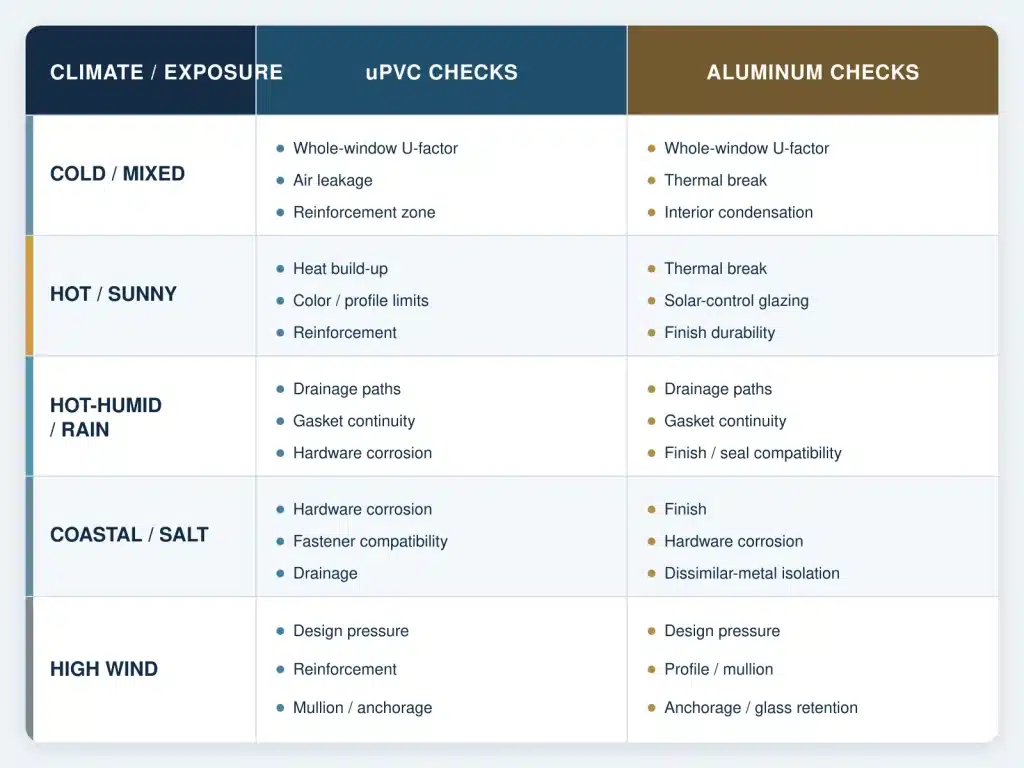
5. Climate and Exposure Suitability
A material choice should respond to both regional climate and site exposure. A coastal project can also be hot-humid and high-wind; a cold-climate building can have high indoor humidity and severe condensation risk. Use the project conditions to write performance requirements before selecting a frame.
| Condition | uPVC priorities | Aluminum priorities | Both systems must address |
| Cold or mixed climate | Whole-window U-factor, chamber and reinforcement effects, seals, spacer, installation air seal | Effective thermal barrier, whole-window U-factor, interior surface temperature, seals | Low-e IGU, spacer, air leakage, condensation risk, sill and perimeter air sealing |
| Hot-dry or intense solar exposure | Profile heat resistance, dark-color approval, heat build-up, expansion allowance, finish warranty | SHGC, thermal barrier, coating color and durability, expansion joints, touch temperature where relevant | Solar control glass, orientation, shading, sealant compatibility, installation movement |
| Hot-humid or heavy rain | Drainage, welded and mechanically joined details, hardware corrosion, seals, cleaning | Drainage, corner sealing, coating, hardware corrosion, seals, cleaning | Water penetration test, sill pan, flashing, exterior weather seal, interior air seal |
| Coastal salt exposure | Corrosion protection for reinforcement, hardware, fasteners, screens, and anchors | Pretreatment, coating or anodizing, cut-edge protection, compatible fasteners, metal isolation | Exposure category, written maintenance frequency, drainage, protected packing and site storage |
| High wind or wind-borne debris | Reinforcement, pressure rating, anchors, mullions, glass retention, impact configuration where required | Profile inertia, pressure rating, anchors, joints, glass retention, impact configuration where required | Project design pressure, correct test standard, tested size, glass, hardware, and installation |
| Urban noise | Seal continuity, frame and sash rigidity, laminated/asymmetric glass, installation | Seal continuity, frame and sash rigidity, laminated/asymmetric glass, installation | Acoustic report for the complete configuration; avoid inferring performance from frame material |
For rigid PVC profiles, a recognized specification such as AAMA 303-23 addresses factors including dimensional stability, impact resistance, weatherability, heat resistance, and heat build-up. The correct standard and edition must match the project jurisdiction and the supplier’s claim; citing a standard name is not a substitute for a compliant profile and complete-window test..
6. Durability, Finishes, and Maintenance
uPVC durability
Rigid PVC does not rust or rot, but the window is more than the visible PVC surface. Reinforcement, screws, hardware, screens, anchors, and accessories can corrode. Long-term appearance depends on the formulation, weatherability, surface technology, color, solar exposure, cleaning products, and fabrication. Dark foils or coatings should be approved for the climate and profile system. Damage to a decorative surface may also be harder to repair invisibly than routine cleaning suggests.
Aluminum durability
Architectural aluminum is available with anodized and organic coating systems, but durability depends on pretreatment, coating type and thickness, application quality, fabrication after finishing, drainage, contact with dissimilar metals, site handling, salt exposure, and maintenance. The specification should identify the required finish performance rather than saying only powder coated.
Examples of current FGIA finish references include AAMA 2604-26 for high-performance organic coatings, AAMA 2605-26 for superior-performing organic coatings, and AAMA 611-26 for anodized architectural aluminum. The responsible specifier must select the applicable standard, class, color, gloss, exposure, sample, and maintenance conditions.
Maintenance for both systems
- Wash exposed surfaces with approved non-abrasive products at the frequency required for the environment.
- Keep sill, track, pressure-equalization, and weep paths clear.
- Inspect gaskets, sealants, screens, hardware, locks, rollers, hinges, restrictors, and fasteners.
- Use only approved lubricants and avoid coating drainage holes or seals.
- Repair damaged finishes, perimeter seals, and failed components promptly.
- Retain product-specific care instructions, spare parts, finish codes, and hardware references.

Aluminum finish durability depends on the specified coating or anodizing system, fabrication, exposure, compatible components, and maintenance.
7. Cost and Whole-Life Value
Standard uPVC windows are often less expensive than thermally broken aluminum windows in comparable residential sizes, but no fixed price gap applies across markets or projects. Large glass, custom colors, imported profile systems, reinforcement, premium hardware, special testing, and low production quantities can change either option.
| Cost driver | Why it matters | How to compare fairly |
| Opening size and type | Fixed, casement, tilt-turn, awning, and sliding systems use different profiles, seals, and hardware | Issue one opening schedule with dimensions, operation, handing, quantity, and elevation |
| Glass build-up | Low-e coating, panes, laminated layers, tempering, gas, spacer, thickness, and shape affect cost | Hold the glass specification constant in both bids |
| Frame construction | Reinforcement, thermal barrier, mullions, corners, drainage, and sightline targets change material and labor | Request sections and system details with the quotation |
| Finish | Integral white, foil, dual color, coating, anodizing, gloss, texture, and warranty vary | Price the approved finish code and exposure class, not a generic color name |
| Performance and documents | Testing, engineering, labels, certification, mockups, and inspections add value and cost | List required reports, calculations, samples, and hold points in the inquiry |
| Delivery and installation | Crates, racks, freight, duties, access, lifting, subframes, flashings, sealants, and field tests affect the total | Compare landed and installed scope with exclusions clearly stated |
| Operation and service | Cleaning, adjustment, gasket or hardware replacement, finish repair, parts availability, and warranty response matter | Review maintenance plan, spare parts, service responsibility, and warranty conditions |
Avoid using speculative resale value or a generic lifespan to justify the decision. A durable, tested, correctly installed system that suits the design may create better value than a more expensive material installed with the wrong glass, undersized hardware, poor drainage, or an incompatible wall detail.
8. Acoustic, Security, Fire, and Sustainability Claims
Acoustic performance
Neither uPVC nor aluminum is automatically the soundproof option. Acoustic performance depends on glass mass, laminated interlayers, asymmetric panes, airspace, seals, frame stiffness, leakage, vents, wall interfaces, and installation. Compare a report for the complete window and relevant size rather than a glass-only rating or an unsupported frame claim.
Security and impact
Security depends on the complete assembly: glass, beads, hardware, locking points, sash and frame construction, reinforcement, fasteners, anchors, and installation. Wind-borne-debris impact is a separate code requirement in some locations and must be supported by the appropriate tested configuration. Frame material alone does not prove security or impact resistance.
Fire and life safety
Do not infer a fire-resistance rating from aluminum or uPVC as a material name. Where a fire-rated opening, smoke control, emergency escape, fall prevention, opening restrictor, or safety glazing is required, specify and approve the complete compliant assembly under the locally adopted rules.
Sustainability
Both materials can participate in recycling systems, but actual collection, recycled content, manufacturing energy, additives, transport, service life, repair, replacement, and end-of-life routes vary. Aluminum is not automatically the greener choice because it is recyclable, and uPVC is not automatically greener because the frame can improve thermal performance. Compare product- or manufacturer-specific environmental documentation and the building’s operational energy impact.
9. Which Material Fits Different Project Types?
| Project situation | Likely starting point | Why | Do not approve until |
| Repeated standard residential windows | uPVC often deserves the first comparison | Cost control and frame thermal performance can be attractive for common sizes | Profile quality, reinforcement rules, tested unit, glass, hardware, drainage, and install detail are verified |
| Cold-climate or low-energy home | High-performance uPVC or thermally broken aluminum | Either may work when the complete unit meets the project thermal and condensation targets | Whole-window ratings, spacer, glazing, seals, installation air seal, and indoor humidity assumptions are checked |
| Floor-to-ceiling villa glazing | Thermally broken aluminum often leads | Structural efficiency and slimmer sightlines may support the architectural intent | Each opening’s design pressure, deflection, glass, anchors, water performance, and transport constraints are approved |
| Commercial or high-rise punched windows | Engineered aluminum is common; qualified uPVC may be possible in some scopes | Structural loads, facade interfaces, repetition, finish, and access can favor architectural aluminum | The selected series, size, tests, calculations, perimeter detail, and field quality plan match the project |
| Coastal residence | Either material can be considered | PVC avoids visible frame rust; aluminum offers structural and finish flexibility | Every metal component, finish, fastener, screen, anchor, drainage path, packing method, and maintenance plan is reviewed |
| Traditional renovation | uPVC, aluminum, or another material depending on sightlines and heritage requirements | Proportions, color, texture, opening type, and local planning controls may dominate | A physical sample, elevation, reveal detail, glass, hardware, and approval requirement are confirmed |
A mixed strategy is legitimate. A project may use uPVC for standard bedroom windows and aluminum for oversized living-room glazing or high-exposure facades. If materials are mixed, coordinate visible color, glass appearance, sill heights, hardware, interfaces, maintenance, spare parts, and warranty responsibility.

10. A 7-Step Selection Process
- Define the project conditions. Record location, building type, height, facade orientation, climate, salt, rain, wind, noise, indoor humidity, access, code, and delivery constraints.
- Complete the opening schedule. List mark, quantity, rough opening, frame size, operation, handing, sill, mullions, glass, screens, restrictors, interface, and special requirements.
- Set whole-product performance targets. Include thermal, solar, air, water, structural, impact, acoustic, condensation, safety, and finish requirements as applicable.
- Shortlist exact systems. Choose uPVC, thermally broken aluminum, or both only after checking size capability, sightlines, reinforcement or thermal barrier, hardware, finish, and project availability.
- Compare like for like. Use the same opening schedule, glass, performance targets, finish level, documents, packing, freight basis, and installation scope.
- Verify evidence and samples. Match reports to the manufacturer, series, operation, size, glass, hardware, pressure, and standard. Review samples, sections, finish, shop drawings, calculations, warranties, and exclusions.
- Freeze the design and control production. Approve dimensions, interfaces, glass, finish, hardware, labels, packaging, inspection points, field tests, installation responsibilities, and changes before mass production.

11. Documents to Request Before Ordering
| Submittal | Minimum content | Why it matters |
| Window schedule and quotation | Opening marks, dimensions, operation, handing, quantity, glass, finish, hardware, screens, inclusions, exclusions | Prevents unlike systems or incomplete scopes from being compared |
| System sections | Frame, sash, mullion, sill, drainage, reinforcement or thermal barrier, glazing pocket, hardware zones | Shows what is actually being supplied instead of relying on a product name |
| Performance evidence | Reports, labels, certificates, calculations, standard and edition, laboratory, sample size and configuration | Allows the design team to confirm relevance to the exact product and opening |
| Finish submittal | Material, process, color, gloss, texture, standard or class, sample, warranty, cleaning instructions | Controls appearance and environmental durability |
| Glass and hardware schedule | Pane build-up, treatment, low-e surface, spacer, safety marking, gas, locks, hinges, rollers, restrictors, loads | Controls thermal, solar, acoustic, safety, security, and operation |
| Shop drawings | Elevations, sections, tolerances, mullions, anchors, subframes, sill, flashing, perimeter joints, wall interfaces | Coordinates structure, water, air, finish, and installation responsibilities |
| Quality and delivery plan | Approved sample, inspection points, tolerances, test or check records, labels, protection, racks or crates, loading sequence | Reduces production, transport, and site damage risk |
For North American projects, the current NAFS 2026 publication is an example of a standard covering air leakage, water penetration, and structural performance for windows, doors, and skylights. A current publication is not automatically the edition adopted by a local code. The project team must identify the required standard and edition.
12. Factory Quality Control, Packing, and Installation
Factory checks
- Confirm approved profile series, reinforcement or thermal-barrier construction, and finish batch.
- Measure cut lengths, frame and sash diagonals, joint quality, drainage and weep paths, and glazing clearances.
- Verify glass markings, build-up, coating orientation, spacer, dimensions, edge condition, and IGU appearance.
- Check gasket continuity, sealant application, hardware model, fasteners, locking points, hinge or roller capacity, and operation.
- Compare color, gloss, texture, sightlines, accessories, screens, and labels with the approved sample and drawings.
- Record final dimensions, operation, visible defects, protection, opening marks, packing list, spare parts, and inspection result.

Packing and transport
Large or finished windows need edge and corner protection, clean separators, secure racks or crates, moisture and abrasion control, opening identification, balanced loading, and a plan for unloading without twisting the frames. Protective film should be compatible with the finish and removed within the supplier’s stated time. Site storage must keep units upright, supported, dry, ventilated, and protected from cement, sparks, chemicals, impact, and prolonged sun where relevant.
Installation interface
The installed window must connect to the wall’s water, air, thermal, and structural layers. The detail should show opening preparation, sill support and drainage, flashing or sill pan where required, shims, anchors, perimeter gap, compatible sealants, backer rod, exterior weather seal, interior air seal, insulation, weep clearance, cladding interface, and tolerances. Do not block drainage paths or use foam as a substitute for required structural fixing.
Agree who verifies openings, accepts substrates, installs subframes, supplies flashings and sealants, protects finished work, adjusts hardware, performs field water testing where required, and closes defects. Installation guidance from a supplier does not replace a locally approved project detail or a qualified installer.
13. Common Comparison Mistakes
- Choosing from frame material before defining code, exposure, opening size, operation, and design pressure.
- Comparing a center-of-glass value from one bid with a whole-window value from another.
- Assuming every aluminum window is thermally broken or every uPVC profile has the same chambers, formulation, and reinforcement.
- Using a generic test report that does not match the manufacturer, series, operation, size, glass, hardware, or pressure.
- Calling uPVC maintenance-free or aluminum corrosion-proof while ignoring hardware, fasteners, drainage, seals, screens, and anchors.
- Ignoring dark uPVC surface heat build-up, aluminum thermal bridging, coastal metal compatibility, or indoor condensation conditions.
- Treating acoustic, security, impact, or fire performance as an automatic property of the frame material.
- Approving unit price without glass, finish, hardware, subframes, flashings, packing, freight, duties, installation, testing, and exclusions.
14. Window Selection Checklist
Use this checklist before design freeze. A check means the item has been defined and supported, not merely mentioned in a quotation.
- Project location, building use, height, orientation, exposure, and locally adopted code are recorded.
- Opening schedule includes mark, quantity, dimensions, operation, handing, sill, and interface.
- Project design pressures and deflection criteria are supplied by the responsible engineer.
- Required air, water, structural, impact, acoustic, safety, and security criteria are defined.
- Whole-window U-factor, SHGC, visible transmittance, and condensation criteria are defined where applicable.
- The exact uPVC or aluminum system series is named in the quotation and drawings.
- uPVC profile quality, chamber design, color approval, heat resistance, and reinforcement schedule are documented.
- Aluminum thermal-barrier construction, extrusion sections, and finish system are documented.
- Approved opening sizes, mullions, glass support, hardware loads, and transport limits are checked.
- Glass build-up, treatment, coating surface, spacer, gas, safety marking, and appearance are approved.
- Gaskets, sealants, glazing beads, drainage, weeps, pressure equalization, and sill details are shown.
- Locks, handles, hinges, rollers, restrictors, screens, fasteners, and corrosion compatibility are specified.
- Reports match the manufacturer, product, operation, size, glass, hardware, pressure, standard, and edition.
- Energy labels or ratings are for the whole product and the required configuration.
- Physical samples confirm sightlines, color, gloss, texture, joints, seals, hardware, and operation.
- Shop drawings coordinate rough openings, subframes, anchors, flashings, air seals, weather seals, and finishes.
- Local architect, engineer, energy consultant, installer, and authority approvals are identified.
- Production tolerances, inspection points, records, labels, nonconformance process, and design-change control are agreed.
- Packing method, racks or crates, protection, loading sequence, opening marks, spares, and shipping documents are approved.
- Delivery access, unloading, lifting, storage, installation sequence, and protection responsibilities are planned.
- Field testing, adjustment, cleaning, handover, spare parts, and training requirements are defined.
- Warranty scope, exclusions, maintenance frequency, finish care, parts availability, and claim process are reviewed.
- Landed and installed cost includes all stated products, documents, logistics, installation materials, tests, and exclusions.
- No mass production starts until the final schedule, drawings, glass, finish, hardware, sample, and performance package are frozen.
How Skyland Supports Window Procurement
Skyland can coordinate window requirements within a wider building-material package. The process can include scope clarification, opening schedules, aluminum window system options, glass and hardware coordination, samples, shop drawings, supplier documents, production checks, protective packing, shipping coordination, and installation guidance. Review Skyland’s aluminum window and door systems and the related guide to windows and doors for different climates.
Skyland does not replace the project’s architect, structural engineer, energy consultant, facade consultant, testing agency, installer, or authority having jurisdiction. Final material choice, code, design pressures, ratings, glass, anchors, flashings, sealants, installation details, and acceptance criteria must be approved by the responsible local professionals.
For a useful comparison, send the project location, drawings, opening schedule, window sizes and operations, design pressures, energy and acoustic targets, glass, finish, hardware, coastal or high-wind exposure, required standards, quantities, delivery destination, installation scope, and target date. Skyland can then compare complete systems against one brief instead of quoting incomplete generic windows.
Frequently Asked Questions
Which is better, uPVC or aluminum windows?
Neither is universally better. uPVC often suits standard residential openings where frame insulation and initial cost are priorities. Thermally broken aluminum often suits large openings, slim sightlines, demanding wind loads, and design-led projects. The exact tested system and installation should decide.
Which material is more energy efficient?
uPVC generally has lower frame conductivity, while aluminum needs an effective thermal barrier. Whole-window efficiency still depends on glass, spacer, seals, size, operation, fabrication, and installation. Compare whole-product U-factor and SHGC for the same configuration.
Do aluminum thermal breaks prevent condensation?
No. A thermal barrier reduces heat flow and can improve interior surface temperatures, but condensation also depends on outdoor temperature, indoor humidity, glass and spacer design, air leakage, frame geometry, and installation. Use a relevant whole-product condensation rating and project analysis.
Can uPVC windows be used in hot climates?
Yes, when the profile system, color, reinforcement, dimensions, seals, glass, installation allowance, and weatherability are suitable for the exposure. Dark surfaces and intense solar heat require particular review; do not rely only on the material name.
Which is better for coastal projects?
Either can work. uPVC does not rust, but internal reinforcement, hardware, fasteners, screens, and anchors may corrode. Aluminum needs an appropriate finish, pretreatment, compatible fasteners, protected cuts, drainage, and maintenance. Review every component and the actual salt exposure.
Which is better for large windows and slim frames?
Aluminum is often the stronger starting point because its structural efficiency can support larger units and narrower profiles. The final decision still requires the exact series, tested or engineered size, mullions, glass, hardware, anchors, deflection, water performance, and transport review.
Is aluminum always more expensive than uPVC?
No fixed rule applies. Standard uPVC is often less expensive than thermally broken aluminum in common residential sizes, but glass, size, operation, finish, reinforcement, hardware, testing, quantity, freight, and installation can change the comparison.
Which frame is better for sound insulation?
Frame material alone does not decide acoustic performance. Glass build-up, laminated interlayers, pane asymmetry, airspace, seals, leakage, vents, frame stiffness, wall interfaces, and installation are critical. Request a report for the complete window configuration.
Can uPVC and aluminum windows be used in the same building?
Yes. A mixed strategy can match different opening sizes, exposures, budgets, and design priorities. Coordinate color, glass appearance, sightlines, sills, hardware, installation details, maintenance, spare parts, and warranty responsibility.
What test documents should a buyer request?
Request reports or labels relevant to the project for thermal, solar, air, water, structural, impact, acoustic, condensation, safety, or security performance. Match each document to the manufacturer, series, operation, size, glass, hardware, pressure, laboratory, standard, and edition; then obtain local design-team approval.
Conclusion
The best answer to uPVC vs. aluminum windows is not a universal material winner. uPVC often provides a cost-effective, thermally favorable starting point for standard residential windows. Thermally broken aluminum often provides greater freedom for large openings, slim sightlines, structural demand, and finish choice. A reliable decision compares whole products under one opening schedule, confirms relevant evidence for the exact configuration, and treats glazing, drainage, hardware, packing, installation, and local approval as part of the window system.
Technical References
National Fenestration Rating Council (NFRC) – energy performance ratings
ENERGY STAR – residential windows, doors, and skylights
U.S. Department of Energy – window frame types and thermal breaks
FGIA – AAMA/WDMA/CSA 101/I.S.2/A440-26 (NAFS 2026)
FGIA – AAMA 303-23 rigid PVC exterior profiles
FGIA – AAMA 2604-26 high-performance organic coatings
FGIA – AAMA 2605-26 superior-performing organic coatings
FGIA – AAMA 611-26 anodized architectural aluminum
Reference note: These sources explain example rating systems and current publications. They do not establish the code edition or acceptance criteria for every country or project. Confirm locally adopted requirements.
Next Steps for Your Project
Topic hub: Product Selection Guides
Relevant product pages: Aluminum Windows · Aluminum Windows & Doors · Aluminum Doors
Related guides: Windows and Doors for Different Climates · Thermal Break vs Non-Thermal Break Windows
Related service: Drawing & Sample Coordination