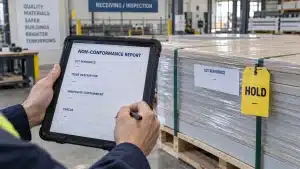
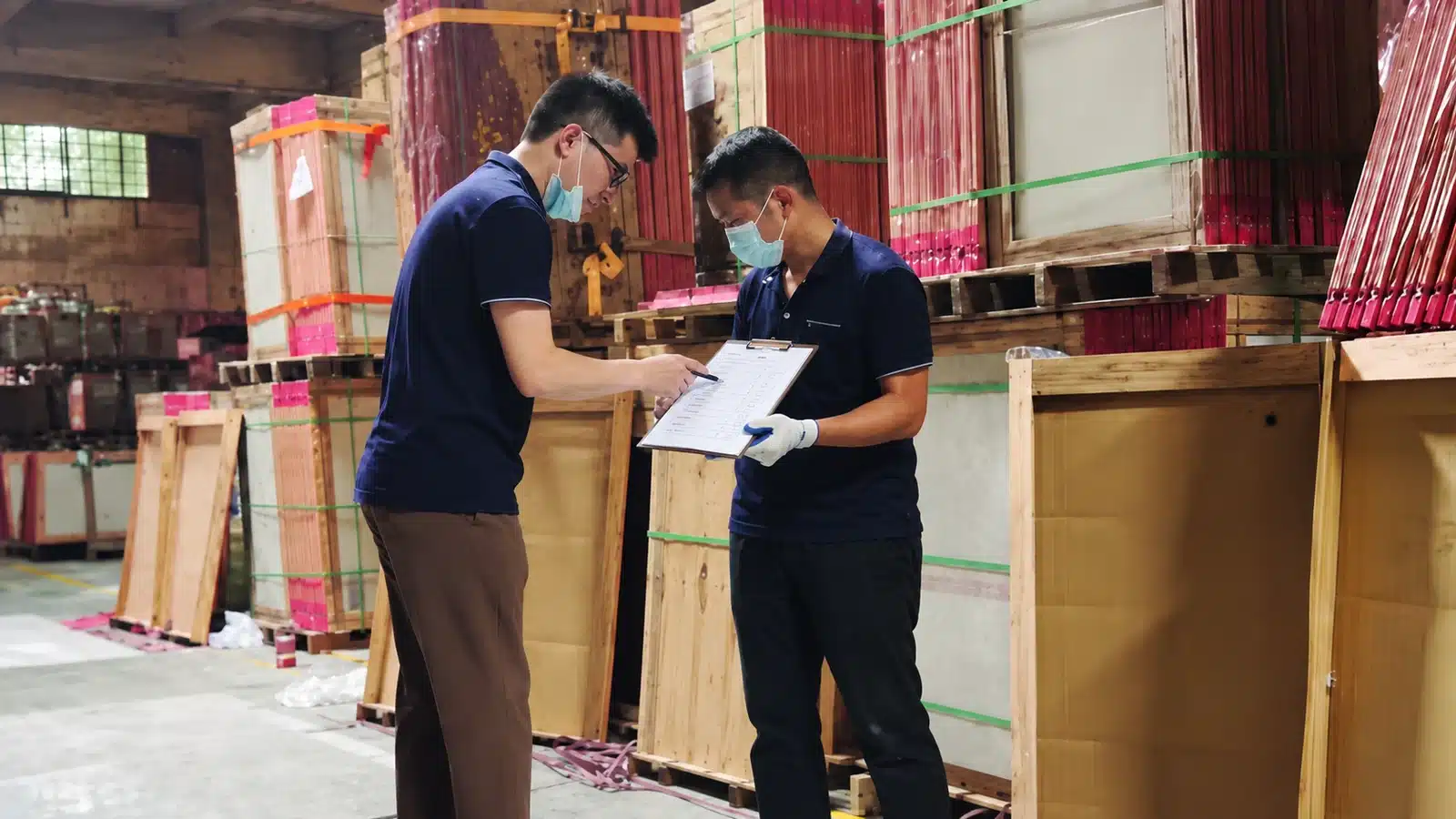
A practical framework for defining inspection stages, acceptance criteria, responsibilities, evidence, nonconformities and release points
This building material ITP template turns project requirements into a controlled sequence of checks. It states what must be inspected or tested, when the activity happens, which requirement governs it, who participates, what evidence is retained and what release decision follows.
This guide provides a copyable field structure, a filled material-package example and a practical workflow for project teams. It is part of Skyland Building’s Quality Control resource hub, which connects material requirements, supplier-side checks, inspection records and release decisions across the procurement process.
Written by Winston
Project Director at Skyland Building · 10+ Years of Building Materials Experience
Updated September 2026 · 22-minute read
Key Takeaways
- Prepare the ITP before the related material is produced, delivered or installed—not after inspection records are already being collected.
- Write acceptance criteria as measurable requirements or precise document references. Terms such as “good quality” or “acceptable finish” are not enough.
- Keep activity, inspection method, frequency, responsibility, inspection point, evidence and release status in separate fields.
- Define hold, witness, review and surveillance points in the project procedure. Their names and consequences are not universal.
- Use sampling only when the lot, selection method, sample size and acceptance rule have been agreed. Sampling does not prove every uninspected unit complies.
- Record a nonconformity as a factual finding first. Correction, concession, rejection and release require the authority assigned by the contract or approved procedure.
- Treat the template as a project control tool. The signed contract, approved drawings, specifications, procedures, jurisdiction and responsible professionals remain governing.
What Is a Building Material ITP?
An inspection and test plan is a planned sequence of verification activities for a defined scope of work. For building materials, the scope may be a product category, supplier package, production lot, delivery batch, installation area or completed system. Each activity should identify the requirement, verification method, timing, responsibility, attendance point, evidence and release condition.
The ITP helps the team answer six questions before work proceeds: What will be checked? Which requirement applies? At what stage will the check occur? Who performs and who reviews it? What record proves the result? Who is authorized to release the next step?
ITP vs Inspection Checklist
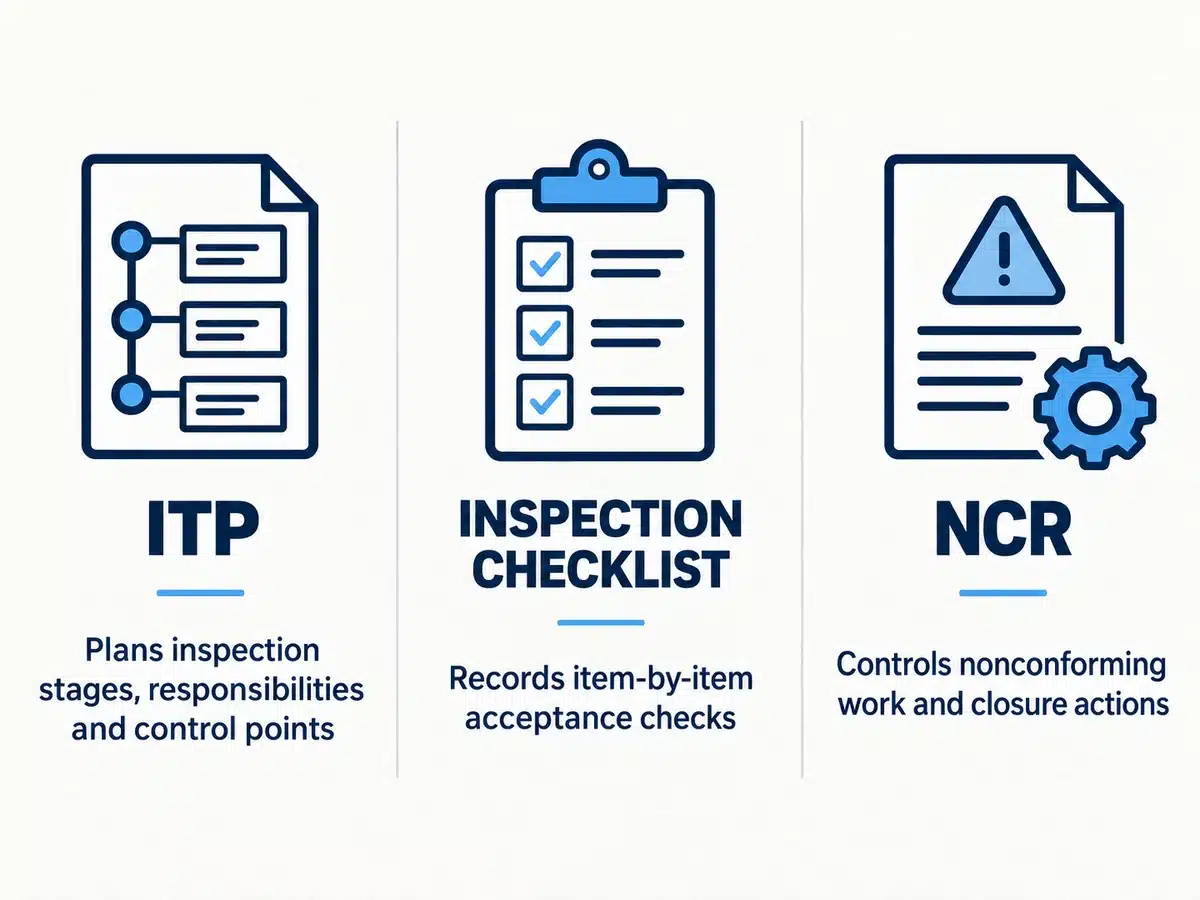
The ITP is the control map; the checklist is one of the records used to execute it. The ITP may state that frame dimensions and finish are checked before packing, while the checklist provides the fields used by the inspector to record actual observations. A construction quality control checklist can help organize field-level checks, but it should be linked to an approved ITP rather than used as a substitute for one.
| Record | Primary purpose | Typical content |
|---|---|---|
| ITP | Plans the control sequence and release gates | Activities, references, criteria, frequency, parties, point type, evidence and status |
| Inspection checklist | Records the checks performed on a specific lot, unit or location | Observed values, pass/fail results, comments, photographs and inspector details |
| Test report | Records a defined test and its result | Method, equipment, sample, conditions, measured results and conclusion |
| Nonconformance record | Controls a requirement that was not met | Finding, affected scope, containment, disposition, corrective action, retest and closure |
What an ITP Does Not Replace
- The signed contract, specifications, approved drawings, schedules and applicable legal or regulatory requirements.
- The approved method statement, installation procedure or manufacturer’s instructions.
- Design review, engineering calculations, code decisions or professional responsibilities assigned to other parties.
- Calibration control, laboratory competence, supplier qualification or document-control procedures.
- The actual inspection checklist, test report, delivery record, photograph, certificate or nonconformance record.
When to Prepare and Update the ITP
Create the first version after the applicable requirements and package boundaries are understood, but before the relevant procurement, production or site activity begins. Review it when the product, supplier, approved drawing, specification, method, test requirement, lot definition, inspection frequency, responsible party or release route changes. Record the revision and approval of the updated ITP instead of silently replacing the earlier version.
Building Material ITP Template Fields
The field groups below can be used in Excel, Google Sheets or a construction-management platform. Keep the master register concise, then link each row to the detailed checklist, test report or evidence file used for that activity.
| Field group | Recommended columns | Control purpose |
|---|---|---|
| Control and identity | Project; package; ITP number; revision; status; prepared, reviewed and approved by | Identifies the controlled document and current baseline |
| Sequence and activity | Item number; work stage; activity; component, lot or location | Places each check at the correct point in the workflow |
| Requirement basis | Specification clause; approved drawing; schedule; standard; method statement; manufacturer instruction | Shows the exact source and revision used for acceptance |
| Inspection or test method | Visual check; measurement; document review; functional test; laboratory test; mock-up | Defines how compliance will be verified |
| Acceptance criteria | Measurable limit, required condition or exact governing reference | Makes the result repeatable and reviewable |
| Frequency and sampling | Each unit; each lot; first article; percentage; sample size; risk-triggered check | Defines how much of the scope is verified |
| Responsibilities | Performer; contractor QC; supplier; consultant or client; laboratory; document controller | Separates execution, attendance, review and release roles |
| Inspection point | Hold; witness; review; surveillance or project-defined code | Controls notification, attendance and permission to proceed |
| Notification | Notice period; method; recipient; missed-attendance rule | Prevents an inspection point from failing through unclear coordination |
| Evidence | Checklist; test report; calibration record; photograph; certificate; delivery record; document link | Defines what must be retained to support the result |
| Result and exception | Pass/fail; comments; NCR number; corrective action; retest result | Connects findings to controlled resolution |
| Release and sign-off | Released by; release date; conditions; next permitted activity | Shows whether the next step may proceed and on what basis |
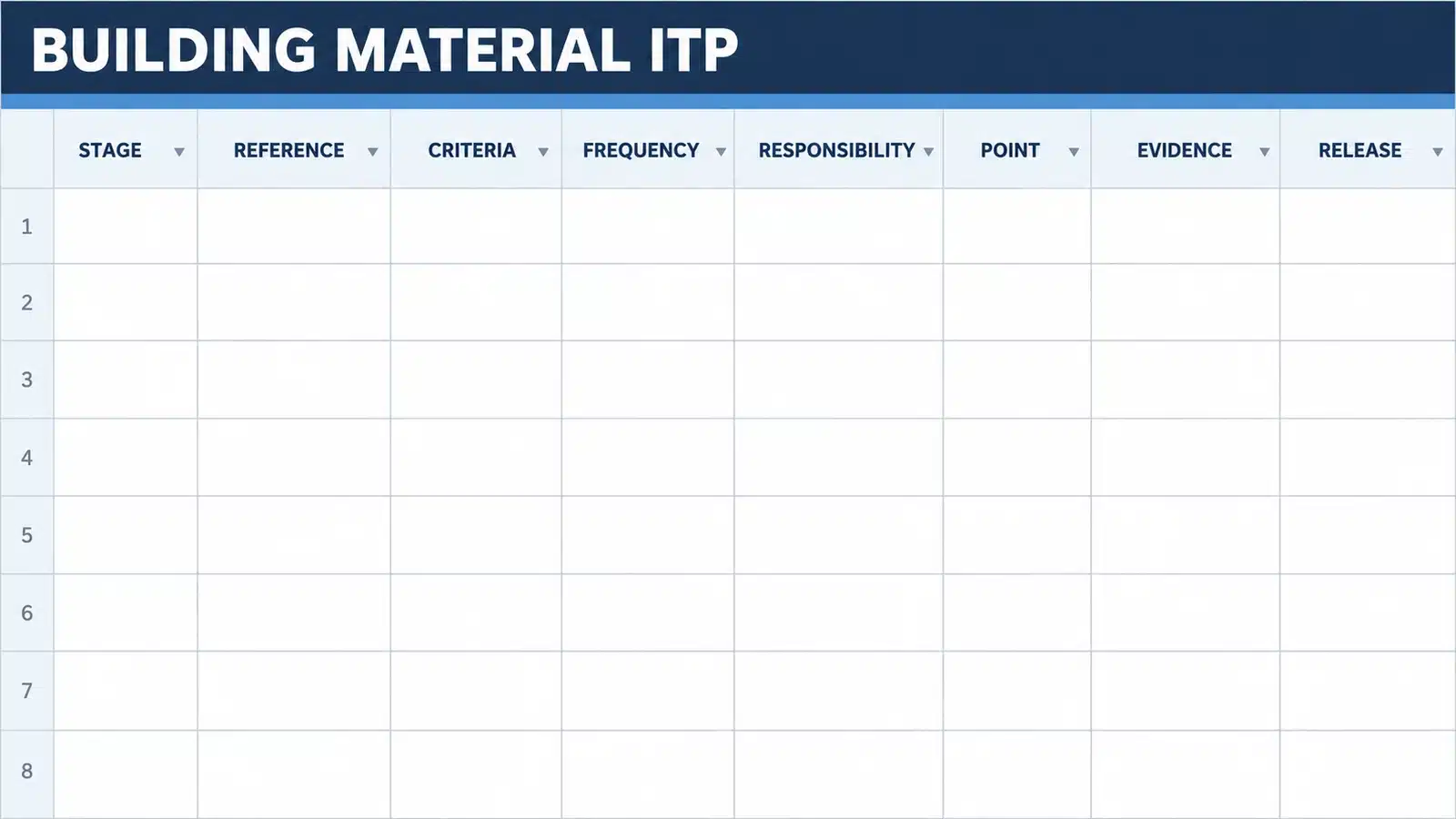
Download the Building Material ITP Template
XLSX · Editable ITP register · Example rows · Dropdown lists · NCR log · Automatic dashboard
Free download. No email required. Replace or delete every row marked “Example” before issuing the workbook for a live project.
Minimum Viable ITP Line
For a small material package, the minimum useful row is: sequence number, stage, activity, applicable reference and revision, inspection or test method, acceptance criteria, frequency, responsible parties, point type, required evidence, result, exception reference and release status. If any of those fields are hidden inside general notes, different participants are likely to interpret the row differently.
Inspection Point Codes
| Common code | Typical meaning | What the project must define |
|---|---|---|
| H — Hold | Work does not proceed beyond the defined point until the named release authority gives the required release | State who can release, what evidence is required and how release is recorded |
| W — Witness | The named party is notified and given the opportunity to attend the activity | Define notice, attendance window and the project rule if the party does not attend |
| R — Review | Documents or records are submitted for review at the stated stage | Identify the record, reviewer, response route and whether review is required before release |
| S — Surveillance | The named party may monitor the activity without a mandatory stop at every occurrence | Define the scope, reporting method and triggers for increased inspection |
Important: Projects use different names and consequences for these points. Attendance, witnessing or signing a record does not automatically transfer responsibility or constitute approval. Use only the definitions written into the applicable contract and approved project procedure.
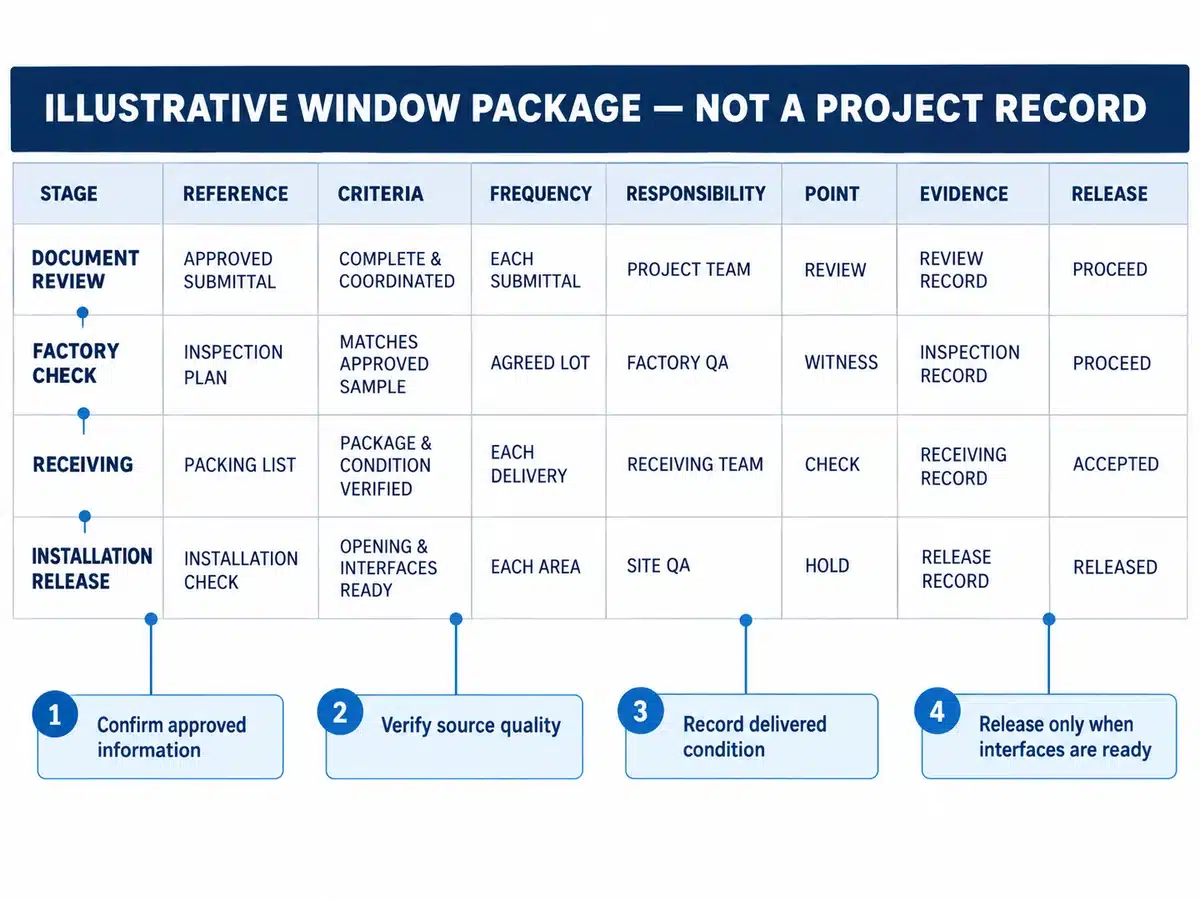
Filled ITP Example for an Aluminum Window Package
Illustrative example only. Replace the document references, responsibilities, point types, frequencies and acceptance criteria with the project’s approved requirements. No universal tolerance is implied.
| Stage | Activity | Acceptance basis | Method | Frequency | Point | Evidence |
|---|---|---|---|---|---|---|
| 1. Document review | Confirm current opening schedule, approved shop drawings, glass, finish and hardware references | Current approved project documents; package references agree | Document review | Once per approved revision | R | Approved submittals and review record |
| 2. First article or sample | Review representative frame corner, finish sample or agreed first completed unit | Matches approved configuration and agreed control sample | Visual and dimensional review | First article and after material/process change | W/H* | First-article checklist, photos and release |
| 3. Pre-shipment | Check identification, configuration, operation, visible condition, quantity and packing | Matches released documents and agreed packing requirements | Visual, measurement and functional checks | Project-defined lot and sample | W | Inspection report, photos and packing list |
| 4. Receiving | Verify delivery marks, quantity, packaging condition, visible damage and storage route | Correct shipment received; exceptions identified and segregated | Document and visual check | Each delivery | S | Delivery and receiving record |
| 5. Pre-installation | Confirm opening reference, interface readiness, released product and required accessories | Current released information and acceptable substrate/interface condition | Document, visual and measurement check | Each area or defined lot | H* | Readiness checklist and release |
| 6. Completion | Check operation, visible condition, labels and required handover records | Meets project-specific completion and documentation requirements | Functional, visual and record review | Defined area, unit or sample | R/W | Completion checklist, test records and closeout file |
*The example uses a possible hold point for illustration. The project team must decide whether the first article or pre-installation check is actually a hold, witness, review or surveillance point and must name the release authority.
How to Build a Project-Specific ITP
- Define the package boundary. State the product, system, locations, supplier, production lots, deliveries and site activities covered. Split the ITP if one document would mix unrelated requirements or responsibilities.
- Extract the governing requirements. Read the specifications, approved drawings, schedules, contract quality clauses, method statements, manufacturer instructions and applicable standards. Record the exact clause and revision used.
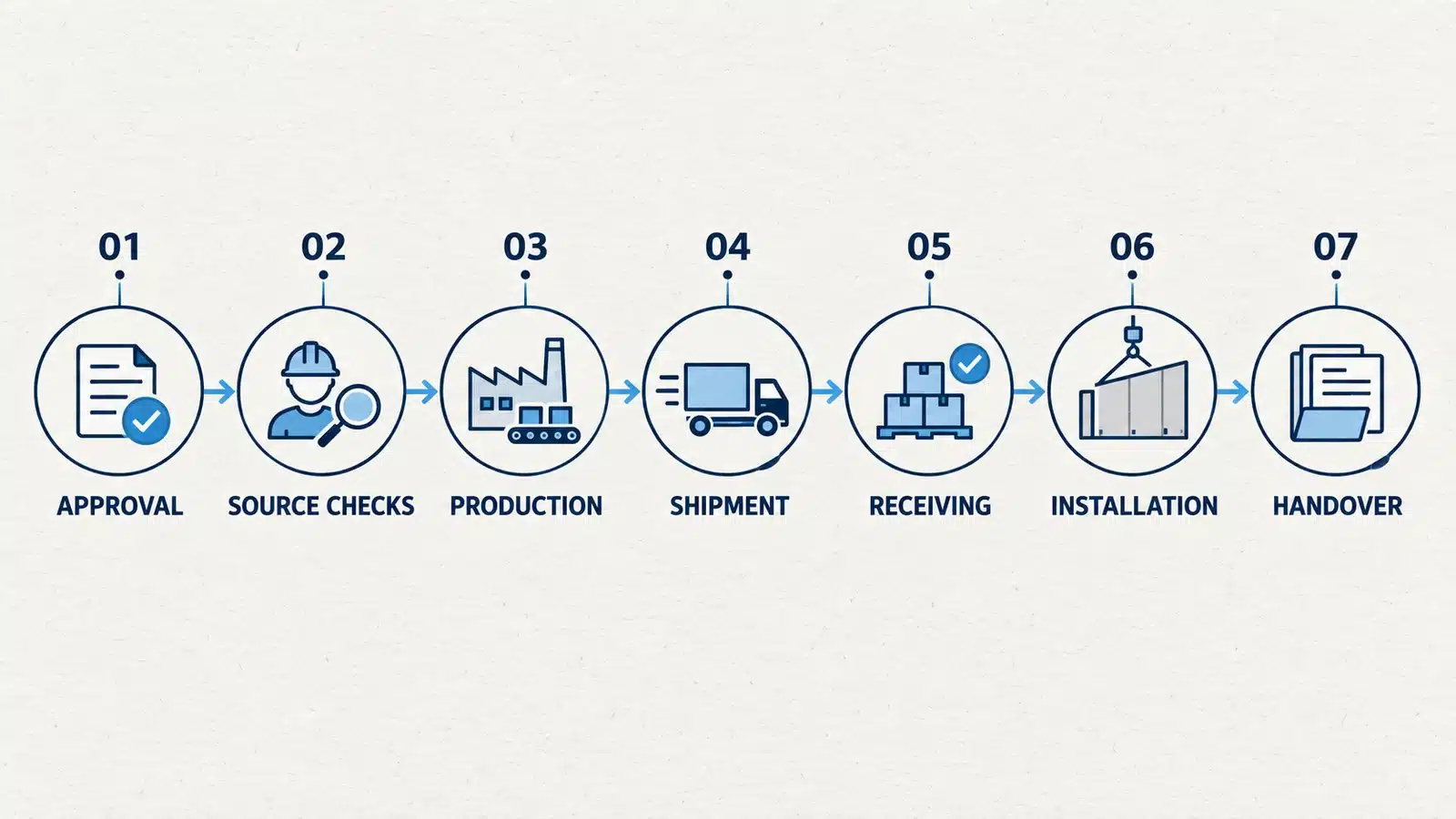
- Break the work into a real sequence. Map approval, source verification, material receipt, production, first article, in-process checks, pre-shipment, delivery, storage, pre-installation, installation, testing and handover as applicable.
- Write measurable acceptance criteria. Use a stated limit, required condition or precise document reference. If a criterion requires judgement, identify the approved sample, mock-up or responsible decision maker.
- Set frequency and sampling. Define the lot, unit, location or stage being sampled. Increase inspection where risk, change, failure history or contract requirements justify it.
- Assign responsibilities and points. Name who performs, records, attends, reviews and releases each activity. Add notification periods and missed-attendance rules.
- Identify the evidence. List the exact record needed, including checklist, report, photo set, calibration evidence, certificate, signed release or document link.
- Test and approve the baseline. Walk the draft through one real package. Remove duplicate checks, fill missing gates and confirm that every hold point can be released by a named authority.
Inspection Stages from Approval to Handover
Not every package needs every stage below, but the ITP should cover the points where a defect could be introduced, concealed, multiplied or accepted without sufficient evidence.
| Stage | Typical control focus | Risk being controlled |
|---|---|---|
| 1. Pre-procurement and approval | Approved product, drawings, samples, substitutions, supplier scope and quality requirements | Wrong product or configuration released for purchase |
| 2. Source and first article | Incoming factory materials, process readiness, prototype, mock-up or first completed unit | A repeated defect is multiplied through production |
| 3. In-process production | Critical dimensions, components, finishes, assembly, traceability and process records | A concealed or irreversible feature is missed |
| 4. Pre-shipment | Quantity, identity, configuration, operation, appearance, documents, labels and packing | Nonconforming or poorly protected material is shipped |
| 5. Receiving and storage | Delivery marks, quantity, packing condition, damage, segregation and storage | Transit damage or wrong material enters site stock |
| 6. Pre-installation | Released revision, substrate, opening, interface, accessories and environmental readiness | Compliant material is installed in an unsuitable condition |
| 7. Installation and concealment | Workmanship, anchorage, alignment, joints, protection and concealed work | Defects become costly or impossible to inspect later |
| 8. Testing and handover | Functional tests, completion checks, as-built records, warranties and closeout documents | A system is handed over without evidence of performance or completion |
Pre-Shipment Inspection
For imported or consolidated material packages, pre-shipment inspection is a valuable gate because many defects are easier to correct before export packing and dispatch. Use a project-specific pre-shipment inspection checklist to record the selected units, checks, evidence, exceptions and release recommendation. The checklist should follow the approved ITP; it should not invent new acceptance criteria at the factory.
Receiving, Storage and Readiness
Receiving checks should connect each delivery to the purchase order, packing list, product marks and inspection release. Record visible transport damage, shortages, wet or broken packaging, mixed lots and storage risks. Before installation, verify that the actual substrate, opening, services, access and environmental conditions are suitable for the released product and method.
Acceptance Criteria and Evidence
Acceptance criteria should be objective enough that two competent inspectors working from the same approved information reach the same result. When the requirement is numerical, state the characteristic, limit, unit, method and governing reference. When appearance is judged, identify the approved sample, mock-up, viewing condition or documented reference used for comparison.

- Use exact references. Record the drawing, schedule, specification clause, standard or instruction and its applicable revision.
- Make criteria measurable. Avoid “good workmanship,” “normal tolerance” or “as approved” unless the referenced approval is uniquely identified.
- Preserve traceability. Connect the result to the inspected lot, unit, room, elevation, container, delivery or production date.
- Use suitable equipment. Identify measuring or test equipment where the result depends on it, and retain calibration or verification evidence when required.
- Check document applicability. A certificate or test report is useful only when its product, configuration, method, issuing body, date and scope apply to the material being supplied.
- Separate evidence from decision. Photographs and measurements support the finding; the authorized party still applies the agreed acceptance and release rules.
Sampling and Inspection Frequency
Choose inspection frequency according to the requirement, consequence of failure, product variability, process capability, supplier history, production volume and ability to correct a defect later. Some characteristics may require every unit to be checked; others may be controlled by first-article, lot-based or risk-triggered sampling.
| Approach | When it may be suitable | Information the ITP must state |
|---|---|---|
| 100% inspection | Critical identity, safety-related or functional checks; small quantities; unstable processes; prior failure | Exact characteristic, unit population, method and record |
| Lot-based sampling | A defined batch has consistent production conditions and an agreed sampling plan | Lot definition, random selection method, sample size, defect classes and acceptance/rejection limits |
| First article | A new product, tool, configuration, supplier or process needs early confirmation | What the first article represents and what changes trigger a new review |
| Periodic surveillance | A stable repetitive process is monitored during production or installation | Frequency, coverage, reporting and escalation triggers |
| Risk-triggered increase | A failure, change, complaint or process drift raises uncertainty | Trigger, increased frequency, duration and return-to-normal rule |
Do not apply a universal AQL value. If acceptance sampling is used, the standard, inspection level, lot size, sample size, defect classes and acceptance/rejection numbers should be agreed in the contract or inspection protocol. Critical features may still require full inspection or a different control method.
Responsibilities, Notification and Release
Use separate columns for “performs,” “witnesses,” “reviews” and “releases.” A compact letter matrix is convenient only when every code is defined and each organization understands its authority. Company initials alone can hide whether a signature is an attendance record, technical review or permission to proceed.
| Party | Typical ITP role | Boundary to keep clear |
|---|---|---|
| Supplier or fabricator | Implements production controls, performs agreed checks, identifies lots and retains supplier records | Product-specific accuracy and conformity to released information |
| Contractor or subcontractor | Coordinates the package, verifies readiness and compliance, arranges notification and controls site work | Contractual obligations, interfaces, field conditions and trade coordination |
| QC inspector | Performs or witnesses assigned checks and records factual results | Scope and authority stated in the ITP; does not redesign or approve deviations |
| Consultant, client or named reviewer | Attends, reviews or releases points assigned by the contract | Authority follows the agreement and approved procedure |
| Laboratory or third party | Performs defined testing or inspection within its authorized scope | Method, sample identity, competence and report applicability |
| Document controller | Registers revisions, notifications, reports, NCRs and release records | Controls traceability; does not make technical decisions unless separately authorized |
For witness and hold points, state how much notice is required, how it is issued, who receives it and what happens if the invited party does not attend. A missed witness point should follow the project’s written rule; a hold point should not be released by assumption or an informal message.
Nonconformity, Corrective Action and Retest
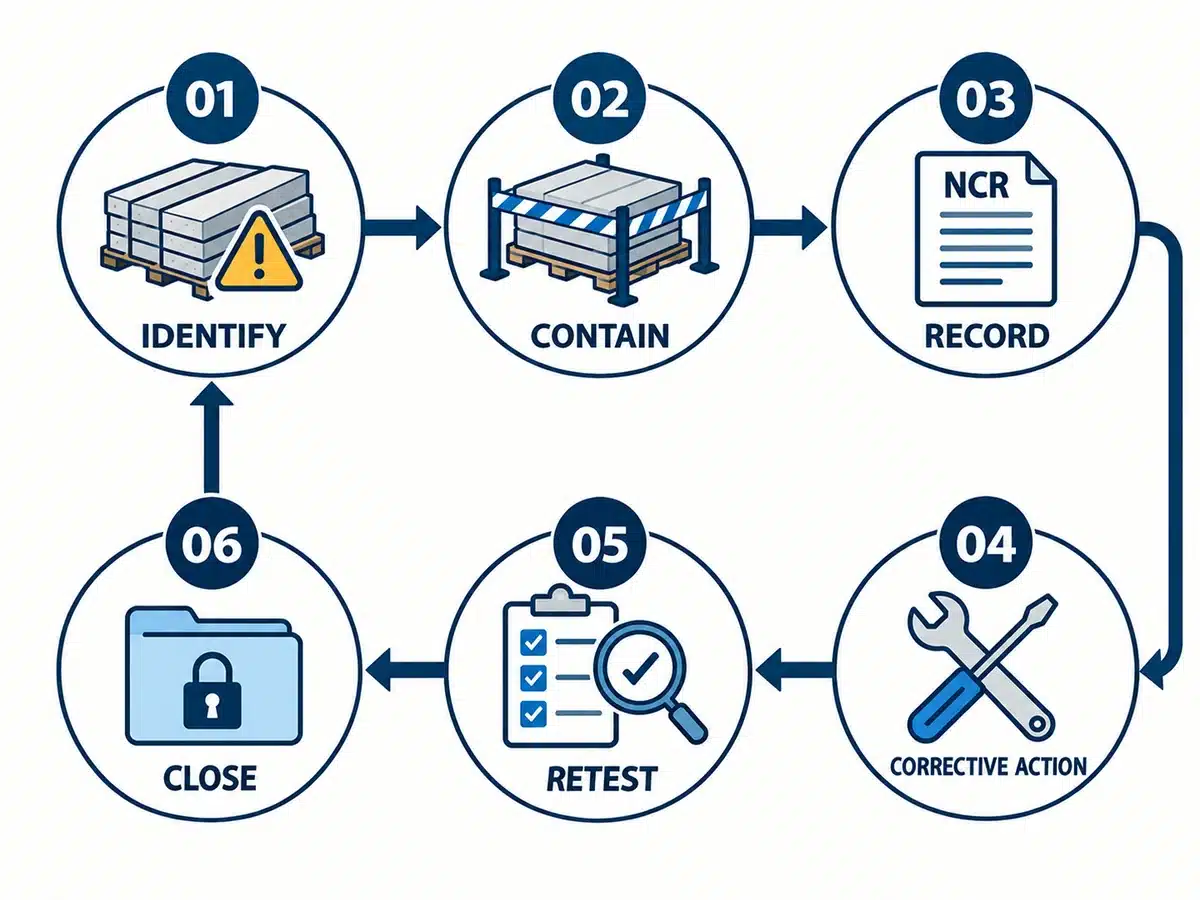
A failed ITP activity should lead to a controlled exception record, not an edited checklist that makes the original result disappear. The finding should identify the unmet requirement and affected scope without prematurely deciding the cause or disposition.
1. Identify and contain. Mark or segregate the affected material where practical and stop the dependent activity if the approved control requires it.
2. Record the requirement and evidence. State what was observed, the exact acceptance reference, lot or location, date, photographs, measurements and related records.
3. Assess the extent. Determine whether the finding affects one unit, a lot, earlier production, delivered material or concealed work.
4. Obtain the authorized disposition. Rework, repair, replace, reject or accept under a concession only through the authority and process defined for the project.
5. Correct and verify. Complete the approved action, then reinspect or retest against the applicable requirement with a new result record.
6. Close and learn. Link the closure evidence, release the next step if authorized and update the control plan when the issue indicates a wider process risk.
Apply the ITP to Different Material Packages
The same field structure can serve different categories, but the activities and evidence must be product-specific. For aluminum window systems, the ITP may connect opening marks, frame and glass configuration, hardware, finish, drainage, operation, dimensions and approved documents. For custom cabinetry packages, it may connect room and cabinet marks, board and finish references, hardware, machining, assembly, accessory boxes and site interfaces. For full body floor tiles, it may address batch and finish identity, size and thickness requirements, surface and edge condition, storage, substrate readiness, installation method and applicable test documentation.
These examples are categories, not acceptance limits. The project documents, approved samples, supplier information, applicable standards and intended use determine the actual checks. Split the ITP when one package contains different lot definitions, reviewers, test methods or release routes.
Set Up the ITP Template in Excel
A practical workbook should separate controlled input, activity rows and exception records. Avoid building the entire process in one wide worksheet with free-text cells and no definitions.
| Worksheet | Recommended content | Purpose |
|---|---|---|
| Instructions | Scope, status definitions, point codes, responsibilities, notification rules and revision history | Read-only guidance for every user |
| ITP Register | One row per inspection or test activity with filters and release fields | The controlled working plan |
| Activity Library | Reusable activity prompts by product category, clearly marked for project editing | Speeds setup without pretending criteria are universal |
| Lists and Definitions | Dropdown values for stage, method, frequency, point, result, status and role | Keeps terminology consistent |
| NCR and Action Log | Exception number, affected scope, owner, due date, disposition, retest and closure | Connects failed activities to resolution |
| Dashboard | Open holds, overdue actions, failed checks, unclosed NCRs and stage status | Highlights exceptions; does not replace the source records |
- Use data validation. Provide controlled lists for stage, inspection method, point type, result and status, while retaining a documented route for project-specific values.
- Protect controlled fields. Limit edits to identifiers, approved references, formal release and closed records according to user responsibility.
- Calculate only useful controls. Flag overdue notices, open hold points, failed activities and unclosed NCRs. A blank source value should not become a false “pass.”
- Link evidence. Use stable document references or repository links rather than embedding large photo sets and reports inside the workbook.
- Keep a revision log. Record what changed, why, when and who approved the new baseline.
- Test mobile and print views. Filters may work on desktop while important columns become unreadable in site reports or narrow screens.
Common ITP Mistakes
| Mistake | Why it causes problems | Better control |
|---|---|---|
| Copying a generic ITP without requirement review | Activities may look complete but omit project-specific criteria and release points | Extract requirements and map each row to the exact package |
| Using vague acceptance language | Inspectors and reviewers apply different judgement | State a measurable criterion or precise approved reference |
| Combining roles in one company column | Attendance is mistaken for approval or release | Separate performs, witnesses, reviews and releases |
| Assigning hold points everywhere | The plan becomes unworkable and important gates lose visibility | Use points according to risk and contractual authority |
| Leaving frequency as “random” | The inspected population and selection cannot be reproduced | Define the lot, selection method, sample size and escalation rule |
| Accepting certificates without applicability checks | A valid-looking document may cover a different product or configuration | Verify identity, scope, method, issuer, date and referenced standard |
| Editing failed results to pass | The original finding and audit trail disappear | Open an NCR or action record and retain reinspection evidence |
| Releasing work through chat or verbal instruction | The exact scope, conditions and authority become unclear | Use the approved notification and release record |
| Closing an NCR after correction only | The requirement may still not have been verified | Reinspect or retest, record the result and obtain authorized closure |
| Using the dashboard as the record | Summary values cannot prove what was checked | Retain the checklist, report, photos and release evidence |
How Skyland Can Support Supplier-Side Inspection Records
Skyland Building’s Inspection & Packing coordination service can help organize agreed supplier-side checks, inspection records, product and package references, photographs, labels and packing information across selected material categories. The scope must be defined before inspection, and the service does not replace design responsibility, code approval, laboratory accreditation, site supervision or the release authority assigned to other project parties.
For a project-specific review, send your BOQ, drawings, specifications and inspection requirements. Include the project location, current revisions, material categories, supplier or production status, required checks, target delivery dates and the parties authorized to witness or release each stage.
Conclusion
A useful building material ITP is more than a list of inspections. It connects the project requirement to a specific activity, a defined stage, competent participants, objective evidence and an authorized decision about what happens next. Build it before the work starts, keep the criteria and revisions controlled, and preserve failed results as part of the quality record.
The template should remain simple enough for the project team to maintain and specific enough to answer five questions at any time: What is being checked? Which requirement applies? Who must act or attend? What record proves the result? Is the next activity formally released?
Frequently Asked Questions
What is a building material ITP?
It is a project-specific inspection and test plan that defines the sequence of checks for a material package, including applicable requirements, methods, acceptance criteria, frequency, responsibilities, evidence and release points.
What is the difference between an ITP and an inspection checklist?
The ITP plans what must happen and when; the checklist records what was actually checked for a defined lot, unit or location. One ITP activity may use several checklists or test reports as evidence.
What is the difference between a hold point and a witness point?
A hold point normally prevents the work from proceeding until the named authority gives the required release. A witness point gives the named party an opportunity to attend after proper notice. The project contract and procedure must define both terms and the consequence of non-attendance.
Who prepares and approves the ITP?
The supplier, subcontractor or contractor may prepare it, while contractor QC, the consultant, client or another named party may review or approve it. The actual roles and authority must follow the contract and approved quality procedure.
What records should be linked to an ITP?
Typical records include inspection checklists, test reports, calibration evidence, approved drawings and samples, delivery records, photographs, certificates, NCRs, corrective-action records and signed releases. Include only records relevant to the defined activity.
Should building materials be fully inspected or sampled?
It depends on the requirement and risk. Critical characteristics, small quantities, unstable processes or prior failures may justify full inspection. Sampling requires an agreed lot, selection method, sample size and acceptance rule.
How should nonconforming material be handled?
Identify and contain the affected scope, record the unmet requirement and evidence, obtain an authorized disposition, complete the approved action, reinspect or retest and retain closure and release evidence.
Can one ITP cover the whole project?
A master ITP framework can standardize fields and codes, but separate plans are often clearer where products, suppliers, stages, test methods, responsibilities or release authorities differ.
How often should an ITP be updated?
Review it whenever the scope, product, supplier, approved document, method, frequency, responsibility, point type or requirement changes. Keep the revision and approval history rather than overwriting the baseline.
Reference and Project Note
ISO 9001 is an organization-level quality management system standard; it is not a ready-made project ITP. Its official status page is useful general context for controlled quality processes, while the project’s own contract and approved procedures determine the inspection plan used on a specific job.
- ISO 9001:2015 — Quality management systems — Requirements — Official ISO status page. Check the applicable edition and contractual reference at the time of use.
Project note: Every example in this article is a working control, not universal contract language. The signed contract, approved drawings and specifications, applicable standards, jurisdiction, method statements and assigned authority govern the project.