
A building materials RFQ should do more than ask suppliers for a total price. It should give every invited supplier the same project information, quantities, technical requirements, commercial basis, and response format so the quotations can be compared on a like-for-like basis.
That is especially important for a whole-house package. Windows and doors, cabinets, tile, sanitary ware, flooring, lighting, furniture, stone, and related accessories may come from different factories, follow different approval paths, and arrive at different stages. If the request is incomplete, the lowest quotation may simply contain the largest scope gap.
This guide explains how to prepare a quote-ready package, control assumptions, and evaluate supplier responses without relying on vague descriptions or unsupported promises.
Written by Winston
Project Director at Skyland Building · 10+ Years of Building Materials Experience
Updated August 2026 · 15-minute read
What is a building materials RFQ?
A request for quotation asks one or more suppliers to price a defined supply requirement. For building materials, that usually means the buyer already knows the main product categories, quantities or quantity basis, required specifications, delivery destination, and commercial instructions.
An RFQ is most useful when suppliers can quote substantially the same scope. If the project still needs suppliers to develop the solution, propose different technical approaches, or define the package, an RFP or an earlier technical enquiry may be more appropriate before the final RFQ.
RFQ, RFP, and purchase order: do not treat them as the same document
| Document | Main purpose | Best time to use it |
| RFQ | Obtain prices and commercial responses for a reasonably defined requirement. | When scope and evaluation basis are clear enough for comparable quotations. |
| RFP | Compare proposed solutions, methodology, design input, and commercial terms. | When the supplier’s approach is part of the decision. |
| Purchase order / contract | Record the binding scope, price, terms, responsibilities, and acceptance requirements. | After clarifications, negotiation, and final scope reconciliation. |
The RFQ should state whether it is an invitation to quote and remains subject to final agreement. Contract formation and legal effect depend on the purchase order, contract wording, and applicable law; they should not be assumed from the RFQ alone.
1. Define the project brief and package boundary
Begin with a short project brief. A supplier should not have to infer the location, building type, design stage, or delivery conditions from scattered attachments.
Include:
- Project name, property type, destination country and city, and a contact for RFQ questions.
- New build, renovation, extension, or fit-out, plus the current design and construction stage.
- Areas included in the package: for example, whole villa, public areas, guest rooms, kitchens, bathrooms, façade, or external works.
- Target construction or installation sequence and any phased release requirements.
- Known site constraints such as limited storage, restricted unloading, remote access, high humidity, coastal exposure, or occupied areas.
Then define the package boundary. State which categories are included, which are excluded, and which interfaces still require coordination. For example, a window supplier may price the frame and glazing while another party supplies structural openings, waterproofing membranes, interior trims, or installation labor.
Assign design, quantity, approval, and installation responsibilities
A responsibility matrix prevents duplicated allowances and missing work. For each category, identify who is responsible for:
- Design intent and final dimensions.
- Quantity takeoff and verification.
- Shop drawings, calculations, samples, and technical data.
- Local code review and authority submissions where required.
- Installation, site measurement, testing, commissioning, and handover documents.
Do not assume a supplier’s shop drawing review transfers the architect’s, engineer’s, contractor’s, or local consultant’s legal responsibilities. State the expected review process and have the appropriate project professionals confirm jurisdiction-specific requirements.

2. Issue a controlled document register
The RFQ should contain a document register rather than an unstructured folder of drawings. List the file name, drawing or document number, title, revision, issue date, and status. Suppliers need to know which information is current and whether it is concept, tender, approved-for-construction, or provided for reference only.
Depending on the package, issue the relevant:
- Architectural plans, elevations, sections, details, and reflected ceiling plans.
- Door, window, room, finish, sanitary, lighting, furniture, and equipment schedules.
- Structural opening information and MEP connection requirements.
- Material specifications, mood boards, approved samples, or benchmark products.
- BOQ, quantity takeoff, or pricing schedule.
- Photos and verified dimensions for renovation or existing-condition work.
If documents conflict, the RFQ should tell suppliers to raise a clarification rather than choose an interpretation. The final contract or purchase order should establish document precedence after those conflicts are resolved.
3. Build the BOQ or pricing schedule
The pricing schedule is the working core of the building materials RFQ. Give each product or assembly a stable reference number and require suppliers to return their quotation in the same order. This makes missing lines, substitutions, and exclusions easier to identify.
Clarify whether it is a formal BOQ or a supplier pricing schedule
A formal bill of quantities is a coordinated list of work items with identifying descriptions and quantities, often prepared under a defined measurement method and potentially incorporated into the contract. A supplier pricing schedule may be simpler and limited to the materials package. Do not call every spreadsheet a BOQ if it does not carry the same measurement and contractual function.
For every quantity, state:
- The unit of measure and measurement basis.
- Whether the quantity is firm, approximate, provisional, or for comparison only.
- Whether waste, spares, breakage allowance, or attic stock is included.
- Who must verify quantities before ordering or production.
- How variations or remeasurement will be handled.
If suppliers must perform their own takeoff, require them to submit it in the same reference structure and to identify assumptions. If buyer-issued quantities are to be priced without supplier verification, say so. Quantity responsibility should be agreed before the order, not discovered after production starts.
Use one line for one clearly priced item or assembly
| Ref. | Item and location | Qty. basis | Key quotation information |
| WD-01 | Exterior window system — living areas | 24 units; verify openings | Frame, glazing, finish, hardware, screens, performance basis, packing |
| TL-07 | Porcelain floor tile — ground floor | 185 m² net; waste separate | Size, finish, thickness, batch, trims, installation accessories |
| CB-11 | Built-in wardrobes — bedrooms | 8 room sets; drawings govern | Layout, board and finish, hardware, internal fittings, installation scope |
For custom assemblies, list the included components. A cabinet price should not leave doors, internal fittings, hinges, handles, fillers, end panels, plinths, lighting channels, packing, or installation support to assumption.

4. Write specifications suppliers can price
Avoid descriptions such as “standard window,” “premium cabinet,” or “high-quality tile.” They do not create a measurable compliance basis. Describe each item by the characteristics that affect selection, manufacture, approval, installation, and cost.
| Category | Information normally needed | Common omissions |
| Windows and doors | Opening size, configuration, frame system, glazing, finish, hardware, screens, applicable performance criteria | Thresholds, anchors, sealants, restrictors, insect screens, shop drawings |
| Cabinets and wardrobes | Approved layout, carcass and door construction, finish, edge treatment, hardware, internal fittings | Fillers, end panels, plinths, countertop interface, appliance clearances |
| Tile, stone, and flooring | Format, thickness, finish, color range, performance requirement, installation pattern, batch control | Trims, skirting, wastage basis, adhesives, underlay, transition profiles |
| Sanitary ware and fittings | Model or performance benchmark, dimensions, finish, connection data, mounting method | Waste kits, traps, valves, carriers, fixing sets, local connection compatibility |
| Lighting and electrical accessories | Fixture type, dimensions, finish, electrical data, control requirement, applicable certification basis | Drivers, lamps, emergency components, dimming protocol, mounting accessories |
Name the applicable code, standard, test method, and edition only where the project requires it. Do not copy a certification or rating from another market without confirming that it is accepted by the authority having jurisdiction. Where a local consultant must review compliance, state that responsibility in the RFQ.
Control brands and substitutions
If a brand or model is listed, label it as mandatory, preferred, or a benchmark. If alternatives are allowed, define what “equivalent” means for dimensions, performance, finish, compatibility, warranty, documentation, availability, and maintenance.
Require every proposed substitution to be shown separately from the compliant base quotation. The submission should identify the affected reference, technical differences, sample requirement, price effect, lead-time effect, and any change to adjacent work. No alternative should proceed to ordering or production before written approval.

5. Define samples, shop drawings, and approval gates
Custom and appearance-sensitive products should follow an approval sequence. The RFQ does not need to invent a universal duration, but it should identify the required submissions, reviewer, response method, and the milestone that releases production.
Depending on the category, request:
- Product data sheets and selected model references.
- Finish chips, physical samples, control samples, or mockups.
- Shop drawings showing dimensions, materials, finishes, hardware, connections, and interfaces.
- Calculations, test reports, certificates, or declarations required for the specified market.
- Installation instructions, care information, spare-parts information, and warranty terms.
State what “approved” means. Approval of appearance does not automatically confirm dimensions, structural adequacy, code compliance, quantity, or installation responsibility unless the approval record expressly covers those points.
6. Set the commercial quotation basis
Require suppliers to complete the same pricing schedule and show the cost boundary clearly. At minimum, request:
- Currency, unit rate, extended amount, package total, and quotation validity.
- Taxes, freight, insurance, export packing, inspection, documentation, and other charges shown as included or separate.
- Payment proposal and the events that trigger each payment.
- Lead-time basis, including the event that starts the clock: purchase order, deposit, approved shop drawing, approved sample, or another defined milestone.
- Exclusions, assumptions, provisional sums, alternates, minimum order quantities, and price-sensitive items in dedicated schedules.
Use Incoterms® 2020 precisely for international quotations
For cross-border supply, state the intended Incoterms® 2020 rule and the exact named place or port. “FOB,” “CIF,” or “DDP” without a named location is incomplete for comparison. Also confirm that the selected rule suits the transport method; for example, some rules are restricted to sea or inland waterway transport.
Incoterms rules allocate defined delivery tasks, costs, and risk between buyer and seller. They do not by themselves determine product title, payment terms, governing law, dispute resolution, or the complete contract. Address those matters separately in the final purchase documentation.
7. Specify packing, consolidation, and delivery
Whole-house packages are vulnerable to damage and site confusion because categories differ in size, weight, finish sensitivity, and installation sequence. The RFQ should request packing and labeling that matches the receiving and installation plan.
- Required crate, pallet, corner, surface, and moisture protection.
- Labels using the RFQ reference, room, floor, elevation, or installation area.
- Packing lists that connect every carton or crate to the pricing schedule.
- Rules for mixed loads, fragile items, long items, hazardous or regulated goods, and stack limits where applicable.
- Shipment consolidation, phased dispatch, container planning, destination handling, and split-delivery requirements.
- Receiving inspection, shortage reporting, visible-damage records, concealed-damage procedure, and replacement process.
Ask for the proposed production and logistics milestones, but separate supplier-controlled activities from customs, carrier, port, and site events that may remain estimates. The delivery schedule should align with the project’s construction procurement schedule and storage capacity.

8. Tell suppliers exactly how to respond
A good RFQ is also a response template. Set a quotation deadline, clarification deadline, submission contact, required file formats, and rules for partial quotations. Ask every supplier to return:
- The completed pricing schedule with no reordered or deleted reference lines.
- A compliance schedule stating comply, deviate, alternate, or not quoted for each applicable item.
- A separate list of assumptions, exclusions, substitutions, and optional prices.
- Stock status, production lead time, approval dependencies, and proposed delivery milestones.
- Requested product data, sample information, warranty terms, company information, and relevant project references.
Do not allow important exclusions to remain buried in email text. If the supplier cannot price a line, require a clear status and explanation rather than a blank cell or unexplained zero.
9. Normalize and evaluate supplier quotations
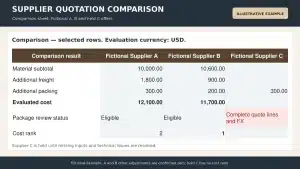
Do not rank quotations before making their scope and cost basis comparable. Start with technical compliance and scope reconciliation, then normalize the commercial totals.
A practical comparison should review:
- Technical compliance, dimensions, compatibility, samples, and required documentation.
- Missing lines, exclusions, substitutions, quantity differences, and duplicated allowances.
- Unit prices and total delivered cost on the same tax, freight, packing, insurance, duty, and destination basis.
- Lead-time starting point, approval dependencies, production capacity, and logistics plan.
- Quality-control process, communication, relevant project experience, warranty support, and replacement capability.
A lower unit rate is not necessarily the lower project cost. A quotation that omits hardware, trims, documentation, export packing, or delivery may become more expensive after clarification. Record each adjustment so the final recommendation can be traced back to supplier evidence.

10. Issue clarifications and revisions under document control
Send the same issued package to every invited supplier and keep a distribution record. Maintain a clarification log with the question number, affected reference, answer, date, and revised attachment where applicable.
When an answer changes scope, quantity, specification, delivery, or commercial terms, issue a numbered addendum or revised schedule. Give suppliers reasonable time to incorporate material changes. Avoid allowing separate conversations to create different technical bases for competing quotations.
Before award, reconcile the selected quotation against the final RFQ, addenda, approved substitutions, and negotiated changes. Transfer the agreed references, quantities, approvals, packing, delivery milestones, and open items into the purchase order or contract.
Whole-house building materials RFQ checklist
- Project brief, destination, building type, design stage, and package boundary.
- Responsibility matrix for design, quantities, approvals, installation, and compliance.
- Controlled document register with drawing numbers, revisions, dates, and status.
- BOQ or pricing schedule with stable reference numbers and quantity basis.
- Product specifications, accessories, finishes, performance criteria, and acceptable alternatives.
- Sample, shop drawing, test-document, and approval requirements.
- Currency, price format, quotation validity, payment proposal, and lead-time start event.
- Incoterms® 2020 rule and named place for international supply, where applicable.
- Packing, labeling, consolidation, delivery, receiving, and damage procedures.
- Supplier response form covering compliance, exclusions, substitutions, availability, and milestones.
- Evaluation criteria and a method for normalizing delivered cost and scope gaps.
- Clarification log, revision control, final quote reconciliation, and award handoff.
A copy-ready RFQ package structure
- RFQ cover letter and bid instructions
- Project brief and package scope
- Responsibility matrix
- Document register
- BOQ or supplier pricing schedule
- Technical specifications and product schedules
- Drawings, room data, and reference images
- Submittal, sample, and approval schedule
- Commercial response form
- Packing, logistics, and delivery requirements
- Compliance, deviation, substitution, and exclusion schedules
- Clarification form and revision log
Frequently asked questions
What should be included in a building materials RFQ?
Include the project brief, package boundary, controlled drawings, quantity or pricing schedule, technical specifications, responsibility matrix, samples and shop-drawing requirements, commercial basis, delivery requirements, supplier response format, and evaluation criteria.
Can I request a quotation before all drawings are complete?
Yes, but identify the design status and uncertainty. Mark quantities as approximate or provisional where appropriate, request allowances separately, and avoid presenting an early estimate as a firm production price. Custom products normally require approved dimensions, drawings, and finishes before final production release.
Who should verify RFQ quantities?
The RFQ should explicitly assign quantity responsibility. The buyer, quantity surveyor, contractor, designer, supplier, or a combination may prepare or verify the takeoff depending on the contract and package. The key is to state the measurement basis and verification duty before ordering.
Should the RFQ include target prices or budget information?
It may include an approved budget or target where that supports value engineering, but the buyer should decide whether disclosure will improve the response. If alternates are requested to meet a budget, require the base compliant price and the alternative price to be shown separately.
How many suppliers should receive the RFQ?
There is no universal number for private projects. Invite enough qualified suppliers to create a meaningful comparison without sending an incomplete package to a large, unqualified list. Public or financed projects may have mandatory procurement rules, thresholds, and competition requirements that must be followed separately.
Does an RFQ replace the purchase contract?
No. The RFQ and supplier quotation become important procurement records, but the final purchase order or contract should confirm the agreed scope, price, responsibilities, approvals, delivery terms, warranty, acceptance, change process, and governing commercial terms.
Conclusion
A strong whole-house RFQ connects design information, quantities, product requirements, approvals, commercial terms, packing, and delivery in one controlled package. When suppliers price the same references and disclose deviations in the same format, the buyer can compare complete offers instead of comparing headline totals with hidden scope differences.
Before requesting a quotation, assemble the available floor plans, BOQ or material schedule, door and window schedules, finish references, destination details, and required delivery stages. A coordinated supplier can then identify missing information, organize category quotations, and prepare the next sample, drawing, quality-control, and shipping steps.
| EDITORIAL NOTE Project codes, procurement rules, contract formation, tax, customs, and import requirements vary by jurisdiction. Have the appropriate architect, engineer, quantity surveyor, contractor, customs adviser, or legal adviser confirm project-specific obligations before issue or award. |
Fact-check references
These references were used to verify procurement, BOQ, submittal, and international-delivery terminology. They do not all need to appear in the published article.
RFQ structure: World Bank — Standard Request for Quotations for Goods
BOQ definition: RICS NRM 2 — Detailed Measurement for Building Works
International delivery terms: ICC — Incoterms® 2020
Shop drawings and samples: WBDG / U.S. Department of Veterans Affairs — Section 01 33 23
Next Steps for Your Project
Topic hub: Procurement & Sourcing Guides
Relevant product pages: Custom Cabinetry · Aluminum Windows & Doors · Luxury Sanitary Ware Systems
Related guides: Construction BOQ Template · Construction Procurement Schedule
Related service: BOQ & RFQ Review